Physicists find the first evidence of a new force, called chameleon field energy, linked to dark energy
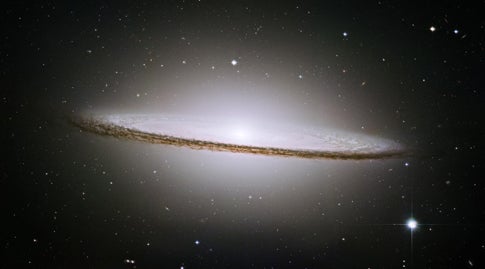
Sombrero Galaxy Pockets of chameleon energy explain the loss of brightness from galaxies like this galaxy courtsy of NASA

In an attempt to explain why the light emitted from distant galaxies appears dimmer than predicted, some astronomers may have inadvertently provided the first evidence of dark energy.

Dark energy is the theoretical force behind the expansion of time and space. Dark energy has yet to be experimentally observed, despite the fact that it may represent the vast majority of all the material universe.

As first reported by Nature News, the researchers believe that the light dimmed when photons travelling between the galaxies and Earth transformed into a form of dark energy called chameleon field energy. Chameleon field energy was first theorized to exist in 2003, but these observations represent the first direct evidence of the phenomenon in nature.

According Justin Khoury, a physicist at the University of Pennsylvania who proposed the theory of chameleon energy in 2003, chameleon energy emits an attractive force similar to gravity, and got its name because the properties of the force relative to gravity change based on the density of matter in the surrounding area.

However, Khoury, who said that he would be excited about any evidence that proves his theory right, urged caution about overstating the significance of this new discovery.

“The data is tantalizing,” said Khoury, “but it’s too early to tell.”

Want to read more articles on the military, aviation, and space? Subscribe to Popular Science and enter to win $5,000!

8 Comments

is this a real picture?

Yes, it's real. That's what the Sombrero Galaxy looks like from Earth, or at least at high magnification from Earth orbit. Beautiful isn't it? Who needs the latest fad in modern art when our universe provides such breathtaking and thought-provoking scenery?

thats a good point mike. it is pretty cool.

Question, could this be a meteor field the beginning of a new planetary system? A new sun pulling in debris with it's gravity.. Just my thinking of how our own may have started..Very interesting though...

I have to ask this. They theorized that the expansion of the universe is being driven by dark energy because they found that the distant galaxies are moving away faster and faster and the farther they look the faster they are going. My question is this: Isn't that exactly what we would expect to observe since as we look farther into the universe we are also looking backwards in time therefore the objects we are observing are closer to their initial velocities from the big bang?
Jim

This is a very exciting news. I'm looking forward to read more abouth the evidences that prove this teaory.

www.misschat.net

Jim - my amature understanding is that, no, in the vacuum of space they would expect matter to be expanding at the same, constant rate. So to find that not only is it getting faster, but faster at different rates depending on distance is rather incredable.

Additionally, this article is not talking about looking back towards the center of the universe, but out to the farther edges. That being so, we are more looking at what our own galaxies' future would be, rather than the past.

Nightgirl quote-
Jim - my amature understanding is that, no, in the vacuum of space they would expect matter to be expanding at the same, constant rate. So to find that not only is it getting faster, but faster at different rates depending on distance is rather incredable.
*************************************************
No they expected to find the galaxies slowing down due to the force of gravity. But I think they forgot that even if they were slowing down it would not appear that way to us due to relativity.

Additionally, this article is not talking about looking back towards the center of the universe, but out to the farther edges. That being so, we are more looking at what our own galaxies' future would be, rather than the past.
*********************************************************************
Again you are ignoring the effects of relativity. Everywhere we look is backwards in time. It is not possible to see the future.


Download Our iPhone App

Stay up to date on the latest news of the future of science and technology from your iPhone with full articles, images and offline viewing


Follow Us On Twitter

Featuring every article from the magazine and website, plus links from around the Web. Also see our PopSci DIY feed


Become a Fan On Facebook

Share links with friends, comment on stories and more


December 2009: Best of What's New

In our December issue, Popular Science names the 100 best innovations of the year: bombproof wallpaper, self-parking cars, the fastest helicopter, and 97 more. Plus inventor profiles and videos.

Check out the best of what's new here.

Popular Science Photo Pool


Share your photos in the Pop Sci pool at www.flickr.com!
tags_sprite.png
POP_embeddedForm_cover_May09.jpg