Happy 10th Birthday, SETI@home
Every space geek's favorite screensaver keeps plugging along, using idle CPU cycles to search for alien life
We may earn revenue from the products available on this page and participate in affiliate programs. Learn more ›
Ten years ago, my computer had a lot of junk on it. There was Napster, of course; Snood, which almost caused me to fail out of high school; and a weird screensaver that promised to find some aliens.
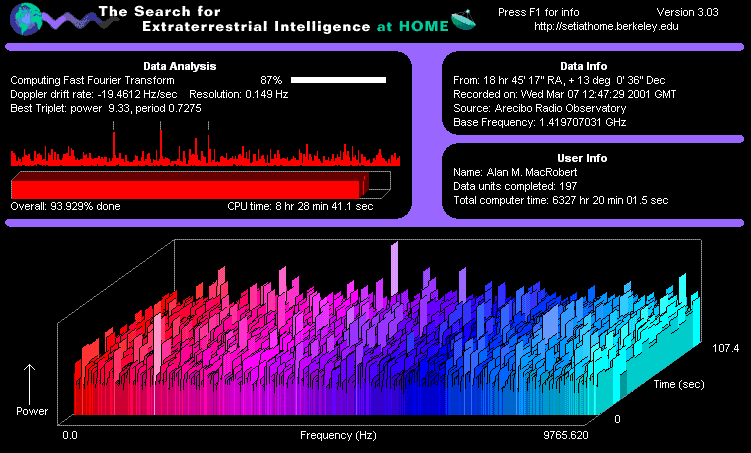
This week marks the tenth anniversary of the publication of that screensaver, SETI@home. The software, which pooled the computing power of millions of Windows 98 PCs and candy-colored iMacs to help the Search for Extra-Terrestrial Intelligence (SETI) listen for broadcasts from space. The program also became the largest distributed computer program in history, paving the way for current programs that study complex problems like code breaking and protein folding.
The program added up small bits of unused processing power from idle computers to run calculations intended to separate the general radio noise in space from targeted alien broadcasts. Those little bits of computer power eventually added up to almost as much processing muscle as the world’s most powerful supercomputer.
While the program never actually found any aliens — at least none that the government wants you to know about — it did serve as proof of concept for distributed computing. The lessons learned about distributed computing eventually emerged as the Berkeley Open Infrastructure for Network Computing, a program that provides free supercomputing power for everything from Stanford University’s folding@home protein folding program to the data collectors of the Large Hadron Collider.
Not bad for a free program that never actually served its intended purpose.