iRobot's lovable fighting machine can be toted in your pocket
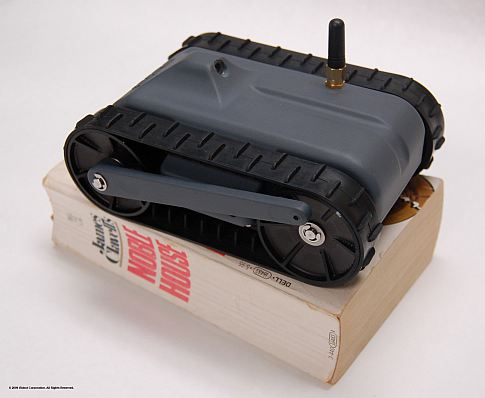
iRobot's multipurpose PackBot has helped lead the way among war-bots, disabling improvised explosives and carrying out recon missions for snipers. But soon paperback-sized robots such as the Ember prototype could join their larger cousins on the battlefield.

Ember's strength rests with numbers and disposability -- one soldier could theoretically carry around several of the bots and place them to create a networked mobile swarm. Each robot might carry several radios and sensors that make up a small part of the larger wireless network envisioned in the Army's now-gutted Future Combat Systems.

The one-pound robot gets around easily enough for its size. Twin flipper mechanisms allow the robot to climb obstacles and even right itself after awkward falls. Future versions are slated to pack enough artificial intelligence to detect and maneuver around obstacles in cluttered urban environments.

Soldiers need not treat Ember gently, either. Dropping or throwing the tiny bot works just fine -- apparently toughness is an inherited trait in the iRobot family, if PackBot has anything to say about it on Facebook.

"I like to think of myself as a rugged, shockproof, waterproof part of the team," PackBot confides on its personal page. Since early this year, the robot has joined college students and narcissists alike in polishing its online credentials and sharing family photos of Ember. It's kind of charming, even if the choice of "Mr. and Mrs. Smith" under favorite movies seems a bit random for a robot.

The trend toward smaller robots doesn't completely shunt aside the bigger unmanned ground vehicles, such as the tank-like Ripsaw that won one of PopSci's "Inventions of the Year." Large and small bots alike may simply play their own roles to ensure unmanned domination of the battlefield; as PackBot brags on Facebook, "I came, I saw, I conquered."

Ember:  courtesy iRobot

Want to read more articles on the military, aviation, and space? Subscribe to Popular Science and enter to win $5,000!

6 Comments

I wonder how quiet the motors for this thing are.It would sure help it remain stealthy.

What a determined little buzzard! Not sure if it can carry enough to be worthwhile, but it is certainly a fascinating concept.

I can imagine it could easily carry hi-def cameras,along with a GPS and laser designator to paint targets for smart munitions.

I think battery life would be limiting factor. That is always going to be a problem. Consider how useful one of those toy micro helicopters would be with autopilot, video and a 24 hour battery life.

Very cool robot, but it's technology in search of a realistic application.

As mentioned above, battery life will be limiting. So will wireless range and computing power for the envisioned wireless LAN.

I work in the space and can't imagine the wireless hardware costing less than $2-300 by itself, and that would be using commonly available 2.4GHz WiFi chipsets. Radio signals propagate best when elevated. The antenna on the back of Ember is not only low to the ground but would have low gain. In cities you would rarely have line of sight. To keep cost and power consumption low the radio couldn't produce much power, max 100mW (comparable to a small home wireless network). All told, range between Embers might be 100' at best. I can't see how this concept will ever fly.

However, if you eliminate the robot, solders could place low cost wireless nodes with a higher gain antenna on a small mast. Range would be vastly improved, power increased, and all battery power put towards higher power radios. I could envision such a system for less than $1000, approaching $500 with volume. $100 would still be a stretch.

Presto! Much less need to worry about the shading effects that Ember is supposed to address. That concept is achievable with off the shelf technology. DARPA should have saved their money.

What's with the prono soundtrack on the video?

I noticed that the Ember was shown navigating curbs and slopes, but not the RR tracks. Is there a reason for that?

Probably good for sneaking and listening. I'm sure that the following generations will have considerably more capabilities.

Violence must be eradicated; Kill all the violent people you know!!


Download Our iPhone App

Stay up to date on the latest news of the future of science and technology from your iPhone with full articles, images and offline viewing


Follow Us On Twitter

Featuring every article from the magazine and website, plus links from around the Web. Also see our PopSci DIY feed


Become a Fan On Facebook

Share links with friends, comment on stories and more


December 2009: Best of What's New

In our December issue, Popular Science names the 100 best innovations of the year: bombproof wallpaper, self-parking cars, the fastest helicopter, and 97 more. Plus inventor profiles and videos.

Check out the best of what's new here.

Popular Science Photo Pool


Share your photos in the Pop Sci pool at www.flickr.com!
tags_sprite.png
POP_embeddedForm_cover_May09.jpg