A Look Back at a Noble Mars Lander
On the first anniversary of the Phoenix Mars Lander's touchdown, we know a lot more about Mars than we did a year ago
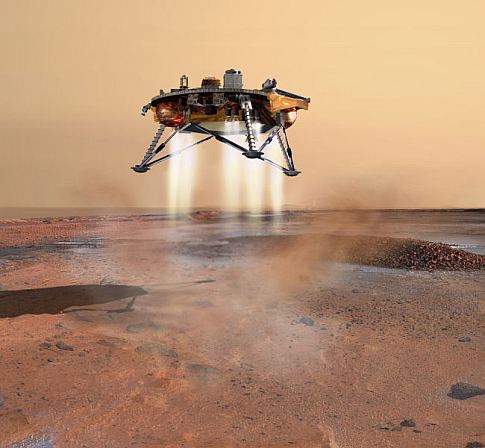
One year ago, scientists at NASA’s Jet Propulsion Laboratory, Lockheed Martin Space Systems, and the University of Arizona held their breath as the Phoenix Mars Lander hurtled toward its final descent and touchdown in the northern arctic plains of Mars. It was the first spacecraft landing on Mars without airbags since Viking 2 landed in 1976.
At 4:53:44 PM Pacific time on May 25, 2008, radio signals confirmed that Phoenix had survived its final descent and had landed safely on the Martian surface. The tricky and precise maneuvers involved with the spacecraft’s entry, descent, and landing were executed in a manner described as “textbook perfect,” leaving Phoenix poised almost perfectly level on the Martian surface. And the crowd at Mission Control went wild.
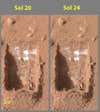
During its five-month mission, the at Phoenix mission surpassed all expectations — completing scientific work and experiments during 149 days of its 152 Martian-day lifespan. The first milestone occurred less than a month after landing, when the Lander’s Robotic Arm uncovered evidence of frozen water when digging a trench. Chunks of bright material in the trench were exposed on June 15 and were still present on June 16, but by June 19 they had vaporized through the process of sublimation, whereby ice goes directly from a solid to a gas state.
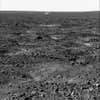
In September, the Lander’s Surface Stereo Imager camera photographed several dust devils moving across the Arctic plain. On the mission’s 104th Martian day, 29 images were taken of the western and southwestern horizon, and six different dust devils appeared in 12 of the images. Later in September, a laser instrument on the Lander detected snow falling on the Martian surface. And soil samples analyzed by the Lander’s Thermal Evolved Gas Analyzer (TEGA) and wet-chemistry laboratory revealed the presence of calcium carbonate and clay — both of which form only in the presence of liquid water on Earth.
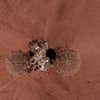
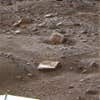
Other findings included mildly alkaline soils unlike any found by previous Mars missions, and small concentrations of salts that could be nutrients to support life. Cameras onboard Phoenix returned more than 25,000 images, from panoramic vistas of the Martian surface to microscopic images of soil samples.
By the end of October, seasonal sunlight at the landing site was declining, and the solar arrays could no longer generate the battery power needed to operate the Lander’s instruments. On November 2, after operating for two months beyond its expected three-month life, Phoenix transmitted its final brief signal via NASA’s Mars Odyssey orbiter. “Phoenix has given us some surprises, and I’m confident we will be pulling more gems from this trove of data for years to come,” said Peter Smith, the Phoenix mission’s principal investigator.

Parachuting Down

Touchdown
In The Trenches
Robotic Arm

Midnight Sun Panorama
Sublimation
Dust Devil
Self Portrait
Winkies and Quadlings