The Future of the Military — Perhaps
The most ambitious weapons program in Army history calls for a whole new arsenal of connected gear, from helicopter drones to GPS-guided missiles. But what happens if the network that links it all isn’t ready?
The Army wants to modernize — and Defense Secretary Robert Gates isn’t sure he wants to pay. Among the budget cuts he announced yesterday was a major hit to the Army’s most ambitious new weapons program, Future Combat Systems (FCS). Under Gates’s proposed budget, a set of FCS fighting vehicles that was supposed to provided light-brigade speed with heavy-brigade punch will be axed entirely. And you know what? Maybe that’s okay. The core of what makes FCS futuristic is its ambitious wireless network, which will connect soldiers, surveillance drones and sensors, giving everyone more and better information than ever before.
Author James Vlahos explains how it’s all supposed to work in this article, from our May issue.
Wall-E went to Iraq.
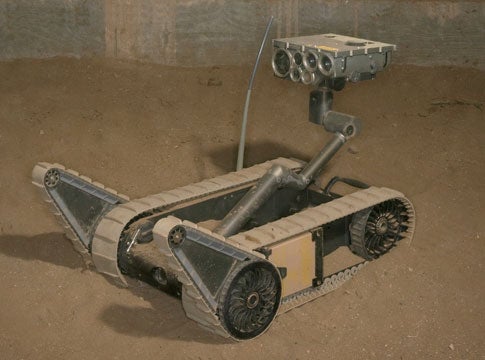
The small robot rolled out of the desert scrub into a village, paused between two houses, and then approached the closer one. His square head swiveled around, unblinking camera eyes surveying the structure. The sound of shuffling boots filled the air as six U.S. Army soldiers rushed in behind him, assault rifles drawn. Reaching the building he’d scoped, they took cover inside. The robot, meanwhile, whirred on tank treads to investigate the second house. The building had no door, and he rolled inside easily. The soldiers followed. Bang, bang! Gunfire erupted, and moments later the Americans emerged unscathed. The two insurgents inside the house weren’t as lucky.
My view of the Showdown at the Baghdad Corral came from atop the roof of the first building, where I stood with two Army colonels and a brigadier general, a cadre of defense-industry contractors, a couple of reporters, and a cameraman from Al Jazeera. For some reason, we were all wearing helmets, even though this wasn’t a live-fire exercise. The shootout had been staged at Adobe Village, an Army training facility at Fort Bliss, Texas, and the robot was a prototype of a reconnaissance ‘bot known as the Small Unmanned Ground Vehicle, or SUGV (pronounced “sug-vee”). Transmitting live imagery back to a helmet-mounted display worn by one of the soldiers, the robot had conveyed that the first building was safely empty, while the second contained insurgents who were rigging a bomb. Tipped off, the soldiers were able to execute a successful raid and “kill” the bad guys.
Sensor in Hand
The waist-high SUGV is at the forefront of more than just pretend infantry assaults. It’s one of the first technologies to emerge from a program called Future Combat Systems, the most ambitious Army modernization effort since World War II. The Army traditionally develops weapons in isolation — a new tank here, a helicopter there. But FCS, scheduled for full deployment by 2015, was conceived from the ground up as a unified family: eight armored vehicles, three robotic transports, a suite of battlefield sensors, unmanned aerial and terrestrial surveillance crafts, and a guided missile launcher. Each component boasts better-than-before features (the SUGV, for instance, weighs less than 30 pounds, half as much as the robotic scouts currently deployed in Iraq and Afghanistan), but stacked spec sheets aren’t the main point. The key innovation is that the pieces will work as a coordinated team linked by a wireless network — interconnection that the Army says will revolutionize the way war is fought.
The FCS vision combines the best of laser-guided munitions, robotics, and Facebook. Mouse clicks steer missiles and drones, computers display the locations of combatants like restaurant icons on a GPS unit, picture messages show insurgent hideouts, and Twitter-like posts provide intelligence updates. Imagine a platoon of 50 soldiers spread out over a few miles, some on foot and some in Humvees, some out in the open and some inside buildings. Each soldier is linked to the other fighters in the area. He or she can receive pictures from a SUGV, intelligence from the command post, and information such as vibrations from tank treads and traces of biological weapons from unattended sensors. The objective is to make soldiers more precise about identifying targets and more lethal once they do; to harness Web-style connectivity to reduce the fog of war.
The goal is unimpeachable. It’s the execution that’s under fire. The cost of FCS has risen at least 45 percent since its inception in 2003, with the Army putting the final tally at $161 billion and an independent review by the Department of Defense estimating up to $234 billion. Either way, FCS, a dog’s breakfast of 896 contractors in 45 states, is the most expensive weapons program in Army history. In March 2008, the Government Accountability Office reported that progress so far is “well short of a program halfway through its development schedule and its budget” and that “only two of FCS’s 44 critical technologies have reached a level of maturity that . . . should have been demonstrated at program start.” The most critical unproven technology is the network itself, which is relying on a system of high-bandwidth radios that is still being developed. Without it, FCS collapses like a house of cards.
Eye, Eye Cap’n
With FCS in the crosshairs, the Army has scurried to publicize progress — hence my invitation for a daylong show-and-tell at Ft. Bliss — and accelerate the schedule. The deployments of the SUGV, the missile launcher, an unmanned aerial vehicle and the first phase of the network have been moved up to 2011. Whether this is enough to save the program remains to be seen. This summer, the Defense Acquisition Board will complete a critical review, deciding whether FCS will move forward in its entirety, in a scaled-down version, or at all.
Intent on success, the military has assigned a 1,000-member brigade, the Army Evaluation Task Force, to test prototypes, provide feedback, and develop new strategies for network-enabled combat. Stationed at Ft. Bliss, more than 90 percent of the task-force members previously served in Afghanistan, Iraq or both. After the SUGV mock assault, I went down to the street and approached the robot’s driver, Tony Salinero. “In Iraq, how often do you get a house with no door that you could drive a robot right through?” I asked. Salinero laughed, and then there was an awkward pause. “Occasionally,” he finally said. Inside the building I met the soldiers who had been cast as insurgents in the SUGV drill. They seemed to lack the moxie that one would expect from dangerous rebels. One said, “We’re two guys, and they had like six of them coming in. What you gonna do? Die in place.”
Reinventing the Radio
To achieve the kind of interconnectedness on which FCS relies, the Army needs a portable computer that allows soldiers to wirelessly share intelligence through voice, text, pictures or video; initiate commands in remote computers; access informational servers; and use satellites to determine their location and the locations of others. A cynical take on FCS is that the Army is spending $200 billion and waiting until 2015 to invent a cellphone no more sophisticated than that carried by the average American teenager today.
“Every other day, somebody jabs me about cellular — you know: ‘It’s so prevalent and available,’ ” says Col. Michael Williamson, the project manager for FCS network integration. But the infrastructure that allows you to wirelessly call and Web-surf while sipping a Frappuccino at Starbucks has been built up over the course of decades at a cost of hundreds of billions of dollars, he says. In war zones, modern communications are often limited or nonexistent. Even when robust commercial Internet and cellular technologies are in place, for security reasons the military can’t rely on them. Communicating over widely known standards would enable an enemy to easily intercept information, like the coordinates for an upcoming missile strike. Worse yet, even encrypted transmissions could allow foes to pinpoint soldiers’ locations and to launch counterattacks. When the Army shows up to fight, it must therefore build a network from scratch, says Paul Geery, the director of network development at Boeing, the lead systems integrator for FCS. “Our constraint is to be able to take a fighting force, roll off a C-17 [cargo plane] or boat with nothing in place, and within a short period of time start operating in a network fashion.”
The military has made considerable progress in the past decade at linking commanders at the battalion level and above. Leaders at war-zone bases have hardwired or satellite-enabled connections to a protected version of the Web. They can share intelligence data, reconnaissance imagery, logistics reports and battle plans. Rank-and-file warriors, however, are mostly cut off. The soldiers’ networks that do exist are isolated, small and slow, with data-transmission rates measured in kilobits, not megabits, per second.
Rocket Box
A central goal of FCS is to extend connectivity to these lower-echelon fighters. But because the military can’t rely on preexisting networks of cell towers and cables, it must find alternative methods to move information around the battlefield. Communicating via satellite is part of the answer, but this method fails when soldiers don’t have a clear view of the sky, such as inside buildings, on narrow streets, in caves and narrow mountain valleys — in other words, in the very kinds of environments in which the American military increasingly operates.
To solve this “final mile” problem of linking soldiers and vehicles that are away from command posts and reliable satellite access, FCS hopes to use a device still under development called the Joint Tactical Radio System, or JTRS. Software-controlled JTRS radios link to one another to create local-area networks and form chains all the way back to the nearest command post or vehicle with satellite connectivity to the military’s Internet. They function like typical radios — that is, a soldier can hold one in his hand and use it to talk to another soldier — and can also transmit data and imagery like cellphones do. Versions of them can be built into sensors, surveillance drones and vehicles to allow those FCS components to communicate too.
Consider how the JTRS system differs from that of your cellphone or laptop. There are more than 200,000 cellphone towers in the U.S., which route communications through an elaborate network of cables and computers. Wireless Internet is only wireless in the limited distance between your laptop and the base station. Even the satellite-Internet services used by people in remote areas eventually tie back to a hardwired network. Since a battlefield environment typically has none of this infrastructure, JTRS radios must pick up all of the slack for moving data around. It’s as if each device were both cellphone and tower.
Current Army radios are used primarily in the conventional, walkie-talkie way, and only minimally for data, because they transmit just 2.4 kilobits of information per second. The JTRS units are being designed to manage up to two megabits per second. That’s still far slower than a basic home cable-Internet connection. But it will allow the units to handle voice, text and photos. Chris Brady, a vice president at General Dynamics C4 Systems, which is developing the most compact and portable versions of the new radios, calls JTRS “the glue that holds the whole lower tier of FCS together.”
Intel-gathering gear
When you talk to people about FCS, few bits of military jargon get more airplay than “situational awareness” — soldier-speak for “knowing what the hell is going on.” Knowing the battlefield locations of friends and enemies. That a resupply vehicle is a mile behind you. That insurgents are launching attacks from an abandoned apartment, or that the location is in fact a mosque occupied by civilians. If the JTRS radios are the primary means by which this information will be moved around the battlefield, the purpose of many of the other FCS components is to collect more and better information to feed into the network.
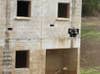
Spy ‘Bot
Col. Emmett Schaill is the former leader of the Army Evaluation Task Force, and he makes a very personal case for boosting situational awareness. In 2005, while stationed in the northern Iraqi city of Tal Afar, he went to a castle that was being used as a police station. During his meeting with the police chief, a car bomb exploded outside the southeast wall. Schaill rushed to investigate. Only once bullets started whizzing past did he realize that insurgents were attacking. He peered from a parapet to get a good shot but didn’t see the insurgent taking aim nearby. The bullet ripped through his forearm and bicep. “If I had a UAV [unmanned aerial vehicle] to see what was going on out there, I personally would not have been shot,” he says.
The FCS robot he covets is the Class 1, Block 0 UAV. Later the morning of the infantry exercise, it scoped Adobe Village from the sky. With a soldier controlling its movement by way of a Panasonic Toughbook, the craft captured high-resolution video of the assembled soldiers, a pair of porta-potties and me. It looked like a beer keg and sounded like a leaf blower. But the Task Force soldiers are excited about its potential. Unlike the Raven UAV, the small unmanned plane currently used by the Army for low-altitude recon, the Class 1, Block 0 is a helicopter and can hover in place from 10 to 200 feet off the ground — in a narrow alley between buildings, outside a window looking in.
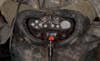
Drones have become common battlefield tools in the past decade but are typically controlled at the company or battalion level, which respectively have about 135 and 650 soldiers apiece. FCS wants tools like the UAV at the platoon (approximately 40 soldiers) and even squad (10 members) level. The vision is also to expand the range of applications. The Massachusetts-based company iRobot manufactures a PackBot currently deployed overseas, which the military uses primarily to scout for improvised explosive devices, while the SUGV, also made by iRobot, may one day lead infantry assaults like the one I witnessed. A single soldier can comfortably tote a SUGV, and the controller, copied almost directly from that of an Xbox game console, was designed to be intuitively easy for a young recruit to use.
Look Familiar?
One of the soldiers handed me the controller; I donned the head-up display and started driving. The robot crashed into a wall. After practicing for a few minutes, I was able to steer into one of the buildings and scan for insurgents. There was something exciting — and faintly disturbing — about the notion that I could help battle insurgents with technology that felt only slightly elevated from the R/C cars of my childhood. But I wasn’t totally sold. Removing the display, I asked what would prevent an enemy from shooting the SUGV as soon as he spotted it. “Nothing,” replied one of the soldiers nearby, Lt.-Col. Ed House. “But if he does, we know he’s there, so the SUGV has accomplished its mission. Better to shoot a robot than a soldier.”
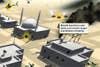
A soldier drove up in a Humvee and parked in the middle of Adobe Village. Inside the truck was a suite of computer and communications gear that collects information from the SUGV, the drones and the rest of the battlefield nodes, displays it on a computer screen, and feeds it into the broader network. The point, after all, is not just for someone like Schaill to know that there are barbarians at the castle gate, but to share that information with everyone. FCS can’t handle too much streaming video — the system won’t have enough bandwidth — but still images can be captured and distributed, which soldiers say is a major step forward. The operator of a hovering drone who takes a picture of an insurgent entering a hideout can share it so that soldiers conducting the subsequent raid know exactly who they’re looking for. A sensor that detects a biological threat can instantly alert everyone on the network.
A catchphrase of Army modernization is “every soldier a sensor.” If soldiers observe a roadside bomb, they can post the coordinates to the network. Their locations, movements, text messages sent, and shots fired can be automatically recorded. In aggregate, the information streaming onto the network from hundreds of soldiers will give commanders an exceptionally accurate and up-to-the-second portrait of battlefield conditions. Schaill describes the creation of a “cognitive network across a 4,000-man brigade.” So it’s not that FCS will somehow turn the grunts of the past into autonomous killing machines — rather, they will become the grunts of the future, fighters with the pluck of American GIs and the hive mind of the Borg.
Network In Action
But What About The Network?
With such noble goals, why does FCS have so many doubters in Washington? Paul Francis, who authored the GAO’s March 2008 report to Congress, describes the fundamental problem as one of putting the cart before the horse. The network is the key to FCS, and yet the Army dove into building every piece of equipment before proving the core network technologies that would connect them. If some of these don’t pan out, major aspects of FCS may have to be scrapped and rethought.
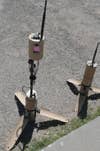
The fate of the network and, therefore, of FCS, hangs principally on those JTRS radios, which will serve as the primary means of connection. But the JTRS program, launched in 1997, has been so plagued by delays and cost overruns that some components were nearly canceled before the program was reorganized and transferred from Army to Department of Defense oversight in 2005. To be sure, the technological challenges are significant. Features like the ability for the radios to assemble themselves into ad-hoc networks have little precedent, even in the civilian world. The JTRS radios must be compatible with all preexisting military radio systems, adding to the complexity of the software needed to run them. Because they can’t rely on cell towers to pick up and relay signals, they must radiate 10 to 20 times the energy of a cellphone and have bigger antennas. All these attributes must be crammed into packages small and light enough so that overburdened soldiers can carry them or fit them into cramped vehicles and robots. Yet the cost per unit must be relatively low because they will be widely deployed.
Smart Sticks
Since JTRS management was reorganized, the program has met its deadlines and the radios have passed limited field tests, says Ralph Moslener, the JTRS program manager for Boeing, which is manufacturing one version of the radios. The open question is whether they will function adequately once scaled up to a much larger system.
FCS’s manned vehicles are a case study of the promise and peril of relying on as-yet-unproven technologies — the JTRS radios, as well as new, lightweight armor and a missile-detection system. The Army has long been confounded by the fact that its heavy brigades have battle-winning weaponry but take too long to deploy, while light brigades are fleet but firepower-light. FCS offers a solution in the form of vehicles that pack heavy-brigade punch with light-brigade speed, deployable to anywhere in the world in 96 hours or less. This is possible in part because each vehicle weighs as little as half that of similar previous vehicles.
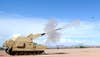
I got to check out one of the FCS vehicles, the Non-Line-of-Sight Cannon (NLOS-C). The interior wasn’t so different from that of the family minivan. After I lowered myself through a narrow hatch into the prototype, the first controls I noticed on the dash were those for the air conditioning and high beams. The gas and brake pedals were underfoot. I could just hit the power button, roll off the warehouse floor, and lay waste to the nearest Wal-Mart.
The NLOS-C, heir apparent to the Army’s M109 Paladin — a self-propelled howitzer widely deployed in armored divisions — is one of the eight manned vehicles in FCS. Featuring the Army’s first hybrid-electric drive, the NLOS-C is designed for a common counterinsurgency challenge: trying to attack foes who strike quickly and disappear. Col. Robert McVay, an Iraq veteran who is the NLOS-C’s product manager, describes how “the insurgents would set up a 127-millimeter rocket launcher, fire on us, and then take off within two to three minutes.” The Paladin takes that long just to get ready to fire. But the NLOS-C can get off a shot within 30 seconds of receiving coordinates because the fire system is automated; the vehicle needs a crew of two rather than the Paladin’s five because soldiers don’t have to manually hoist 100-pound shells into the breach. The weapon fires up to six rounds a minute — three times as fast as the Paladin — and can change the trajectory of each shell so that they all hit nearly simultaneously, depriving the enemy of the opportunity to take cover after the first shell strikes.
Fast Fire
But there’s a tradeoff to the svelte build of the NLOS-C. When it comes to armored vehicles, less weight traditionally means less protection for the soldiers inside. To compensate for this potential weakness, FCS designers are trying to perfect advanced armor that provides more protection with less bulk. But the armor isn’t ready yet. The second core technology still under development is a system that is supposed to detect incoming enemy missiles and shoot them down before they hit the tank. And finally, there’s the not-yet-functional FCS network itself. One reason designers thought they could get away with lighter-weight vehicles is they figured that the soldiers would have such good intelligence from the network that they could detect enemies and strike them first — the best defense is a good offense, essentially. “The designs of the vehicles and everything else depend on the quality of service [the network] provides,” Francis says. “It would have been a better approach to have demonstrated the network’s quality of service before you proceeded with the design of all the vehicles that depend on it.”
Stick ‘Em Up
A Precise Aim
Toward the end of the day, I stood under the scalding Texas sun next to a tan metal container stuffed with missiles. This was the Non-Line-of-Sight Launch System (NLOS-LS), a portable system that could fire GPS-guided missiles so accurately that they could strike enemies hunkered down in a narrow alley. Two soldiers standing by shouted out mission orders and then clicked a button on a screen marked “execute.” At this point, I was supposed to imagine a missile blasting forth and streaking toward its target. But it was a Fourth of July firework that went off with a whistle and no pop.
Schaill looked on approvingly and then gave a little speech. The theme was borderline pacifist for a military man and seemed to sum up the hopes for FCS — that more information would result in less bloodshed. “Over the next 30 to 40 years, we’ll be doing a lot of operations in populated areas,” Schaill said. “What that means is we have to be able to precisely gain target information, because I don’t want to hurt civilians. I don’t want to hurt anybody I don’t have to hurt. This [launch system] gives us the capability to get these missiles precisely where they need to be on the battlefield.”
A reporter standing near me cleared his throat and said, “at least more precise than in current systems. Precise and war are generally two concepts that don’t go well together.” Schaill looked straight at him. There was a long pause before he responded. “Historically, perhaps. But a sword is pretty precise. I think this will be much more precise as well.”