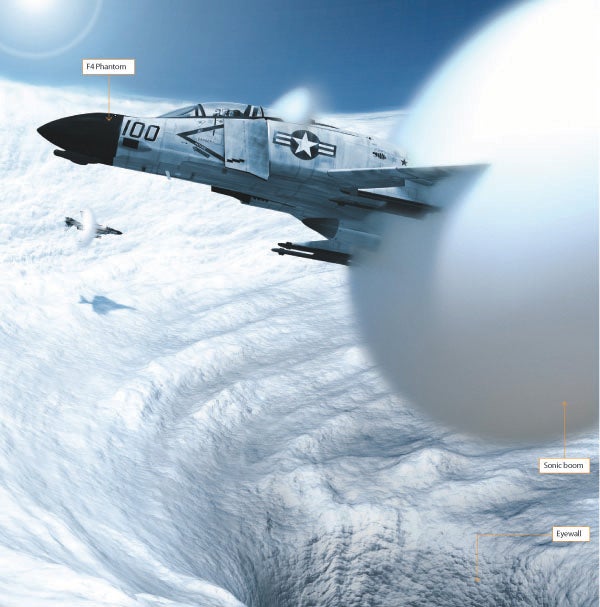
A Category 4 hurricane approaches New Orleans, yet “When the Saints Go Marching In” continues to spill out of clubs on Bourbon Street. No one’s worried, because two F4 Phantom fighter jets have just taken off from the nearby Naval Air Station Joint Reserve Base to kill the storm before it hits land.
Such is the idea drawn up by Arkady Leonov, a fluid-dynamics engineer at the University of Akron. According to his calculations, sending supersonic jets into the eye of a hurricane and circling them counter to its winds could slow the storm. Furthermore, flying the jets near the water could choke off the supply of warm air that fuels the storm. If the plan works, it would offer the first option for quenching hurricanes, which inflict $5.1 billion of damage every year in the U.S. alone.
As you might expect, some hurricane scientists are skeptical. Shock waves from a sonic boom would probably travel through the storm without slowing it, like trying to stop the wind with a tennis racket, says Hugh Willoughby, a hurricane researcher at Florida International University. He also thinks that the turbulence in the eyewall would rip apart a plane flying so fast. (Leonov contends that a jet traveling at more than 1,100 mph would have no trouble slicing through 100mph gusts but suggests that robot pilots could deal better with the 4-G forces exerted on the pilot during the maneuver.) Wen-Chau Lee, a scientist at the National Center for Atmospheric Research, points out that hurricanes, like earthquakes, are the planet’s way of releasing energy from one part of the world to another. “If you terminate or even diminish a hurricane, what would the Earth do with all that pent-up energy?” Lee says.
Finding out might be worth the risk. In 2005, hurricanes Katrina and Rita killed some 1,300 people, and 2008 saw a record number of consecutive storms hit the U.S. Leonov hopes to discuss his plan with Air Force officials later this year. “I’m not a pilot,” he says, “so maybe these guys can come up with an even better approach.”
Five amazing, clean technologies that will set us free, in this month's energy-focused issue. Also: how to build a better bomb detector, the robotic toys that are raising your children, a human catapult, the world's smallest arcade, and much more.


Online Content Director: Suzanne LaBarre | Email
Senior Editor: Paul Adams | Email
Associate Editor: Dan Nosowitz | Email
Assistant Editor: Colin Lecher | Email
Assistant Editor: Rose Pastore | Email
Contributing Writers:
Kelsey D. Atherton | Email
Francie Diep | Email
Shaunacy Ferro | Email
I don't see it working with the pilots and fuel restrictions we have now, but with a fleet of purpose-built UAVs? That would be really interesting.
The P-3 Orions and the C-130 transports that are used by the hurricane hunters right now take a tremendous beating every time they fly through a storm. I can't see a fighter with an airframe that is going on 40 years old faring too well trying to cut through the heavy chop at those speeds unless they stay inside the eye in the clear area. But then, if you are in the calm area of the eye can you really influence the eye wall areas? With the average size of a storm eye in the 20-50Km range, can such a small plane really do the job? Lots of questions, no hard data yet.
My take, get someone to loan you a supersonic drone and pay up the insurance premiums, then got for it. You're not going to turn a monster storm into a wispy patch of cumulus clouds though, so the folks in the french quarter should be getting ready for a bad storm with flooding either way.
I just don't understand how this could possibly work. The amount of energy being pumped into the hurricane by the aircraft is so miniscule compared to the overall energy, it would be like a fly trying to push over an elephant. To continue that analogy, if the elephant were balanced on the head of a needle, (in other words, in a very, very unstable position) maaaaybe I could see a fly pushing him over. But is a hurricane really that unstable? Is the eyewall that fragile? I've read of similiar proposals involving nukes, and they were dismissed for many reasons, not the least of which being that even nukes are insignificant compared to the power of a hurricane. If a nuke can't disrupt the eyewall enough to stop a hurricane, how would a couple of tiny aircraft.
I also have to agree with the concern above; even if this would work, do we really want to do it? That energy has to go somewhere, it won't just disapear.
I am still on a neutral side on this issue. There are arguments for both sides. A sonic boom MIGHT be powerful enough to slow down a hurricane, but there is no proof of it.
This idea has to be tried and be successful several times before it is thought to be a success. However, even if you stop a hurricane, what is the point. The energy is going to be released anyway. It is just delaying the worst. A hurricane is a NATURAL disaster, trying to control it isn't going to help that much. The jets might be able to slow down the hurricane, but that might just make it last longer. There are always side effects to everything.
There seems to be a lot of doubt that man made tools could stop a hurricane.
I'm sure there's probably a few things wrong with my line of thinking but.. is it possible to stop a hurricane with another hurricane? It seems from the comments that the only thing with equal force to a hurricane would be another one.
I guess my questions would be, has there ever been an event where two hurricanes came together and cancelled each other out, and if so, what would it take to create a man made hurricane.
Yeah, this idea seems out there even to me, but flying a couple of jets around such a massive force doesn't seem like it's going to work either, even though it's quite ready to test come storm season.
Its too bad we can't harness the energy instead of trying to destroy it. Nature knows what she's doing most times and we seem to keep screwing it up. We fought forest fires for years only to learn that we were just building up tinder boxes. We build massive levies to create more arable land and then whoops, the ocean knocks them over and takes out a few hundred folks in a day. Don't get me started on the Everglades and the Army Corp of Engineers.
Natures giving us a tremendous force of energy - let's harness them, not destroy them or worse try to overcome them with "engineering".
Of course if we didn't build levies, didn't redo the everglades and we stopped building homes on piles out on the edge of the beaches, we probably wouldn't lose 5.1 billion dollars due to Hurricanes.
Okay done with my rant...
Show me a wind turbine farm that can suck all the energy out of a hurricane and power the US and I'll show you an achievement.
I think the concept may have merit. Though two posters questioned the means (40 year old fighters) and (sonic boom), these can be explained away fairly easily.
First off, even those 40-year-old fighters were built to take extreme stresses, much more so than the C-130s that currently fly through the storms so successfully. Part of the reason is that they are so small, by comparison, that it would take much stronger winds to affect a fighter to the same extent. However, since the F-4 has been retired from active duty, the plane used in this concept was strictly a theoretical proof-of-concept application.
Secondly, we're not talking about a single pass by the aircraft. You're right, a single sonic boom (shock wave) would have almost no effect. Multiple aircraft orbiting at speed inside the eye or perhaps just within the eye wall in the opposite direction would over time disrupt the stability of the hurricane. When an eye develops, that's a clear indication that the storm has gained stability and strength. If this eye wall can be disrupted... the circular winds randomized to any extent at all, it seems there'd be a good chance the storm could be weakened or perhaps even disrupted as a coherent weather system.
The only drawback to item two is that nobody, as yet, knows just how effective a supersonic aircraft would be in countering the forces of the storm. Two jets might do it--or they might not. It might take an entire squadron of smaller craft or a bigger craft like a B-1 to create enough wake and shock wave.
What people forget is that an aircraft, no matter how small, leaves a wake in the air in the same manner as a boat in water. If you drop two stones in a still pond, you'll see that in certain points, the ripples seem to vanish--but in others they build to twice their height. Only very precise placement of that energy would neutralize the entire storm.
Hurricanes are among the most powerful of Earthly phenomena, unloosing some 1,000,000,000,000,000 watts, 3,000 times the total electrical power generated in the world. This is equivalent to exploding 500,000 Hiroshima-type atomic bombs per day.
I really don't think that a few thousand pounds of jet power is going to put a dent in it. It's kind of like spitting in the ocean.
I understand the idea of a sonic boom scattering the hurricane but the sonic boom can not be more powerful than the jet it self.
Hurricanes are quite big and even 1,000 little airplanes are not going to put a dent in it.
This shouldn't be so quickly dismissed, since it might be powerful enough to destabilize tornadoes. While hurricanes may be too ambitious, this may prevent a lot of tornado damage.
But in this stability problem, this is a ball in a valley, not a ball on a hill. It won't be sensitive to small perturbations like shock waves. An extreme example is Jupiter's Red Spot. Shock waves from A-bombs would not likely perturb the wind pattern.
Furthermore, I don't think the eye structure is a cause of the stability, but rather a result. Air begins the veering nature that creates the eye from hundreds/thousands of miles away. Remove the eye structure and those air pockets will still be moving toward the center and veering rightward. If there wasn't a lot more mass aside from the closes 20 miles of air mass creating the structure, centripal force wouldn't be creating the spin and eye in the first place. The heat source from below still exists too.
The aim is to turn a hurricane into the sort of storm it becomes after making landfall, i.e. disrupting the ORGANIZED upward flow of heat that leads to such high air speeds.
An electrical analogy is a capacitor with a wire discharging the two. A tornado is the wire/conductor, connecting a hot-air capacitor with a cold-air capacitor. Since it's the easy path for hot air upward, trapped hot air that can't move upward quickly rushes laterally from far away to get to the tornado where it can move upward quickly. Similar thing for hurricanes. How to remove the wire/conductor organized structure so that the hot air has to rise in a slower less organized way? For a tornado, the jet fighters would have to wait for the eye to form to perturb its structure and prevent the wire/conductor structure from forming; otherwise, how would you know where to fly the plane? For a hurricane, by the time the eye has formed, it's probably too late, too stable. At some point on the spectrum between tornado size and Red Spot size, the stability of the hot air conduction is such that the structure is "too big to fail." But flying fighters close to West Africa and making sure the eye/conductor doesn't form to begin with may be the most cost-efficient way to do this.
As for getting support for this idea, I don't think there will be much. It likely won't be able to undo a hurricane's eye structure, but could prevent it. But then budget-conscious pols will say, "How do we know it really prevented it?" since the storm can't be treated multiple times to see what the turn out is each time. Obversely, weakened storms will be met with, "How do we know it wouldn't weaken on its own?" Success with tornadoes may be good for developing support.
I was with the Hurricane Hunters for 26 years, (WC-130). This idea won't work for several reasons. The first most obvious is what Mr. Lee stated, hurricanes are a "relief valve" for pent up heat and energy in the atmoshphere. They also have a cleansing effect, so in alot of ways, they are desirable.
The Hurricane Hunters tried numerous things including seeding clouds with crushed dry ice, nothing worked.
Flying a few old fighters into a storm and breaking the sound barrier won't phase one.
Even if you disrupt it for a sort period of time, and the weather conditions that caused it to form in the first place are still there, the eye will reform, and it will just carry on.
The best thing you can do with these giant storms is to be prepared.
This is crap! LOL! You would need a force equal to or greater to have an impact on said force. What the hell are they thinking? Besides like they said, this is a force of nature, it's a healing process. It might cause US damage, but do not forget, the Earth provides us a home. I think we deserve to die if all we do is try to control the world's natural processes. We don't even understand it all that well to be making such large decisions. I think this is a STUPID idea.
Why do we always try to outsmart nature? People are powerless against the forces of nature and even if we succeed to stop one hurricane for a short while it will form again and hit even harder.
Jen @ http://www.silverandgold.biz