Economy got you down? Not sure if this whole “American capitalism” thing is working out for you? Looking for cheap housing? Well, you can always start from ideological scratch and build a new society on a free floating platform in the high seas.
Sounds nuts? Well it’s not to the Seasteading Institute, who is trying to make this utopian fantasy a reality. Backed by billionaire entrepreneur Peter Thiel (a PayPal co-founder) and run by Patri Friedman (grandson of Nobel prize winning Chicago economist Milton Friedman), the Institute’s goal, as stated on its Web site, is to “build a new frontier, a place where those who are dissatisfied with our current civilization can go and build a different (and hopefully) better one.” The eventual goal is to foster better government using free market principles. The Institute asserts that the challenge of experimenting with different governmental models is the high cost of switching (just try and get Australian citizenship) and high barrier of entry in starting a new nation. With seasteads, the idea is that people can sample a myriad of free-floating societies with different governmental structures, and this marketplace of social philosophies will lead to better societies. Don’t like the enlightened despotism of Seastead A? Then, move to the green-socialist colony on Seastead B!
Okay, still sounds crazy? Well, the concept is not as far fetched as it may seem, and there are existing real world examples. The idea of “seasteading,” creating permanent, politically-independent dwellings at sea, is an old one and based on the international legal principle that, outside of the exclusive economic zone (generally extending a set distance from the terrestrial borders of a country), the international waters or “high seas” are not subject to the laws of any nation except for the home flag of the ship in those waters. If the ship or dwelling does not fly the flag of a recognized nation, then technically it is not under any national jurisdiction if it remains in the high seas. So if you drop anchor in the right spot and have the means, you can begin your own society.
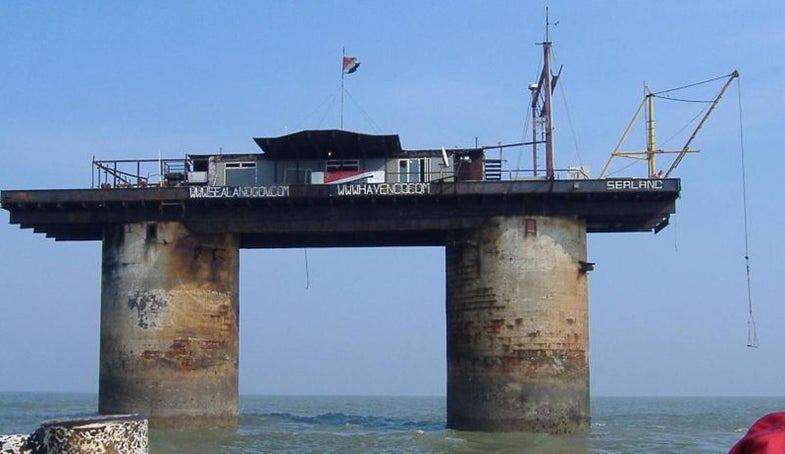
This is the (disputed) legal basis for Sealand, a self-declared micronation established when former British radio host Paddy Roy Bates took over the abandoned British World War II sea fort off the British coast in 1967. Although not recognized as a sovereign state by the UN, it operates as a constitutional monarchy by Prince Michael Bates, son of the founder/squatter of Sealand, and has been for the most part left alone by the British government. Sealand has had a colorful history, including issuing its own coins and stamps, establishing an offshore internet hosting facility or “data haven” that mysteriously disappeared, and hosting sporting events such as the annual international egg throwing championship and a 2008 Red Bull Extreme Skateboarding competition.
One look at Sealand and you will see that it is not likely what the Seasteading Institute has in mind for its sea-based utopias of the future. The Institute is not interested in squatting old military rigs, but rather in engineering new free floating cities that would provide a self-sustaining habitat and economy, much like any nation. Despite its political ideals, the Institute understands that eventual acceptance of seasteading starts with practical implementation. So they are beginning their ambitious agenda by focusing on incremental engineering achievements. This plan starts with designing and building small model seasteads that will demonstrate the viability of the larger design (i.e. prove through working models that they can achieve stable flotation, ballast control, mobility, synchronization, and habitability). If all the stages prove successful, they will build their primary prototype, the ClubStead, a 200-room hotel/resort to be located off the coast of San Francisco (and whose design they patented last month).
Of course there are a myriad of engineering, financial and political pitfalls that will have to be addressed along the way. But even a cursory glance at the Seasteading Institute’s Web site and the work already invested in these ideas, and it's clear they are committed to making this dream a reality.
In the meantime, we can all look to Sealand for some real world guidance. One recent issue has been defense. Just this month, a British newspaper reported that a self-proclaimed German despot named King Marduk has claimed to have taken over Sealand and plans to demolish it and rebuild a Dubai-style resort replete with windfarms and a modern communication platform. Sealand’s Prince Michael has denied any such hostile conquest. Perhaps, he should take some defense advice from the Seasteading Institute. In a white paper entitled “Seasteading: A Practical Guide to Homesteading the High Seas,” the Institute recommends cost effective defensive measures: “For example, sea-skimming anti-cruise ship missiles like the Chinese silkworm are fairly cheap and quite effective.”
138 years of Popular Science at your fingertips.
Each issue has been completely reimagined for your iPad. See our amazing new vision for magazines that goes far beyond the printed page
Stay up to date on the latest news of the future of science and technology from your iPhone or Android phone with full articles, images and offline viewing
Featuring every article from the magazine and website, plus links from around the Web. Also see our PopSci DIY feed
The first issue of 2012 is a great one: we've got stories on how to make planes, tanks, subs, and soldiers invisible. Also, how the U.S. is reengineering homeland security at the southern border, inside the deepest mine in the world, and our predictions for the year to come.
the former Principality of Sealand is from 17 January 2009 a state territory of the sovereign absolute monarchy State Kingdom of Marduk become. The facts of occupation read under king-marduk.de <> forum - report: PRINCIPALITY SEALAND - KINGDOM OF MARDUK Fourt Roughs Tower Sealandcity - 1. / 2. part they are highly interesting read, certainly in the forum about the Antarctica can read very much.
I have absolutley no idea what the previous poster was trying to say!
OK, so why couldn't you make your own bank that would hold money for all the criminals of the world? Let's name all the things all nations have outlawed and charge for them. Guns, slavery, the list goes on and on. I wonder if the Hedonisum backers are looking into this. Hmmm.
I guess in the end, anyone could attack it and no other nation would care.
The only problem I see with these sea-based mini-nations is that their sovereignty only lasts as long as the weather is nice. First time you get a hurricane or some really rough seas, and the whole nation evacuates to the nearest land-based neighbor. That kinda puts a cramp on the whole idea of being an independent nation-state, doesn't it?
Ultimately, the goal is not to create a completely independant nation, but rather a basis for social and governmental experimentation. Small sea-states are an exemplenary idea for such a thing, especially if they're supported by a multi-billion dollar corporation. Granted, due to the dangers (pirates, vindictive countries that want to cause trouble, weather hazards, etc. etc.) these sea-states won't last too very long on their own, but with a big company supporting them, they stand a better chance at survivng. Not to mention, they open a prestine opportunity for social, political and ethical groups to gather and experiment with new ideas and fresh approaches to the many, and great variety of issues that exist in and persist throughout the world's capitalist, communist, monarchal, parlimentary and otherwise well established governing systems.
I think the idea's great. It'd be a huge step towards bettering our social world, by presenting a proving ground for new governing systems, and perhaps a solution to uniting the world under a single government, so we can turn our eyes toward bigger things. Among them, exploring the depths and mysteries of our oceans, as well as the endless vastness of the galaxy and universe surrounding our tiny blue planet. If we can solve the issue of human diversity, and unite as a species, we can work towards exploring the true depths of the playground God has provided for us.
from Winnipeg, Manitoba
How Idealistic. ONE PROBLEM. You Want this Atlantis to Exist? It is the prospective view of a perfect civilization?
Build it Under Water, Not on top.
Run by All, Not One.
Floating is great and all, but not when What your floating on is going 50ft up and down.
~ You fall somewhere in the Balanced Frequency of Nature. Someone Along the Indefinite Spectrum of Life.
www.darkfx.cjb.net
from Winnipeg, Manitoba
This is a "Water World" (1995 Kevin Reynolds) Plan to Survive Global Flooding...
[Excert from article: “With seasteads, the idea is that people can sample a myriad of free-floating societies with different governmental structures, and this marketplace of social philosophies will lead to better societies. Don't like the enlightened despotism of Seastead A? Then, move to the green-socialist colony on Seastead B!]
This is a fantastic idea. Too often I overhear people lamenting on their dissatisfaction with their county’s social/political/economic situation. This will allow those individuals the ability to “sample” each different society and see if it corresponds to their internal disposition.
There are inherent problems that will be identified as this project is in its evaluations phase(s).
Problem: Pregnant mother is on one of these Seasteads and gives birth. Which nationality will the child assume? If the child assumes the nationality of whichever seastead they are on, then there may be a problem as to whether the country that the seastead represents may NOT want any more citizens at that time. If the child assumes the citizenship of the first country that it touches when making landfall, then what if the mother or father did not actually want that citizenship and were trying one they did NOT like as well? So, they were “citizenship” shopping – so to speak. Granted, all of this is far fetched and not likely, but to be fair – these citizenship problems currently exist today and should be asked prior to creating the “Utopian Seastead” for which there is no current legal system or economic system in place yet.
Problem: Many countries currently have stringent laws in place to control how many people they let into their country. This is to maintain a more stable form of government. Presupposing that there are a few countries for which individuals will be drawn to, this would de-stabilize the government/economic system currently in place. What if the countries represented on a Seastead do not wish to let anyone in, or will those countries just pick and choose the individuals and create an almost “super” society of nothing but the “cream of the crop” individuals. Perhaps, these individuals may create a society that is not part of the mainstream society, then if a crime is committed against an individual on one of these “Seasteads” then which legal system will the individual(s) involved with be held accountable to?
Personally, I think this is a fantastic and wonderful idea. This would re-affirm individuals’ sense of trust in the country that they are a party to, and will allow people to funnel out to societies that may better be suited to their personal convictions. Wait, what if those individuals don’t have the funds necessary to get to the society that want? Then you have created a class system where only the individuals who have the funds necessary to move – can move. Then again, this is already how it is today, so those individuals can just sit an salivate over a country that they can't become a party to. Ah, I’m sure all of this will work itself out. Still, I love the idea and I can’t wait to see it in existence.
I suppose this may have some potential for some jonestown-esque adventures.
That "sea-skimming anti-cruise ship missiles" makes it sound like people have missiles designed to destroy cruise ships. :-) The source has "sea-skimming anti-ship cruise missiles" which makes more sense.
I think this is awesome idea. I wouldn't mind living there, it reminds me of Bioshock but on top instead of underwater. Who knows maybe they will build down there too.
The only problem really is that it doesn't have what all other nations have: ground. Steel and metal supports in the ocean are poor substitutes for stable ground. Plus, the amount of these sea nations, if they become popular, won't be very high because people will only build in areas that aren't heavily affected by weather, like in tropical areas.
Additionally, they won't be around too long in individual lifespans. They are so small that they will probably end up being families or very small communities that probably won't be able to sustain themselves for too long.
We really don't have the technology to support such structures yet. If you consider something like Bioshock, which is what someone else mentioned, the technology it would take is tremendous. Just to build one takes time and money. Making a large one would be just ridiculous.
There is a solution, though. Ship nations. A cruise commercial plays on the idea of having a "nation on a ship". Potentially, it could work, since they would be able to navigate to all different ports and avoid bad weather.
heyyyyyy!!!!! now i can smoke my herb in peace without people in uniforms of brutality who believe they are superior to us harassing me!!! yes!
ecuapride92 - There are plenty of places on land that you can go waste your life in a smokey cloud already. If you can hold a job long enough to buy a ticket, just go to one. Anyone trying to live a life at see stoned will find that life to be a short one. Munchies doesn't make food appear, work does.
The problem with these societies is their vast dependence upon exisiting nations for basic goods (based on man's basic dependence on land). Apart from the ridiculous amount of necessary start up capital to create such a society, that society would need product in order to maintain economic feasibility (or where these meant to just be little islands where billioniares played god and ignored national laws?).
Throw in (1) the cost of renewable or inported energy, (2) the cost of importing all solid state supplies for maintainance, exspansion, or repairs, (3) non-biodegradable waste removal, (4) storm avoidance or durability, and (5) dietary variety.
The only products of exportable worth would have intellectual or sea-based. Since being at sea has no benefit to intellectual exports (new medicine, technology, etc) and a society cannot be based competely on an exportation of the arts (human skill), it must be an ocean based economy.
To be in open waters is going to put you out of range for oil drilling or cooling data servers. Open water aquaculture would be a natural answer, but it is not going to employ enough people to be a political testing grounds. To test a political system, you must have enough population to insure that (1) someone doesn't like it and (2) the person can find others who don't like it. After all, that is how every revolution is born, and resisting revolution is the business of government.
"Darkfx: This is a "Water World" (1995 Kevin Reynolds) Plan to Survive Global Flooding..."
That would be Kevin Costner. And that movie was ridiculous.
And like everyone is saying, this will not work. Good in theory, but beyond all the physical problems of living off terra firma, a nation has to produce something to be a nation. That's why America is struggling now, we shipped all our jobs to China.
It'd be an easy shot to say this idea won't float or hold water, but the technology exist. I'm rather surprised more land based governments haven't taken to erecting such places for prisons since (Like Gitmo) They represent a questionable legal status in regards to national and international law.
It would of course pay a designer or developer of such establishments to include in their National microsystem the important things of self sufficiency. That is the ability to grow your own food and supplement your agriculture with sea farming. A self defense force of some type, against pirates, and even other sea cities,,as well as against land based nations. Naturally long term viability like staying afloat is critical. Other items like water resource, waste elimination, Taxes (And ALL the world shall be taxed), and MEDICAL CARE should be addressed before the establishment of such oceanic colonies. People do live on islands for their entire lives,,,why not a floating one? After all haven't any of you seen the movie "The legend of 1900?".
I'm certain that if you had sufficient funding,,enough steel cargo barges, old ferries, the remains of an old Navy purchased at as a scrap, mothball fleet sale, and you cold keep all of it afloat with welders, divers, mechanics, doctors, engineers, and maybe a lawyer and a minister and a monarch, or other governmental element (A constitution, or playground rule book) a few cops or Army, Navy types to enforce the rules, then in fact you could make it work. Getting recognition from existing countries and or a body like the United Nations, would help. Of course being recognized and becoming a formal nation, would also create new challenges and threats, as well as advantages and problems. Treaty, agreements to honor international laws, copyright and other intellectual property laws, extradition of criminals etc. There would be a need to become formal and established before recognition as a defacto-nation entitey would proceed. It's almost as interesting as America and Russia staking claim to millions of square miles of ocean seabed and the resources contained there in with the simple planting of a flag, and making a claim. Like the CEO of Face Book, just claiming you automatically own something forever, just doesn't make it so. Possession is 9/10s of the law as the old cliche goes. But in historic terms it might take a few basement nuclear weapons to make your aquatic nation, a self secure, and thus recognized piece of metal floating in the sea. The historical might makes right is a rule that tends to negate international law. Hey, it worked for Israel.
I would imagine a house at the beach, but I think this is driving my dreams. There are a lot of detail is different and thought-provoking
www.misschat.net