Despite measures taken to prevent a bird strike, little can prevent an engine from being felled by a flock
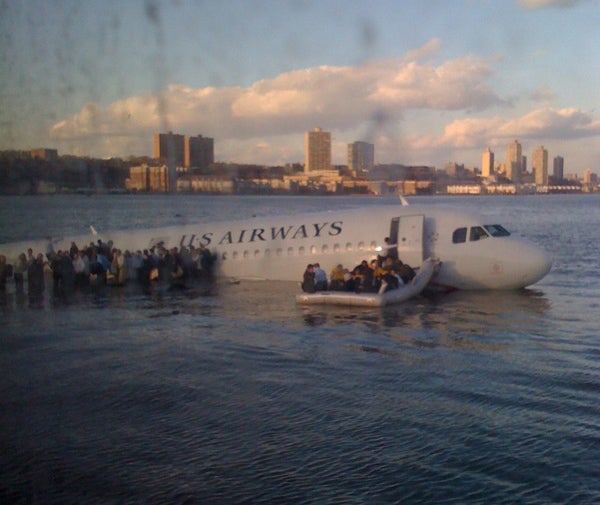
US Airways Flight 1549 natekoechley (CC Licensed)

Today US Airways flight 1549 made an unexpected stop: the Hudson River. After a troubled take off around 3:30PM, the Airbus A320 descended into the river on the west side of Manhattan. Local ferry operators immediately began to throw life vests into the water and pick up passengers, with the Coast Guard Cutter Ridley and NYPD arriving shortly there after. All 148 passengers, as well as the 5 crew members, are all alive and accounted for. An FAA report said that a flock of geese likely caused the crash.

One passenger, interviewed on WNBC television, said he saw the left engine blew out, and current reports say both engines went out. The pilot attempted to return the plane to LaGuardia, but the birds damaged the engines too severely. As the plane descended into the icy river, the pilot then guided it into a hard landing on the water. The passengers rapidly evacuated in a fashion described by the interviewed passenger as "kind of orderly." After waiting on the wings of the plane in the freezing cold while the aircraft sank into the river, police, fire and Coast Guard units rescued the passengers.

This is not the first time a bird strike has caused the crash of an airliner in New York: In 1995 alone, geese brought down two planes. Both were in the process of landing, and would eventually be repaired and returned to service. In fact, the threat of bird strike is such a worry for New York area airports that JFK even employs falcons to clear the airspace of potentially dangerous birds. But with the number of geese on the rise—between 1990 and 2000, the population tripled—prevention can only go so far.

The FAA requires all engines to be tested against bird strike, a process that involves throwing actual birds into running engines. While an engine can often withstand the strike of a single small bird, a flock of large birds like geese are more than enough to bring down even the largest aircraft.

CNN.com is streaming live footage of the crash, for further updates.

Want to read more articles on the military, aviation, and space? Subscribe to Popular Science and enter to win $5,000!

25 Comments

Man that must have been scary. And to think of all the people who get annoyed if the flight they're on isn't playing the latest James Bond movie or whatever. At least they don't have to swim to their destination.

Would a falcon actually take on a goose? or are they just to scare them away?

DarkFx

from Winnipeg, Manitoba

Don't Airbus's come with a Horn? Mabye that would be something to consider... Or even a Grate over the turbine intake? Hell, how about a laser and cook the birds before they destroy the plane... j.k...

Really though a Horn would work right?

These planes should have a built in artilary unit(unlike the air force ones) which would actually fire bullets in such situations to avoid collisions!

With bad news almost on a daily basis, it is very heartwarming that a disaster was avoided, all passengers and crew were saved and that we have a new National hero.

Ironically, only six hours earlier, American Technology Corporation announced the sale of its' directed sound acoustic device aka LRAD to DeTect Corp. which is the world leader in development of systems for aircraft bird strike avoidance. Perhaps some day with the use of sound equipment, disasters like this can be avoided.

Congrats to the flight crew for bringing in a wounded plane safely. Water landings are not the easiest thing in the world with and airplane that has engines under the wing.

Congrats to the cabin crew for getting everyone evacuated safely and in semi order as described. This is also a tough task with human nature in an emergency.

Congrats to the crews of the boats that sprung right into action. No doubt their quick response also saved lives, as it does not take long in cold water to succumb to hypothermia.

The entire crew did everything right it seems in this case and need to be congratulated for a job well done in a bad situation.

The old aviation proverb:
Any landing you can walk away from is a good landing, if you can use the plane again it is a great landing.

By definition, still a good landing!

I am happy all walked away. Good job to all involved.

This story hits home for me because I fly every Monday and every Friday for work. As some have already mentioned, it's good to hear a story with a happy ending these days. The flight crew did an outstanding job and this is proof of the importance of continuing training. I know I will be listening a little closer to the pre-flight briefing this afternoon as I prepare to fly home for the weekend.

Echoing DarkFx's comment,mounting a grate in front of the engine intakes might help chop any birds encountered into chunks small enough for the engines to digest without damage.If they were retractable,so much the better-they could be deployed at take-off and landing,and retracted when radar shows clear skies ahead.

They should try painting a aircraft to look like a Gigantic Falcon.... I'm sure the geese would be moving out of the way then!!!

The problem is that most US airport do little or incomplete bird and wildlife control compared to Canadian and European airports. JFK uses falcons ... that's about it! They like most US airport do too little and rely on only 1 or 2 control techniques to which the bird habituate. The US is also behind the times in use of advanced bird detection and tracking radars like those used by the USAF, NASA and foreign airports.

I wonder if it's possible to deflect birds using a high-pressure blast of air.The trigger would be an optical sensor inline with the engine intakes,which would trigger the release of air.Either that,or a fast acting flap to come down to mechanically deflect the sensed object away from the engine intake.

Zengrath, better try instead painting all Airbuses as Boeings. Apparently geese don't down Boeings (or Douglas or whatever).

(I have worked years in French civil aviation - e.g. headed Paris Airport operations)

Versailles, Fri 16 Jan 2009 20:12:00 +0100

Newbeak, both of those ideas wouldn't work. You couldn't blast air forward on a moving plane ( at least not enough to push a goose)and you certainly couldn't push a flap down in front of the engine. Have you ever even been on a plane? you know that they go a lot faster than it seems. It just looks like you're going slow because of the altitude

I don't think Ive ever had to explain that to anyone before...

njdevil,I would like to clarify my previous comment.I propose a compressed air blast at 90 degs up or down 10 or 15 feet in front of the engine intake.The idea is to deflect the bird enough to miss the intake.My flap device would be positioned ahead of the engine as with the air blast idea,and consist of an open grate in the shape of an airfoil,which when tilted down about 45 degs would cover the approach to the engine intake.If the bird hit my device,it would be shredded and deflected downwards,most if not all of it missing the intake.

but 90 degrees down 10 feet in front of the engine intake means you would have to stick a 10 foot long pipe coming out of the side of the plane or the middle of the wing. That would probably break/bend a lot from wind resistance first of all. And I don't believe you could detect a bird in enough time to blast nearly enough air. back to my 'planes are really fast' statement before. The time between a bird being anywhere near the plane and charred bird dust coming out the back of the engine is a split second.

a 45 degree grate would maybe work, but you still couldn't get it up on time. and if the force of birds hitting the grate plus wind resistance > the strength of the grate, you no longer have a goose in the engine, you have a large chunk of metal.

I think very little can be done to prevent bird strike on jet engines. Well, grates may be able to break up larger birds into smaller pieces, but you still have the same amount of solids being digested through the blades and the engine itself. Furthermore, the engine's suction is so great that anything near the intakes, even if it isn't in their direct path, will be sucked in. On take-off, with the engines at full throttle, a whole flock of birds will go through the engines. I watched videos and was stunned about the tremendous area of vacuum a jet engine creates. In one of those I saw a worker UNDERNEATH a much smaller running jet engine being sucked up. Luckily he got stuck at the intake rim and survived.
But back to the birds: I think once a jet engine encounters a large flock it doesn't matter whether or not it was broken up before. The split-second of the digestion would just break the blades on impact.

I saw a few good sugestions e.g. installing a grille in front of the engine or something but the problem is that will decrease the amount of thrust produced in the engines. This is not good in times of problems like lack of fuel or something. Placing artillery is just really stupid. I agree with bashpurt. US airports are taking everything too easy and their attitude is "Who cares. There is a low chance of it happening." I think they should install radars, even though there is a chance of the radar missing it, it can save some lives.

I saw a few good sugestions e.g. installing a grille in front of the engine or something but the problem is that will decrease the amount of thrust produced in the engines. This is not good in times of problems like lack of fuel or something. Placing artillery is just really stupid. I agree with bashpurt. US airports are taking everything too easy and their attitude is "Who cares. There is a low chance of it happening." I think they should install radars, even though there is a chance of the radar missing it, it can save some lives.

Some of these ideas or comments are good! Maybe some should be taken into concideration, but remember one thing the world of being a pilot isn't dramatic and , certainly not slow paced at times. When your taking off in a commercial airliner you have check lists to perform ,and yet at the same time fly the aircraft ! At the speed the aircraft is traveling ,by the time you see the birds there already there . Putting grades or screens in front of the intakes of the engine wont work, simply because it just shreds the bird into smaller pieces,and what makes it in the engine still does damage. opening and closing doors in front of the intakes of the engines wont work because that would simply choke the engine because of lack of air. If your choking ,your loosing air. That's the same principal. Blasts of air in front of the engines simply will not work because the engines will just suck the air in. Bird strikes are just a blatent reality of flying. Believe it or not Airports can only do so much ,because of animal rights groups ,and others associated . Laws even make it hard to controle wild life. As for the pilot who flew the Airbus A320 , hats off to you from a fellow pilot . 3 seconds at 220 knots isn't much time to react!

Northwest Airlines A320 Pilot
Cecil Watkins

congratulation to the pilot of doing a very good job. God Bless America...

__________________
http://kasikas.com

Kudos to the pilot and crew and the First responders. The plane could have crashed into a building full of people and hundreds more if not thousands die as a result. I spent over 15 years as a Air Force Jet Engine Mechanic. Foriegn Object Damage (FOD) accounts for billions of dollars worth of wear and tear on Turbine Engines. FOD can be Ice, or a bird, or a mechanics tools, sand, even people get injested by Jet Engines. Working on an engine thats taken a bird strike isn't plesent (kind of like working on a cadaver or road kill). Engineering Aircraft with intakes high off the ground does help prevent FOD from being sucked up off the ground and into the engine. The Russian aircraft engineers seem better at that than Americans. The American answer is to have several hundred men walk the length of the runway, shoulder to shoulder picking up every little piece of rock, stone, nuts, etc from the Tarmac. That practice works in peacetime in the USA and gives the troops some excercise, but is only an invite to snipers in a war zone environment.
Birds are a problem and geese can get you at altitudes over twenty thousand feet, although it's rare. As dangerous to engines a large bird can also punch through the canopy or windshield of the cockpit, and that has injured a few piolets as well. Some airports have automatic air blast cannons that shound like gunshots, that go off on a programmed schedule to scare off birds. Even the way the grass is cut on the fields adjacent the runways can make a difference in deer being on the runway. Every Air Force Mechanic regardless of his specialty who works on the flight line is required to wear a small pouch on his belt, and it's marked FOD. It's for the collection of debries found around jets. Every vehicle on the flight line has a FOD container. It was an annual requirement that every mechanic recieved one hour training per year on FOD. It's such an intergral part of aviation, each base has an officer (Usually the second in command) designated as the FOD control officer. Regulations had it for a while that the FOD control officer go out on the flightline one a week and ask not less than 3 individuals if they knew what FOD was. This affirmitive action overkill often led to enlisted people who, (while standing within site of FOD written on 5 or 6 objects in plain view printed with FOD) to answer the question with F--K OFF Day, or worse. Kind of like "UNLEADED GAS ONLY". Federal law requires it written on your gas gage, the filler cap, the gas pump, the price sign, and at the signs on the underground storage tanks. We spend millions in writing unleaded only, when there hasn't been unleaded gas sold in North America for almost a generation. But I digress. Anything which obstructs or changes the airflow going into a jet engine suddenly, may cause a compressor surge or stall in which the normal functioning of the compressor and the resulting pressures it generates to stop. This in turn stops the burning of fuel and the infamous "Flame-out" of a jet engine. Most times a flame out or compressor stall in no big deal, and the engine can be restarted within a minute or two. But,,,,when you are in the process of taking off, or landing a plane, sudden engine power loss, spells sudden aircraft loss because you don't have a minute or two. General Electric manufactured engines usually use variable inlet guide vanes to alter airflow and reduce compressor stalls. Pratt & Whitney designed Axial flow turbo-jet and turo-fan jet engines are generally engineered with a bleed control valve located near the diffuser case, which bleeds off 10th to 13th stage compressed air when a compressor stall is indicated by pressure monitors that monitor ram air pressure, comressed air at various stages including differintial air pressures. In short there is lots of devices and science employed already, not to mention considerable human based programs in place to prevent these giant vacume drawing jet engines from sucking up ANYTHING loose in the intake vicinity that might cause a failure. Todays installment of the ever-continuing saga of "as the turbine turns" or Jet Engines 101, end with a cliche known to most Jet Mechanics, "They Sucks, They Blows, They Go's.

Syberscriber! well said. every thing this gentleman has said is true to this day. By the way i withdraw my comment about animal rights groups, and laws making it hard to controle wildlife. Everyone is entitled to there opinion, and beliefs. The fact of the matter is that the airlines of today have alot to keep in mind. Public opinion can kill a business, and so can lack of funds. The wild life will always be there . The problem is doing it within the laws and keeping the public happy. Many things are being done, tryed to deter wildlife in the vacinity of the airport. The problem is that wildlife has a mind of it's own just like we do. I remember standing and watching a MD80 do a go around simply because the same animal, that was scared off came back 5 minutes later. Lets just say that deer wanted that grass really bad! I've stood near a boarding gate and watched airport personell run down the center of the main runway trying to chase geese away that only took off and turned around and landed 100 yrds from where the were before they were chased! The airlines and airports do alot, but when it happens in the air theres little to nothing that ya can do!

Since this is an old story, hope someone still reads my comment. I have three suggestions to avoid this problem.

1 Use a Horn - One could use a normal loud horn or better still use a high frequency one like the "mosquito" which is only heard by young people, I am sure we can find a sound which can be heard by birds, this could be activated by the pilot if he sees birds or better still be activated by some kind of sensor, or the high frequency sound could be kept on permanently thus distracting the birds.

2 Use a Taser, a ring of tasers could be built into the front rim of the engine, the mode of activation could be the same.

3 I read somewhere that when aircrafts were first used in war, the propellers were being hit by bullets untill they did something to the timing and the angle thus deflecting the bullets, I am no scientist but could somebody research that.

I am not a cocky guy, so I think that my above suggestions have probably been thought of and found unworkable for some reason, if not, hey, we have a solution.. Eureka.
Thanks for reading.

magilllagorillla
In earlier times, certain military planes were equipped with "JATO" units, which were single-use-only Jet Assist Take Off rockets. While having such a back-up tool on-board an airliner could help in some situations; as they were configured, they wouldn't provide enough power for a return to the same airport. This is probably why they aren't considered for use now. Nearly all bird-stricken planes only lose one engine and could return to the same airport anyhow, which makes the "JATO" unit redundant. HOWEVER-- maybe a more in-depth rethinking of how an application-specific "JATO" unit may address this issue is now in order. Consider that a plane taking off has no shortage of fuel on board, and that such an engine would be allowed to burn itself into oblivion providing relatively tremendous output for this one time use, and that using jet fuel could provide for control that the "JATO" units did not have.

magilllagorillla
In earlier times, certain military planes were equipped with "JATO" units, which were single-use-only Jet Assist Take Off rockets. While having such a back-up tool on-board an airliner could help in some situations; as they were configured, they wouldn't provide enough power for a return to the same airport. This is probably why they aren't considered for use now. Nearly all bird-stricken planes only lose one engine and could return to the same airport anyhow, which makes the "JATO" unit redundant. HOWEVER-- maybe a more in-depth rethinking of how an application-specific "JATO" unit may address this issue is now in order. Consider that a plane taking off has no shortage of fuel on board, and that such an engine would be allowed to burn itself into oblivion providing relatively tremendous output for this one time use, and that using jet fuel could provide for control that the "JATO" units did not have.

I have been told that the Airbus computer software does not allow the pilot to override an automatic shutdown of engines damaged by a bird strike, unlike Boeing which has no such system. This would explain why Sully and his first officer were unable to restart their damaged engines. Can anyone confirm if this is an accurate assessment of the difference in these two systems?

I am neither a pilot nor a Boeing shareholder.


Download Our iPhone App

Stay up to date on the latest news of the future of science and technology from your iPhone with full articles, images and offline viewing


Follow Us On Twitter

Featuring every article from the magazine and website, plus links from around the Web. Also see our PopSci DIY feed


Become a Fan On Facebook

Share links with friends, comment on stories and more


December 2009: Best of What's New

In our December issue, Popular Science names the 100 best innovations of the year: bombproof wallpaper, self-parking cars, the fastest helicopter, and 97 more. Plus inventor profiles and videos.

Check out the best of what's new here.

Popular Science Photo Pool


Share your photos in the Pop Sci pool at www.flickr.com!
tags_sprite.png
POP_embeddedForm_cover_May09.jpg