Bytes in the Air

Popular Science test-drives Internet service on a passenger plane
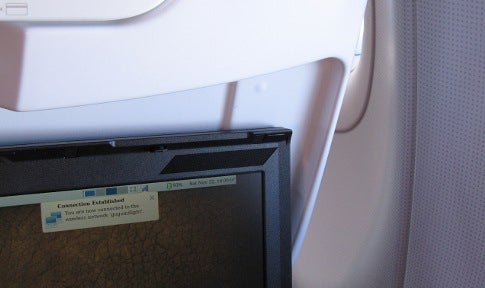
Gogo Inflight Wireless: Paul Adams

As I post this, I am thousands of feet above San Francisco, on a Virgin airplane, surrounded by press and partygoers celebrating Virgin's imminent roll-out of wireless internet to their passengers.

The in-flight service is provided by a carrier called Aircell, which spectrum geeks may recall won an exclusive ten-year contract from the FCC in 2006 to provide air-to-ground broadband at 3MHz. Onboard, a standard 802.11 wi-fi network works with all standard devices.

Aircell's service, called Gogo, has already been rolled out on American Airlines, and seems likely to become a for-pay feature on a majority of airlines. It uses a trio of antennas mounted on the outside of the plane to send an EV-DO signal to the ground, where it is handled by a dedicated network of 92 cell towers, distributed throughout the U.S. Everyone on the plane shares 3.1 Mbps of bandwidth, which suffices for most low-impact purposes.

Email, web, IM, PPX, all your favorite Internet applications are available; all but one. Use of the service for Voice over IP applications like Skype is blocked with a proprietary technology, in part because they would monopolize the shared bandwidth, and in part, according to Aircell spokesman Joseph Gavin, as "a reaction to widespread passenger aversion to the idea of many people talking loudly on flights."

American Airlines charges a fee of $12.95 per person. Virgin will offer the service for free during a beta period that starts Monday, then for a price that is yet to be determined.

In theory, it's a bit of a novelty. Out the window, the foggy Bay Area; on my screen, the latest science news and an email from my catsitter (everything's fine). In practice, my wireless connection keeps dropping, and the speed varies from decent to painful.

I can imagine getting some work done on a plane, if the connection were solid. I might even choose a wireless-enabled airline over another in the future, if I had a deadline to meet. (Conversely, I can see myself opting sometimes for a nice Internet-free flight. Connectivity-free zones are becoming harder and harder to find.)

Now if only they provided power outlets.

Edited to add: Virgin's rep wrote me today to say "I wanted to let you know (and we should have pointed it out to you on the flight!), but we actually do have standard power outlets at every seat (underneath the seat)."

Want to read more articles on the military, aviation, and space? Subscribe to Popular Science and enter to win $5,000!

9 Comments

thousands of miles...that's quite a feat! (thousands of feet??)

ya i think thats what he meant.

To have the ability to text my wife the status of my flight or just to chat with my daughter from the plane would be fun. I fly EVERY week, on Monday away from home and on Friday back home. So, for me staying connected to my family is important. And if I just want to relax, as much as you can on an airplane with Jabba the Hut sitting next to you, I know where the ON/OFF button is on my iPhone. Paying for it, though? That's so 90's.

Yes, I meant thousands of feet. Thanks for noticing. Airplane parties are not the most conducive environments for writing.

Wireless Internet - from the ground received by the plane? Does this mean that it is only available for flights within the US only?

How about for international flights wherein you have to cross thousands of miles of ocean or sea? Maybe something better like make use of a communications satellite? As far as I know most satellites have a huge footprint which can cover alot of space and the bandwidth problem could somewhat be solved by this.

Just some of my crazy ideas... anyways

kingz1991

from Orono, Ontario

This wireless internet that the airlines are providing is only their first attempt. I bet within a year or two that they will have way faster speeds, and will probably be doing it via satellite, as suggested previously, once they see that people are really into it.

3.1Mbps seems pretty slow, that's like the same speed that I have at home. If they tried sharing that kind of speed between like 100 people they wouldn't be able to do much else than just read email. Maybe with better speeds more people will use this, I don't see it being very useful right now.

I have only flowen once (ottawa to newfoundland). But if I was a frequent flyer this would be very helpful. I think with what plane tikits cost the internet should be free.

To Chipper Smoltz:
Aircell Axxess is only available in US, expanding to Canada/Mexico soon. See their website: http://www.aircell.com/index.php?Itemid=368&L3=business&id=24&option=com
_content&task=view

The system is also used on business aviation planes operating in U.S.

For international flights, Satcom Direct system is utilized, either through Inmarsat (http://www.satcomdirect.com/main/aviation_inmarsat.asp) or Iridium (http://www.satcomdirect.com/main/aviation_iridium.asp) satellite clusters. Both currently have bandwidth comparable to Aircell's, but are significantly more expensive.

Both Inmarsat and Iridium are currently expanding their clusters to cover more terrain (they don't work above certain latitude - there's no satellites in polar orbit), and to be able to provide high speed broadband. That capability is not available yet.

As for quality, keep in mind the difficulties of bouncing signals from a moving source (airplane) to a moving relay (satellite), both of which are effectively in different orbits around a curved moving target (Earth). Also recall that an air phone was a novelty 15 years ago.

Satcom systems are pretty well established on BizJets which fly under FAR Part 91 or Part 135. Commercial aviation, covered under FAR Parts 119, 121, and 125, has different operating and certification requirements. It will take some time for the FAA to amend the rules to accept the technology, but once demand appears service providers should improve the quality.

Paul:

You may enjoy this video:

http://www.youtube.com/watch?v=vbIGbZ6gq_Y

Popular Science Photo Pool


Share your photos in the Pop Sci pool at www.flickr.com!

Subscribe for 2 free issues!

POP_embeddedForm_cover_May09.jpg