All Aboard the AeroTrain

A vertical-takeoff concept commercial plane could get you in the air faster
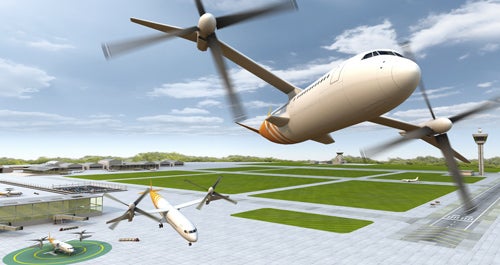
In this age of eternal flight delays, traveling from New York to Miami in the scheduled three hours sounds like a fantasy. Yet within a decade, aircraft designer Abe Karem plans to fix that by bypassing congested runways in his tilt-rotor, vertical-takeoff commercial plane, the AeroTrain. Sitting on a helipad with its twin rotors tilted straight up, the craft can take off vertically and fly like a helicopter. Once the plane has reached a safe altitude of 50 feet, the pilot will tilt the rotors forward and fly the craft like an airplane.

But, you ask, didn’t the military’s tilt-rotor Osprey V-22 claim the lives of 30 people during test flights? Karem, who specializes in designing tilt-rotor aircraft, says he’s learned from those early failures. The AeroTrain adopts the military’s warning system for altitude-stealing turbulence conditions and replaces easily shredded hydraulic control lines with electric motors. And it will use computer software that prevents the pilot from flying into turbulence when landing. “It’s a different animal than the V-22,” says Daniel Schrage, director of the Army Center of Excellence for Rotocraft Technology at Georgia Tech.

Although the 120-passenger plane’s top speed of 410 mph is 20 percent slower than a similar-size Boeing 737, Karem explains that time saved on the ground will make up for that lost in the air, especially on shorter flights. “Two hundred to 1,000 miles, that’s our niche,” he says. Karem aims to have the AeroTrain in production before 2018. Until then, if you’re flying out of a busy airport, you might want to pack a sleeping bag.
Ready for Lift Off: Enlarge this image by clicking, here.  John MacNeil

Want to read more articles on the military, aviation, and space? Subscribe to Popular Science and enter to win $5,000!

13 Comments

This sounds all very nice and I hope the AeroTrain does make it to production, but right now it all sounds a bit like those PS and PM covers from the 60's; personal jetpacks, flying cars in every garage, basement reactors and hotels on the moon. Aviation history (and the covers of magazines) is littered with the abandoned fuselages of aircraft that seemed like a good idea at the time. I like the basic premise of the AeroTrain but it will have to prove itself better than what we have at the present, or find itself at best restricted to niche markets. There are significant economic and safety advantages to conventional take off and landing (CTOL) that VTOL may never be able to compete against, just as land planes eventually triumphed over seaplanes. I do agree that in certain niche markets, like the crowded New York - Miami corridor mentioned in the article, planes like the AeroTrain may be the answer, although here are other ways to solve the same problem of getting to point A and B. Examples would be high-speed rail and better airport design and air traffic control.

I think its a great idea, and like the person above me i hope it does succeed, but the thing is, there are already vtol crafts being made, and while previous aircrafts have killed people, those mistakes should be very much so re-evaluated and fixed, and steps are made towards a better craft. I really would like to see this come into play, now just make it have better fuel efficiency and economy than airplanes, and we're set :)

All of this sounds a bit flawed really. Delays seem to be related to how long it takes to load / unload the planes - vertical take-off doesn't really impact that.
There might be some benefit in reducing the footprint of an airport because there's no need for a runway - that doesn't really work either though, because the plane can't land vertically.
Back to the drawing board I think...

To make this truly practical they need to undo all this security theater TSA BS Bush left as it causes most of the of delays today and makes flying commercial an unpleasant experience.

I'm an aeronautical Engineer by trade, in the rotary wing business. A couple of comments:

The replacement of hydraulics with electric motors is probably in response to the V-22 lost when a hydraulic failure poured hydraulic fluid into the engine nacelle of the aircraft. A man I'd done some work with over the years died in that accident. Electric motors will remove the flammable fluid, but will be no less vulnerable to failure - you still have to have wiring to get power and control commands to the motors, and those are just as subject to damage as hydraulic lines.

The hover rotor speed is no big secret. Any rotorcraft does this about the same way - calculate the drag-rise mach number for the blade (propeller) tips under the range of operating conditions, and keep the tip a certain percentage under that number. If you choose any higher tip speed, you lose efficiency to drag rise. Any lower, and you're not getting all the lift available from the rotor. It's this hover condition that sizes the rotor, not the tilted-forward, level-flight condition.

Dan Schrage is one of the most respected minds in this business. If he's onboard, the concept is worth listening to.

Some things keep coming up. When I was at NASA HQ in the late 1980s we had a major tilt rotor initiative with the FAA and made the commercial tilt rotor pitch to Congress, including a tilt rotor forum on capital hill. The ideas were good then and still are. Maybe with two plus decades of tilt rotor experience it'll stand a better chance.

The software that prevents a pilot from landing in turbulence must be in reference to a condition known as "settling with power" or basically when a rotorcraft gets caught in it's own downwash and descends rapidly. As a helicopter pilot myself I know how touchy those controls can be, If the program was to prevent this condition it would need to keep the forward speed of the rotorcraft at a minimum level to eliminate this effect, or prevent the automatic panic reaction to losing lift which is lifting collective pitch and worsening the condition. If a computer were to make snap decisions about altering flight characteristics during the landing and transition to hover phase it could potentially cause more problems than it would solve. Such a program would have to be carefully written indeed.

to geclinke VTOL can make a difference in that the aircraft do not have to wait in line to enter circuit patterns and also wait for wake turbulence to dissipate. Another advantage is that aircraft can always take off or land into the wind and avoid dangerous crosswind conditions.

With regard to delays loading/unloading, I think Southwest figured out how to do it efficiently. Also, I like how the Dreamliner overhead bin space allows your carryon to slide in on it's side eliminating the "make it fit in the overhead scurry."

ROTARY WING: BEATING THE WIND INTO SUBMISSION.
I KNOW THIS IS A GREATLY VIABLE CONCEPT. WE WILL SURELY SET THIS TO FLY BY WIRE, AND IT WILL WORK WITH FURTHER TRIAL AND ERROR. ROD

What would happen if some large object were to fly into the rotors.... lets say a bird? Could that be a problem?

The V-22 flies over my house all the time. It is the noisiest aircraft I have ever heard. Windows that are open will vibrate in unison to the closed position. Dishes will walk across the table. Walls shudder with the beating of the rotors. The pressure waves from the rotors will cause your clothes to contract and expand on your body even if you are inside. It is spooky to be near large pieces of glass when it flies over. It is far more noisier than even a large helicopter. The tilt rotor noise problem has to be dealt with before it becomes a civilian craft.

Really...... how?

Is it like the article, SHOCK TO THE SYSTEM.

Where blast waves from explosions can cause brain trauma?

Yeesh this world is full of danger...

-THE KID

Popular Science Photo Pool


Share your photos in the Pop Sci pool at www.flickr.com!

Subscribe for 2 free issues!

POP_embeddedForm_cover_May09.jpg