Breaking Open the Unknown Universe
The most powerful and complex science experiment in the history of the universe is finally—after 14 years and $10 billion—about to begin. There’s no telling what it may find, and that’s entirely the point
The proton is a persistent thing. The first one crystallized out of the universe’s chaotic froth just 0.00001 of a second after the big bang, when existence was squeezed into a space about the size of the solar system. The rest quickly followed. Protons for the most part have survived unchanged through the intervening 13.8 billion years—joining with electrons to make hydrogen gas, fusing in stars to form the heavier elements, but all the while remaining protons. And they will continue to remain protons for billions of years to come. All, that is, except the unlucky few that wait in a tank of hydrogen gas 300 feet beneath the small Swiss town of Meyrin, a few miles north of the Geneva airport. Those—those are in trouble.
By the time you read this, a strong electric field will have begun to strip the electrons away from the protons in that hydrogen gas. Radio waves will push the protons, naked and charged, forward, accelerating them through the first of what can reasonably be called the most impressive series of tubes in the known universe (Internet be damned, Senator Stevens). The tubes in this Large Hadron Collider (LHC) have one purpose: Pump ever more energy into these protons, push them hard against Einstein’s insurmountable cosmic speed limit
c
.
And then, the sudden stop. Head-on, a single proton will meet a single proton in the center of a cage of 27 million pounds of silicon and superconducting coils of niobium and titanium. And it will cease to be. These protons will collide with such tremendous energy, so much focused power, that they will transmute. They will metamorphose into muons and neutrinos and photons. All of that, for our purposes, is junk. But about once in a trillion collisions—no one knows for sure—they should turn into something we have never before observed. These protons, these nanoscopic specks of matter that together bear the energy of a high-speed train, will reach out into the hypothetical and bring a little bit of it back.
We have some good guesses about what they will become. They could turn into a missing particle called the Higgs boson—thus completing, through actual observation, the Standard Model of the universe, which describes everything yet known. Or they might vanish into dark matter, and so satisfy the demands of the astronomers who have for decades observed that the universe is suffused with mass of unknown origin and composition. Or—and this is what everyone is really hoping for—these transmuting protons will defy our imagination. They will show us the unexpected, the unanticipated, the (temporarily) unintelligible. The humble proton, just maybe, will surprise us.
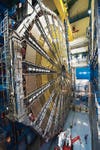
Blank Fate: Think of the 15-million-pound Atlas detector as a giant camera that can take pictures of dark matter
Down the Rabbit Hole
“They turned on the retinal scanners yesterday,” warns Steve Goldfarb, a particle physicist at the European Organization for Nuclear Research (CERN, by its French acronym), the home of the LHC. “I hope this will work.” He steps into the security lock, and the green phone-booth doors slide shut behind him. A wall-mounted scanner matches the pattern of blood vessels in the back of his eyeball against the database of those allowed entry. The system ensures that every person is tracked, that mission control knows exactly who goes down into the tunnels. In a month, trips down will be rare. In a month, the beam will be on.
Access granted. We wait at the elevator with stocky contractors in T-shirts and dirty work pants—murmurs in Polish and French, wary looks at the reporter’s notepad, the red hard hat reserved for visitors—then climb in, and hit the button for floor –1. We are going to Atlas. The detector. The center. The collective work of tens of thousands of physicist-years, which is still, it quickly becomes apparent as we emerge through the concrete corridor and hear the first sharp pings of hammers on steel that echo throughout the chamber, not quite finished.
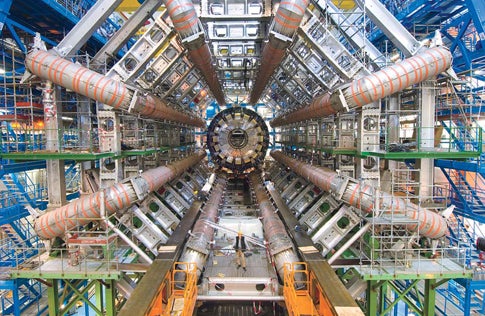
Though it’s often compared to the interior of Notre Dame cathedral, the chamber looks less like a gothic sanctuary than it does the phaser room on the Starship Enterprise. There’s an 80-foot high, 15-million-pound rolling pin of silicon and steel parked in the center, and it looks ready to fire. Except down here, the firing happens in reverse. In a month, once liquid helium cools the magnets down to 1.9 degrees Kelvin above absolute zero (that’s –456°F), beams of near-light-speed protons will race not out, but in, meeting in the detector’s center. (There is another equally sensitive detector, CMS, five miles away across the French countryside. The two groups will double-check each other’s work and provide a bit of friendly rivalry as to who can discover what first.) The collision will concentrate all that speeding energy in an infinitesimally small space. And then that ball of pure energy will become something else entirely. “By Einstein’s
E = m2
, you can make particles whose mass is less than the amount of energy you have available,” says Martinus Veltman, a physics professor at Utrecht University in the Netherlands and a Nobel laureate. Energy becomes mass. This, in a nutshell, is why the protons need to go so fast—with more energy, the LHC can summon ever-heavier particles out of the ether. And the heavier particles are the interesting ones. The heavy ones are new.

Light Reading: Astronomers can make dark matter by tracking how it distorts the light from distant galaxies
Darkness Doubles Down
Here’s what we know about what the universe is made of: We have the ordinary, common matter, like protons and electrons. In addition, there’s all the stuff that transmits a force, like photons of light, or gravitons, which pull heavy objects together. That’s the universe—matter and force—and physicists have spent the past 60 years or so uncovering the details of how all the matter particles and the force particles interact. The totality of that work is called the Standard Model of particle physics, and any particle physicist will tell you that it is the most successful theory in the history of human existence, powerful enough to predict the results of experiments down to one part in a trillion.
And yet the Standard Model is almost certainly not the whole picture. While particle physicists have been busy constructing the Standard Model, astronomers and cosmologists have been working on another task, a giant cosmic accounting project. What they see—or, more precisely, don’t—is a clear sign that there are far more things in heaven and earth than are dreamt of by the Ph.D.s.
If you go out and count up all the stars and galaxies and supernovae and the like, you should get an estimate of how much total mass there is in the universe. But if you estimate the mass another way—say, by looking at how quickly galaxies rotate (the more mass in a galaxy, the faster it spins) or by noting how galaxies clump together in large groups—you will conclude that the universe has much more mass than we can see. About five times as much, by the latest reckoning. Since it can’t be seen, we call it dark matter.
Here’s the problem: These unknown dark-matter particles—there’s no column in the Standard Model for them. Another problem is that not even the people who came up with it think the Standard Model is the whole story. “The theory raises so many new questions,” says David Gross, who won a Nobel Prize in 2004 for his work on the Standard Model, “that we are convinced it must be incomplete in some way.” Sure, the model correctly predicts the outcome of experiments. But it is not, in the deep way that physicists want it to be, pretty.
To make the Standard Model work, there needs to be much fine-tuning, a dirty word to physicists because it implies arbitrarily tweaking lots of little variables in order to make everything come out right. Much better, physicists would argue, to have everything balance out naturally. As Dan Hooper, a physicist at Fermi National Accelerator Laboratory in Illinois, concludes in his new book Nature’s Blueprint, “The Standard Model as we understand it is ultimately unstable and is in desperate need of a new mechanism to prevent it from falling apart.”
Enter supersymmetry, one helluva “mechanism.” Supersymmetry posits that every particle is only half the story—that every particle has a hidden twin. Remember how the universe is split into matter and force? The core idea of supersymmetry is that every matter particle has a twin force-carrying particle. Same goes the other way: Every force particle has a twin made of matter. Matter and force, in one sense, are just two manifestations of the same thing.
How does this work in practice? Electrons give rise to selectrons (as in, supersymmetric electrons), and photons beget photinos (don’t ask). The extra particles, each heavier than its twin, automatically balance out the Standard Model, no fine-tuning needed. But perhaps more important, these particles, were they to exist, could very well be the hitherto invisible dark matter. The universe swarms with squarks, winos and neutralinos, and these supersymmetric particles are just heavy enough and just common enough to outweigh the “normal” stuff by a factor of five to one. Cosmology, meet particle physics.
Of course, for this to make any sense, the LHC first needs to find a supersymmetric particle. And here’s the catch: Even if the LHC makes a supersymmetric particle—two protons come together with enough energy to make, say, a neutralino—that particle will still be invisible. It will pass through the walls of the detector and down into Earth’s crust and back out into space. Invisible means it doesn’t interact with ordinary matter, and ordinary matter is the only thing we can build detectors out of.
So what happens? How can we tell? Well, we look very closely. When two protons come together, they will generate a shower of particles. Most of them will be ordinary particles, and the detectors will catch these. Then the scientists will look for what’s missing. “It’s a bit like the Sherlock Holmes story where the most important clue is the dog that doesn’t bark,” says John Ellis, a theorist at CERN. If lots of stuff comes out going one way, there has to be an equal amount of stuff going the other way—it’s just the law of conservation of momentum. Count up what you have, subtract that from what you started with, and voilà, you could find yourself with a fleeting glimpse of dark matter. Or at least, its absence.
Vintage Store: The quickest, cheapest, most reliable way to store all that data? Tape drives, same as in the 1970s
The Data Junkies
Back in the cavern that holds Atlas, physicist/tour guide Steve Goldfarb stands on a gantry 50 feet above the floor and traces in the air an imaginary track of an imaginary particle that has just spawned from a collision. “The whole idea of building such a huge detector,” he says, “is to be able to draw a very precise line.” Tellingly, the line he draws curves across the room.
Both Atlas and CMS generate magnetic fields so intense that “if you drove a bus in here and if you turned on the magnetic field, you would crush the bus,” says Phil Harris, a graduate student at the Massachusetts Institute of Technology who shows me around CMS the following day. (Graduate students are considered the do-it-all grunt workers of any enormous project like this. Harris’s buddy Pieter Everaerts, another MIT grad student, told me that one of their main jobs was to “go down [into the detector] to look for the blinking lights” that may indicate a faulty connection. Harris, for his part, has spent months building a database to keep track of the thousands of cables that carry data up and out of the machine. The LHC: where America’s best and brightest go to label cables.)
Bus-crushing, despite its indisputable awesomeness, is not on the agenda here. Rather, the point of all these superconducting magnets is to make everything curve. When the two protons collide, the shower of debris they create will not, unlike the cables in the detector, come with labels. Harris and Everaerts and the 2,000 other scientists who work on CMS have to figure out what each particle is. Since a magnetic field bends the path of a charged particle, you can measure how much each particle curves and how fast it’s going and deduce its charge and mass. “We need to understand everything,” Harris explains. “Where it was, how much momentum, how much energy.” And do it over and over, for the hundreds of particles that burst from every collision, 600 million times a second.
This, in turn, presents a slight problem with data overload. “We’ll produce about a World Wide Web’s worth of data every day,” says Harris, an excitable 25-year-old who wears his hard hat backward and his pants a good six to eight inches below his waist. Everaerts turns his eyes up, clearly checking the math behind Harris’s boast in his head. “Yes,” he solemnly intones, “though the Web is growing very fast.”
It’s one thing to undertake a massive (but finite) civil-engineering project like the LHC in the space of a decade. It’s quite another to build a new Google every day. “There’s no way that CERN can provide all the computing components,” says Ian Bird, the leader of the LHC Computing Grid. Instead, scientists figured out two ways to get rid of all the excess data.
Fortunately (or not, depending on how you look at it), most of the data the machines collect will be junk. Old news, particles long discovered, phenomena well-explored. Electronics in the detector throw out any collisions that don’t look interesting, which totals about 99.99997 percent of the raw data.
The remaining 200 collisions per second move upstairs to the main computing center, a warehouse with row after row of rack-mounted computers. This is “Tier 0,” in LHC parlance. From here, dedicated fiber-optic cables send a copy of the data to 11 computing centers worldwide, the so-called Tier 1. (The cables comprise the famous “Internet2” you may have heard about a few years ago—all it means is that the scientists get to use these lines, not you.) The Tier 1 computers then calibrate the data and distribute it to hundreds of Tier 2 computing centers. These are individual server farms, the 100,000 PCs spread among universities like Cambridge and Berkeley and Osaka. This is where the eureka moments will happen. By using a distributed system, the collisions underneath a French village can branch out all over the planet to be pored over by 10,000 brains. It is through this structure, just as much as through the magnets or the silicon, that the impossible will be made real.
Model Student: Inside the office of John Ellis, theoretical physicist at CERN. “SUSY” is short for supersymmetry
Know It All
The history of science is one of hubris. We think we have the natural world pretty much figured out, we think that our theories are pretty darn solid—and then someone does an innocent little experiment, and much to everyone’s surprise, reveals the unfathomable. Never have scientists so self-consciously courted the unknown as they are doing with the LHC. No one thinks the Standard Model will end up being the whole story of the universe, despite its innumerable successes in explaining the world. Physicists know there is more out there, just beyond our reach. “I think of things for the experiments to look for,” says John Ellis, “and hope they find something different.”
“I think we all want to know where we came from and how we fit into the world,” says George Smoot, a cosmologist at the University of California at Berkeley and winner of the 2006 Nobel Prize in physics, “but some of us need to know how it all works in great detail.” The 14 years, $10 billion and 10,000 people it took to build the LHC may be taken as simple measures of human curiosity, of how much we’re willing to give to explore where we came from and how we fit into the world. You might wonder why it matters whether supersymmetry is true or not, why it’s important that we find the dark matter. But understanding the universe is power. “Knowing the laws of physics, you know what can be done and what can’t be done,” says Nobel laureate Gerardus ‘t Hooft. “Knowing the laws of physics lets you see the future.”
See all of PopSci’s coverage of the Large Hadron Collider at popsci.com/lhc.
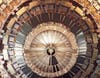
Measuring the God Particle
![The LHC beauty (LHCb) experiment is designed to explain why there is more matter than anti-matter in the universe. To do that, LHCb looks at bottom-quarks—superheavy particles four times the mass of a proton—thrown off in proton collisions. The calorimeter [at right] measures the energy of particles escaping from the collision, which helps determine their identity.](https://www.popsci.com/uploads/2019/03/18/XSMTPS3A7OG2DMVE45ZEVXGY2U.jpg?auto=webp&optimize=high&width=100)
How Heavy is “Heavy”?
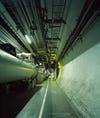
Where the Magic Happens
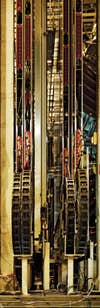
Follow that Particle

Into the Physics Cave
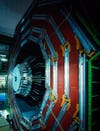
Behind the Scenes WIth the Photographer