Burning the Tide
Alan Burns made a fortune in the oil business. But as oil wanes, he’s convinced that clean energy will be—must be—the next big thing. And so this inventor has poured his fortune into a challenge far greater than finding new oil deposits: extracting energy from the ocean

Alan Burns breaks the surface with a huge grin on his face, his baggy black wetsuit hanging off his body like walrus skin. It’s a scorching February afternoon, and we’re floating in the clear blue water of the Indian Ocean. To our left is the Australian resort island of Rottnest. To our right—just beyond Burns’s dazzling white yacht—is several thousand miles of open sea. And beneath us, the kelp forest where we had been diving moments before is swaying to the rhythm of the waves. “Can you feel the power down there?” Burns asks as we bob in the water, his sunburned cheeks puckered up behind a dripping diving mask. “This is what made me think of it, really.”
Burns is a prodigious inventor and a staunch supporter of clean energy, but he’s no sentimental environmentalist. He’s an oilman. He made his first fortune in the mid-1970s with oil and gas discoveries off Australia’s northwestern coast. In 1987 he founded the exploration company Hardman Resources, which, after an extremely profitable series of finds off the coast of Africa, was sold in 2006 to another oil company for more than $1 billion. Today the 67-year-old entrepreneur is among the wealthiest men in Perth, the tropical, seaside capital of Western Australia. And although he still runs a mineral-exploration company, he spends 90 percent of his time nurturing the wave-power-generation system he first sketched out some 30 years ago.
Burns named his invention CETO, after a Greek sea goddess. For many years, it was a back-burner project for him, a design he worked on along with myriad others, including a puncture-proof industrial tire, a supersonic, steam-driven jet drive, and a shark-repelling wetsuit that’s still in top-secret development. (“I have 500 ideas a day,” he says. “But there’s no point in inventing a pair of stilts for a red ant. It’s got to address a major global problem.”) About 10 years ago, Burns started devoting serious time and resources, including $5 million of his own fortune, to the wave-energy project. Unlike other wave-power systems, it rests on the ocean floor, completely hidden from view. Like the kelp that Burns has dived and fished in for decades, his CETO units are designed to sway slowly and gently in time with the waves. The motion drives a piston that pumps high-pressure seawater to shore and powers a generator to make electricity.

Multimedia Mogul
Burns is one of an increasing number of oil entrepreneurs turned clean-energy advocates who are challenging the idea that there’s some great divide between how the old energy regime is run and how the new one will be. Like T. Boone Pickens, the Texas oilman who is building the world’s largest wind farm in the Texas Panhandle, Burns is confident that the market for renewable energy will be far bigger than the oil industry, and that the developers who overcome the technical hurdles to economical large-scale clean-energy systems will see huge profits. And he’s among those who suspect that the people best equipped to develop those markets and tackle those challenges are not academics or government researchers or young idealists with little real-world business experience. Rather, they’re people like him—people who know how to run a global business with huge inherent risks, serious engineering challenges, and markets that are growing larger by the day. His Perth company, Carnegie Corporation, now has about 40 employees, a power-generating prototype installed just off the coast of the nearby port town of Fremantle—and plans, Burns says, to become the world’s biggest clean-energy company.
FIRST TO THE BOTTOM
Around the world, dozens of wave-energy systems are under development. Some are fastened to vast cliffs at the water’s edge and harness the power of enormous waves pounding against the land. Others are laid across the ocean surface like giant water snakes, sucking in the power from moving surface waves, and still others are more like mechanical buoys that bob up and down in one spot on the water, anchored to the seafloor below. Like many other clean-energy technologies, these designs are slowly moving from prototype to commercial stages. None, so far, have proved themselves to be cost-effective on a large scale. But there are plenty of companies vying to be the first.
On paper, at least, wave power has several advantages over the current leader in renewable power, wind. Water is 800 times as dense as air, so in theory, more power can be produced with smaller farms. There’s more available open space in the ocean than on land, where wind farms are often competing with other development for space. Finally, whereas most wind farms have harvestable wind conditions about half the time, ocean waves never stop their movement toward shore. According to Philip Jennings, the head of the energy-studies department at Perth’s Murdoch University, “wave power has the potential to be as big as, or bigger than, wind power once the technology matures.”
In California last December, the Pacific Gas and Electric Company made the first commitment by an American utility company to buy wave power. The Aquabuoy system will be installed off the coast of Eureka in Northern California and should produce two megawatts by 2012; each megawatt can power about 750 homes. In May, the U.S. Department of Energy announced $7.5 million in federal funding to support the development of other water-power projects in this country, with the money to be distributed by year’s end. Wave power is up and running in Portugal and in Scotland. But worldwide, the industry is still in its infancy compared with wind power, and is riddled with mishaps. Last fall, for example, one of those $2-million Aquabuoys sank off the Oregon coast.
The single biggest problem facing existing wave-power designs is long-term survivability in harsh seas. “The reason we’re not all using wave energy today is because no one’s built something that can stay out there long enough,” says Carnegie’s managing director, Michael Ottaviano. “You can’t have something that’s going to work today and not work tomorrow.”
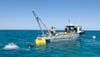
Installation
The ocean’s energy is concentrated at its surface, so every system now in use is designed to work there. Yet being on the surface exposes the systems to the incredible power of the ocean in a storm. The CETO system is explicitly designed to avoid this danger. “Imagine you’re at the beach, swimming in the surf, and a huge wave is crashing toward you,” Ottaviano says. What do you do? Duck down, right? “The best place to be in a storm is under a wave.”
A full-stage CETO wave farm, Burns explains, will be like a piece of chain mail laid down on the bottom of the ocean. Each balloon is attached to the next in a grid-like pattern; if a surge attacks one balloon, the rest will hold it in place. Even in a tsunami, the force would just press the CETO balloons down toward the ocean floor. “What we’ve found in the oil business is that the more we can put on the seabed, the better. Quite a lot of offshore production now isn’t from platforms, but actually on the seabed. It’s safer down there. It doesn’t get raked by the waves.”
Yet a bottom-mounted design has drawbacks. “The problem with getting energy from waves underwater is that most of the energy from waves is at the surface,” says Walt Musial, the head of the ocean renewables program at the U.S. National Renewable Energy Laboratory. “If they’re using the wave energy [from below], they’re going to have to have a fairly low-cost system to be economical.”
That, Burns says, is exactly the idea. He plans to use many of the tricks he’s learned in the oil business to make the system cheap to test, cheap to build, and cheap to operate: “I learned from the oil industry how to run a business on the bottom of the ocean. You apply the same sort of science and surveys [in clean tech]. You do an economic analysis. You’re recruiting top scientists and engineers. The analogue is extremely good.”
Over the course of his career, Burns explains, computer advances have transformed the way engineers search for minerals under the Earth’s crust. Computer modeling has replaced expensive real-world excavation. Now Burns gives his CETO engineers a blank checkbook to upgrade to the latest machines and software every few months. “The first task was to build a virtual ocean, which we’ve done,” Burns says. “It enables us to begin at any depth of water, any current, any wave condition and test the model inside the computer. We’re the only company in the world ever to have achieved that.”
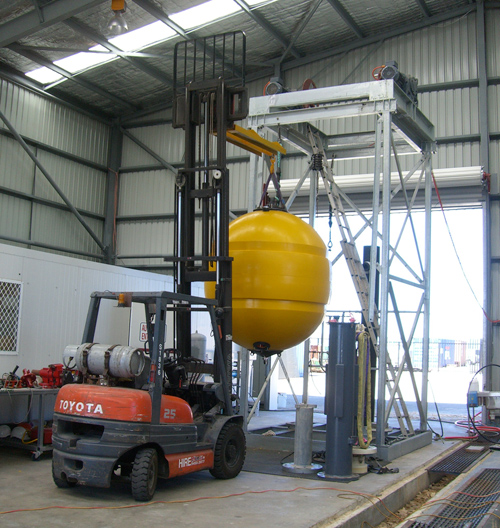
Great Balls of Fire
At Carnegie’s office in West Perth I sit down with Matthew Keys, head of the small team of computer engineers responsible for writing the software to test and tinker with CETO designs. Keys turns on his computer, and a 3-D animation of a yellow CETO balloon swaying in a virtual ocean appears on a white screen that fills the wall on the opposite side of the room, next to a small stack of supercomputers. As Keys moves his mouse, the depth of the water increases, the strength of the swells fluctuates—and the balloon moves slightly differently in response. The movie-screen projection is realistic enough to make me feel slightly seasick. The computational-fluid-dynamics software they used to build the ocean is the same as that used by the engineers who design Formula One racecars, Keys says. Computer processing power has improved so much that calculations that took 11 days a couple years ago now take just three.
Survivability in these ever-turbulent seas, Burns had told me, is the single biggest advantage CETO has over other wave-energy systems. But it’s far from the only one. Unlike designs that generate their power at sea and transmit the electricity to land, CETO simply pumps that high-pressure water to shore. All the complicated, high-maintenance parts of the system are on dry land, where repair is cheaper and easier. There is no oil or polluting lubricant of any kind in the submerged system, he says. He knows they’re getting the materials right because the offshore oil industry has already done all that testing; everything they use will have a proven 30-year life span, the same as that of a typical fossil-fuel-driven power plant. The balloon-like design will allow Burns to mass-produce the 20-foot-tall CETO units at a single large factory and ship them deflated around the world at relatively low cost.
Finally, Burns says, being concealed below the waves allows CETO to dodge the practical and aesthetic criticisms that have derailed other wave (and offshore wind) projects. CETO doesn’t interfere with recreational fishing or sailing. It won’t kill birds or knock out migrating whales. And unlike other systems, it wouldn’t mar the landscape. “You wouldn’t see it,” Burns says. “You wouldn’t even know it was there.”
A single large-scale CETO wave farm right here off Rottnest, Burns tells me, could in theory provide enough electricity to power all of Western Australia. Six months later, Carnegie would announce that its first commercial-scale demonstration plant would in fact be built in Albany, a port city further south. By 2010, construction will begin on a farm of 300 balloons that will ultimately generate 50 megawatts of electricity. That’s enough, the company estimates, to power 30,000 households. The first plant won’t be cheap to build—around $300 million. But once it’s in operation, the ongoing costs will be about the same as those at a wind farm. Future plants will be about the same or cheaper to operate than a traditional power plant. Waves, after all, are free.
THE CLEAN-WATER CONUNDRUM
Although Burns is confident that CETO will someday generate thousands of megawatts of emission-free electricity, he’s relying on a far more immediate need in the fossil-fuel-rich desert state of Western Australia to get his project started: water.
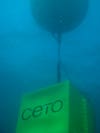
Pump Power
Australia is in the midst of a decade-long drought, one of the worst in the country’s recorded history. In Western Australia, the streamflow running into water-storing dams is now a quarter of what it was in the early 1970s. At the same time, average temperature, population and water demand are all rising. Perth today is a boomtown; mining in the state is at an all-time high and is driving development. Fortunately, the region has tried to prepare for a hotter, drier future.
Two years ago, Australia’s first large-scale desalination plant opened in the town of Kwinana, 25 miles south of Perth. Like all reverse-osmosis facilities, this $400-million plant forces seawater at enormous pressure through a series of salt-filtering membranes. It takes 24 megawatts of power to generate the requisite pressure, which is why desalination plants are most popular in energy-rich, water-poor locations like the Middle East. The plant supplies 16 percent of Perth’s drinking water. Along with a series of solid conservation policies, the facility has left the state with a more stable water supply than other areas of the country (like Sydney, for instance, where last year a conflict between neighbors over water use ended in murder).
“Western Australia has been suffering from climate change more than any other area in the world,” says Ben Jarvis, the manager of water efficiency at the state’s Water Corporation. “We’ve adapted fast. We’ve realized that it’s climate change, we’ve revised our planning estimates, and we’ve built new sources.”
In the next few years, at least five more desalination plants will be built in Australia, including a second one in Western Australia. That plant, to be erected 100 miles down the coast from Perth, will be powered entirely with renewable energy when it opens in 2011. Wind farms will probably be the main source. To support the development of new energy sources, however, the Water Corporation will run 20 percent of the plant on experimental technologies. In April the agency announced several finalists, CETO among them, from an original pool of 18 power-plant designs. The winner will get both a long-term contract to supply power and the legitimacy that comes with a public utility’s backing.
Of course, Australia is not alone in its water problems. From southern Europe to the American West, a combination of population growth and changing weather patterns has forced governments to struggle with the decision to invest in huge reverse-osmosis desalination plants like the one near Perth. A system that could do the same job, for a similar cost, without the greenhouse-gas emissions that are driving the need for the plants in the first place? It would be in demand across the globe.
ENERGY OPPORTUNITIES
Burns’s friendly crew of tanned, uniformed deckhands help us haul ourselves onto the stern platform and quickly hang up our sopping wetsuits. Within a few minutes, Burns has changed back into a polo shirt and white linen pants and is sunk into an overstuffed couch, cellphone pressed to his cheek. The night before, he had received some disturbing news. A representative for his oil company had been arrested and jailed overseas. Now he was on a conference call, working to diffuse the situation from halfway around the globe.

Latch On
Soon Burns walks out onto the deck, settles into a chair, and orders up some freshly brewed iced coffees from the crew. The oil business has gotten tougher, he says. New sources are harder to find and more difficult to extract. Foreign governments aren’t as welcoming as they used to be. And the business itself isn’t as much fun as it was in the 1970s and ’80s. “You sense that a lot of people are no longer proud to be in the oil industry,” he says. “They feel it’s socially unacceptable.”
For him, though, the motivation to expand into renewable energy is mostly a pragmatic one. “We all know that we’re running out of oil. It’s an argument as to when,” he says. Yes, new sources of fossil fuels will be mined from shale and sand, and we’ll find ways to extract deposits that were too deep or expensive to get at with old technologies. Still, Burns says, that won’t be enough. “The growth of energy consumption is so huge that everything is needed. Clean tech has to be far bigger than the oil industry is today. It has to happen. There is no other solution.”
The numbers back him up. According to the International Energy Agency, the world now consumes 87 million barrels of oil a day. That’s projected to rise by a third, to 116 million barrels, by 2030. Yet many oil-industry experts think it’s basically impossible to extract more than 100 million barrels a day. Add to this a worldwide population expected to hit nine billion by 2050 (from 6.7 billion today), together with rising living standards in the developing world, and $4 gasoline may begin to seem like a bargain.
Burns is far more concerned with this supply-and-demand curve than he is with climate change. He’s not a skeptic, exactly; he thinks global warming is real, and anthropogenic. He doesn’t think the worldwide effects will be nearly as bad as predicted, though. Burns acknowledges that climate change will probably be bad for Australia. It will make the country even hotter and drier. But in Greenland and Canada, more carbon dioxide could have many benefits. “Yeah, the weather’s bad,” he says. “It’s not as bad a problem as running out of energy.”
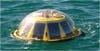
Sun Swim
And so Carnegie is exploring just about every new way to make energy that Burns can think of. It’s late in the afternoon when he suggests that we take a drive to the newest of his company’s operations, a location I had heard referred to several times before as the Skunk Works. In a few minutes, we reach a nondescript storefront. Inside are half a dozen engineers, mostly new hires, working on the next stages of Carnegie’s clean-tech initiative. There’s a guy focused on a novel solar-thermal technology, and two devoted to improving on aerofoil-wing design. The place has the high-spirit, high-intensity atmosphere of an Internet start-up.
Standing amid his new staff and his new equipment, Burns looks pleased. Both the solar and wing research are building on his own inventions, again with the best brains and processing power money can buy. “There are major advances to be made in all fields of renewable energy,” he says. “Using the same engineering team and the same management team, we can cover the whole lot.”
He doesn’t seem concerned that his technologies may soon be competing against one another. In the fossil-fuel business, he says, no one begrudges someone else’s discovery. “It’s not like, ‘Oh hell, I just found another billion barrels—what’s going to happen to the market?’ The oil business doesn’t think that way at all. They think, terrific. Every bit of oil in the world could be sold, and it’ll be exactly the same with renewable energy. Exactly. The world needs every bit that it can get, no doubt about it.”
Earlier, when Burns learned that I live in California, he turned to his assistant and asked her to print out a news article for me, an account of a recent speech Governor Arnold Schwarzenegger had made to United Nations officials about how the clean-energy economy will drive California’s future. “He thinks exactly the same as me,” Burns said, article in hand. “I thought his speech was brilliant. I thought, what a guy! You need leaders to have that sort of positive outlook, rather than just doom and gloom. Don’t go ‘Woe is me, let’s turn the lights off.’ These things are opportunities.”
]</strong>](https://www.popsci.com/uploads/2019/03/18/ROCL7K6BFWOGGA3Z4IGDJN35DA.jpg?auto=webp&optimize=high&width=100)
Underwater Wave Farms
Contributing editor Kalee Thompson last examined one company’s efforts to slow global warming [“Carbon Discredit,” July].