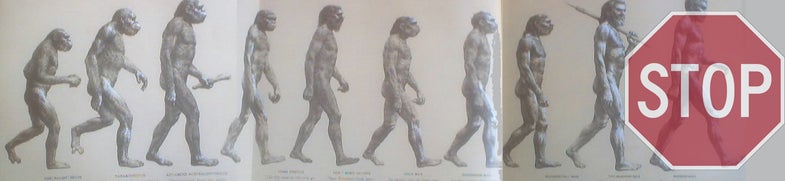
Our future may be uncertain, but leading geneticist Steve Jones at the University of College London says he knows one thing for sure: we're not going to change much on the evolutionary ladder. That's because human evolution is coming to a standstill, he claims. Jones says that the three main drivers behind evolution—natural selection, genetic mutation and randomness—don't hold as much anymore in the survival of the fittest race.
Reproductive patterns, for instance, have changed considerably over time and have resulted in fewer older fathers in the West. This has had an effect on evolution, says Jones, because fathers who have children when older than 35 have a higher rate of genetic mutations to pass down the line. A 29-year-old father—the mean age of reproduction in the West—has approximately 300 divisions between the sperm that made him and what he passes on, while a 50-year-old father has well over a thousand divisions.
Weakening natural selection and decreased randomness are other factors that have slowed the process of human evolution. In the past, Jones explains, only children with genetic mutations that made them fitter lived past the age of 20. But now those genetic mutations don't matter as much because better living conditions, especially in the West, have given way to higher rates of survival and longer life spans, reducing natural selection. As the world becomes increasingly connected, humans are not as likely to lose genes either (in small populations change happens more randomly as genes get lost). In fact, Jones argues, humans are 10,000 more common than they ought to be as a result. Whether people want to believe that is a whole other matter.
Via Times Online
138 years of Popular Science at your fingertips.
Each issue has been completely reimagined for your iPad. See our amazing new vision for magazines that goes far beyond the printed page
Stay up to date on the latest news of the future of science and technology from your iPhone or Android phone with full articles, images and offline viewing
Featuring every article from the magazine and website, plus links from around the Web. Also see our PopSci DIY feed
Science is reinventing play, from extreme sports to gamification to ridiculous roller coasters to the playgrounds of tomorrow, and this issue is chock full of fun. Also, on a less fun note: Did global warming destroy my hometown?
It seems like hubris to declare we have managed to avoid the countless behaviors and pressures that contribute to evolution.
I wonder if monkies will keep evolving until they are more evolved than us . . . probably not, but it's a thought. AND THEN Planet of the Apes will really come true.
yea.....-.-
Our human race will probably be wiped out by the time the happens.
-THE KID
from piscataway, NJ
So biological evolution in humans is coming to a standstill. I think evolution needs to be looked from a technological sense. If you think of it in that way, evolution is happening really really fast. One of my teacher's from high school thinks the next stage in human evolution is the synthesis of technology and biology. Thats why I love coming to this website, so much stuff that's really gonna change the way we live, isn't that what evolution is?
we need fewer people *looks up bioweapon page*
I've been saying this for years. Biological evolution is a thing of the past for the human race. When we encounter an issue, we don't adapt our bodies or behaviour patterns, we just build something to help us overcome it...or destroy it. From now until some undefined time in the future when the variables change, our evolution will be purely technological in nature.
Maybe never did evolve evolution is only a theory not fact and if it was a true fact there would be insects that can talk the way we do and there are fossils of frogs the same as present day frogs and it turns out some so called primitive man fossils are ape fossils.
I think it's obvious we don't adapt physically, we build things to adapt to our problems. Our physiology most likely won't change much if we don't phycially do more challenging things. Becoming obese is most likely a sign that we're not doing enough to change physically. It sounds like a logical pattern. You have to actually DO more to change physically, and do it often for thousands of generations. It's not going to happen overnight. ...the article says later reproduction from older males lends itself to more mutations, meaning the person has been through more... again.. same idea just a different way to say it...
so what if we don't evolve. the fact that we aren't evolving shows that we don't NEED to evolve anymore. If we are surviving well enough without evolving then there's not much of a reason to evolve, is there? And the whole reason that there aren't talking insects is because the (a) they haven't been around long enough or (b) the mutation that would allow them to talk doesn't help them survive and reproduce. I think it's some combination of the two. They haven't been around long enough to find a successful mutation that brings them to human-like intelligence.
If "humans are not as likely to lose genes", we ought to be in a better position to advance since we have more genetic information to work with. Although you would need to gain new genetic information somehow, or reverse the balance of bad/good mutations to the point where good mutations are the norm.
This is, and has been for a hundred years, the arguement for eugenics.
Of course, the Nazi's turned eugenics into a synnonym for genecide, but there are still rational arguements to be made for eugenics as a species.
The ethical issues of euthanasia and sterilization aside, eugenics will return to the forefront when genetic planning becomes commonplace or when elimination becomes required due to space.
One can still imagine, however, a Wells-like future, where the poverty stricken masses continue to breed themselves into stupidity, while the intellegencia breed themselves into an overclass.
I don't agree with this dude necessarilly.
He seems to over generalize and simplify evolution to its most classical concepts. Because of better living standards in the west, better healthcare, and advancements in technology there are certainly less environmental strains on survival. However, because of this there is a plethora of variation within our species. When a catastrophe comes (albeit a small scale one in the view of the total human population) there will certainly be the classic "survival of the fittest." Example: New virus, or antibiotic resitant bacteria. It is important to remember that evolution is something that is constantly occuring over a large scale of time. Although some of the points he brought up may be valid, it does not mean our evolution will come to a halt or is even approaching a halt...It is nearly impossible to tell what environmental stresses there will be far in the future. Also, we are evolving in a much different environment today then our ancestors did. Being able to understand and use technology (as its development exponentially advances) seems to be a factor of selection in our environment. People who are intelligent and people who can cope with the stresses our societies produce will be more successful in a corporate world. Perhaps it is that we are evolving to become more dependant on technology (remember that traits that win out in a population aren't always beneficial overall). Think of what happens when we lose power. Often times people get frustrated, bored, and don't know what to do with themselves because we are so used to technology.
All i'm saying is there are far too many facets this guy isn't taking itno account. I could agree that our greater physiology isn't evolving as much persay, but our brains certainly are adapting to a different world then our early human ancestors primitive brains had to. It's not just about running from predators and spreading your genes as many times as possible anymore. The game has changed.
What happens when we overpopulate the world? Space travel? Eugenics? War? All of these seem like serious enviornmental stressors to me.
Whatever genetic trend this guy is recording I would certainly like to know his sample size...