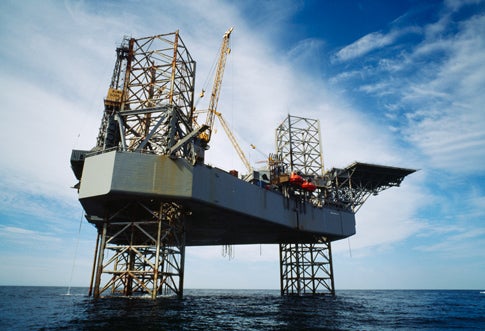
You might guess that magma or tumbling rocks fill the void, but the truth is much more prosaic: water. Petroleum deposits, which are naturally mixed with water and gas, lie thousands of feet below the earth’s surface in layers of porous rock, typically sandstone or limestone. (Contrary to what you might imagine, drilling for oil is more like sucking oil from a sponge with a straw than from a giant pool of liquid.) At such depths, these liquids are under very high pressure. Pump petroleum out, and the pressure in the well drops. Water in the surrounding rock, which is also packed under high pressure, then pushes its way into this low-pressure pocket until the pressure reaches equilibrium. “It’s just like digging a hole at the beach, where water in the sand around it flows into the lower pressure zone of the hole,” explains Chris Liner, a professor of petroleum seismology at the University of Houston.
Unless you drill in a volcanically active region (which would be unwise), magma typically flows miles below the deepest oil wells, which tap out around 30,000 feet down. And although some shifting of rock and deep sediment can occur, it wouldn’t spur a major earthquake. Typical drilling-induced quakes register between –2 and –4 on the Richter scale, which is one thousandth as forceful as the rumble of a tractor-trailer driving by.
Stay up to date on the latest news of the future of science and technology from your iPhone with full articles, images and offline viewing
Featuring every article from the magazine and website, plus links from around the Web. Also see our PopSci DIY feed
Share links with friends, comment on stories and more
In our December issue, Popular Science names the 100 best innovations of the year: bombproof wallpaper, self-parking cars, the fastest helicopter, and 97 more. Plus inventor profiles and videos.
Check out the best of what's new here.
I've always wondered about that. So now that I know that is not what is causing the rise in earthquakes I'm wondering where the water comes from?
Could it be that is why the earth's water level is dropping? Maybe the earth is warming up and melting polar ice to get the water back up to where it should be.
Yes it is a figure of speech that oil wells "run dry". In reality it is the opposite that spells the end of the productive life of a well because they run "wet" with water. Often times this water encroaches from nearby aquifers that provide the pressure necessary to extract oil. Additional water from other sources may also be pumped underground to increase pressure, or in the form of steam to crack rock and heat oil to help it flow more freely. Both oil and water are produced by oil wells with the percentage of water normally increasing as the well ages. This water is usually pumped back underground until the cost of getting rid of the water is no longer worth the amount of oil being extracted.
In this part of the country salt water is a by product of oil wells. It seems odd we would be getting salt water in the Midwest. On the other hand maybe not... considering this area has been under the sea a few times in the geologic past.
Hmm, although it may seem like a deterent from Global Warming, that is, raising water levels. Im sure that it shouldn't be used as recklessly as such. However, im sure we will. T_T
-=InuyashaBlade=-