Over the past dozen columns of Grousings, I’ve occasionally, sometimes vehemently, nominated various bits of gadgetry to an ad hoc deathwatch list. In particular I singled out Polaroid photos, home photo printers; disposable batteries; and Sprint’s WiMAX venture Xohm (maybe even Sprint itself, if they aren’t careful). Some of those predictions are necessarily more long-term than others, and some probably wishful thinking. But I think the deathwatch is a worthwhile pursuit if only because it’s fun to be able to say “I told you so!” some day—or to tell others to eat crow (as all Apple fans are now doing after a decade of defending their passion). So this week I’d like to flesh out the list with a few moribund contenders, and then welcome your input for other nominees in the comments section.
Ideally you’ll submit sound reasoning for your predictions and some sort of timetable to make it interesting—however, there’s always a place for good old-fashioned schadenfreude and playa-hating at my table. I’ll cobble it all together and we’ll check back at year’s end to see where we stand.
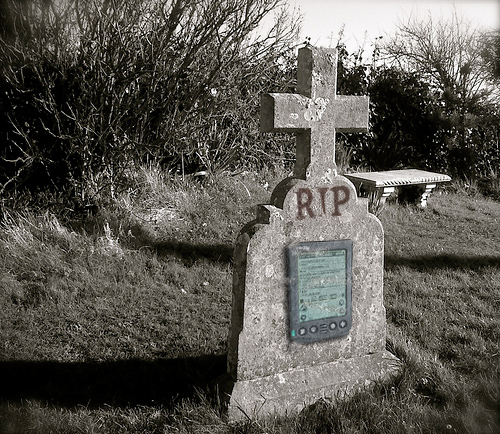
To get the wrecking ball rolling, in no particular order, launch the gallery for this week’s nominees.
PDAs
Estimated Death: 2 Years This, of course, means a handheld with no other functionality, such as a Palm Tungsten or HP iPaq. I know there are plenty of dedicated fans of these once cutting-edge devices, but at this point, there is no point. Convergence will continue its unrelenting course and within the next two years PDA functions will all be taken care of exclusively by our smartphones.
UMPCs
Estimated Death: 1.5 Years I may be underestimating demand on these (and tablet PCs, next page), however I think we’re looking at the equivalent of Homo habilis in the evolution of handhelds. They’re pretty cool, and pretty powerful, and yet I think they’re at the end of their evolutionary value. Again, why can’t the next Treo, Blackberry or iPhone do everything a UMPC does, but on the cheap? I’m sure a few new versions will come out, but I think eventually companies will stop trying.
Tablet PCs
Estimated Death: 4 Years There must be fans of these things, somewhere, as about a million were sold last year (compared with about 75 million notebooks). However, with revolutions in touch screens, battery life and connectivity coming to laptops and smartphones, there’s just no way it can be profitable for the majors to keep doing the R&D and manufacturing of these things for long. Or do you tablet PC folks know something I don’t?
Unlimited Broadband
Estimated Death: 1.5 Years I’m going out on a limb here based strictly on my gut, but true unlimited broadband has anecdotally been proved to be nonexistent alreadyaseveral cable companies (and cellphone companies too) already give customers the boot if they use too much bandwidth per month. Meanwhile broadband use is increasingly getting pummeled with video downloads, so unless we all start paying $100/month for Internet access very soon, the death of aunlimited broadbanda claims seems inevitable. My bet is you’ll start finding download limits buried in the boilerplate of your contracts and eventually a pay-per-GB pilot program in the next year.
Net Neutrality
Estimated Death: Late this Year This prediction comes with a mighty asterisk, in that it all depends on whether Congress and/or the FCC decides to act in the very near future and sort things out before it’s too late. However the fact that Virgin Media’s CEO recently declared net neutrality was aa load of bollocksa and touted Virgin’s ongoing work with content providers in the UK as evidence, it likely means the same secret talks are probably going on here as well. ISPs would love nothing more than to be able to find another revenue stream, and already admit to sometimes dubious apacket-shapinga techniques that basically mean throttling, so don’t look to them for help. Granted Virgin Media doesn’t operate here but I don’t know what the technical ramifications would be if even just Europe adopted the ideaaI mean, if I’m downloading a file from, say, the Netherlands, and they throttle there, presumably it will affect my download speed here, no? (Anyone? Bueller?) Sadly, we may lose either way.
HD Radio
Estimated Death: 2 Years I honestly don’t know much about the technology behind HD (hybrid digital) radio, but I’ve played with a few, and although it’s been around for a half decade already I’ve never met a single person who owns an HD radio. It’s possible, if not likely, that the FCC will some day pull the stunt with radio that they’re doing with TV and force us all to buy HD-equipped digital radios. But for now, I don’t see the market growing one iota, which means there’s little incentive for manufacturers to even make HD consumer equipment. Look for some other digital technology to supersede HD in the near future.
Satellite Radio
Estimated Death: 4 Years Full disclosure: I’m putting this in here strictly as a playa-hater. First off, I do like listening to sat radio on the occasions I have access, and I know of no more devoted customers than XM’s and Sirius’s (besides Apple fanboys, of course). That said, I recall scoffing when XM and Sirius first launched, ridiculing the notion that people would add yet another $15 subscription to their already full plate of monthly fees. In some respects I was proven wronga€”there are now about 17 million subscribers combined (and the two services will likely merge soon), but that also counts people who buy new cars and get the service for free, then ditch it at year’s end. Also, neither company has turned a profit yet, despite robust predictions to the contrary when they launched (50 million subscribers was bandied about at the time), and with the wealth of audio options on the marketplace, and more to come, I’m content with my initial instinct for the long term. Add to that the fact that the technology has been largely static (with the exception of Backseat TV), and the radios themselves pale in comparison to other options out there. I’m ready for these stars to fall from the sky relatively soon.
Dial-Up Internet Access
Estimated Death: Isn’t it Dead Already? Is it really possible that I still see NetZero ads almost every day? In this day of Web 2.0 frippery and bandwidth-intensive multimedia downloading, are that many people really still dialing up? Honestly? Either way it’s beyond belief that it can continue much longer. Time to put aOl Yeller down.
Quark
Estimated Death: Not Soon Enough As a veteran of print magazines for a decade, I can’t wait for those arrogant jerks to die. For the uninitiated, roughly 100 percent of print magazines (I know, they’re dying too) were and continue to be designed on Macs, yet it took those smug jerks at Quark years to finally put out an OS X version when it was needed mostaand even then it sucked. Which meant long painful hours, for years, using Mac Classic, tons of restarts, corrupted files and general misery, stranding tens of thousands of once-devout customers in the process. Then they took years to update again. I know it’s old news but I’m still bitter. Sometimes companies don’t deserve a second chance, and so I say screw aemawelcome to the Deathwatch list, suckers. Long live InDesign! I leave the rest to youawho is dying, deserves to die, or just may be vulnerable? Hit the comments with your Deathwatch nominees.
![R.I.P. [your gadget here]](https://www.popsci.com/uploads/2019/03/18/R4RV4N6SGTTYBU2ETFSD5YNYJY.jpg?auto=webp)