Despite the optimism of Moore's Law, scientists predict computer chips have just four more years of shrinkage
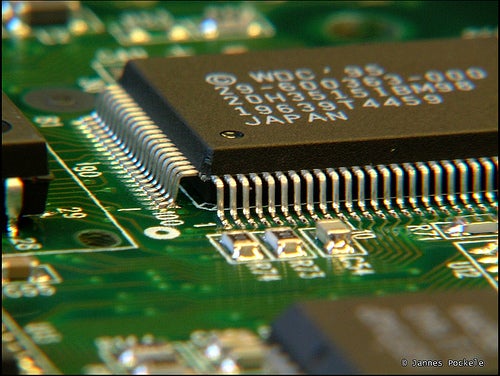
Chips The days of exponentially-shrinking chips are numbered. jpockele

About every two years, transistors shrink in size enough to place double the number on an integrated circuit than was possible during the previous two years. It’s held true since the mid-1960’s when the idea was first posited by Gordon E. Moore (today, it’s called Moore’s Law). If you were to plot the rate on a graph, you’d see it come out as an exponential curve. Exponential curves start slowly and then ramp up quickly, theoretically approaching a limit but never reaching it. I say theoretically because in the very practical real world, a limit will always be reached due to environmental feedback. In silicon-based computing (what we use today), that limit may be only four years away.

Suman Datta, a researcher at Pennsylvania State University, has suggested we have only four years more of miniaturization left before we reach that practical limit for silicon chips. While companies like Intel have devised myriad techniques for circumventing these limits over the years, they will need to look elsewhere when the transistors reach the size at which they leak more current than they can retain.

4 Comments

Get a biological degree and start creating synthetic neurons, it will start large, and then get down to the circuit size of dna. Think, wireless

Yes I agree with DarkFX that we need something other than transistors to flip those 1's and 0's. A biological "transistor" does make sense but I believe we are not anywhere close to something like that. I think we would be using atoms or electrons before cells or DNA. I would like all my neurons replaced with bio-tech enhanced ones though! :-)

Quantum Computers - stop counting ones and zeros, start counting qubits.

http://www.cs.caltech.edu/~westside/quantum-intro.html

No one will need more than 637 kb of memory for a personal computer anyway, I don't know what all the fuss is about.

Quantum is the way to go, not biological or synthetic bio. Transistors (currently made with a 45 nanometer manufacturing process) are already smaller than neurons (smallest neurons are typically 5 micrometers in diameter). The greatest problem with neurons is speed - neurons function by releasing chemicals (sodium, potassium, etc) that create an electrical gradient across the cell's surface. Assuming a human reaction speed of 1/10 of a second, which is pretty quick, a transistor switching at 3 gigahertz is already 300 million times faster. Try wrapping your head around this: a transistor switching at 3 gigahertz will switch 10 times in the amount of time that it takes a ray of light to travel one meter.


June 2013: American Energy Independence

Five amazing, clean technologies that will set us free, in this month's energy-focused issue. Also: how to build a better bomb detector, the robotic toys that are raising your children, a human catapult, the world's smallest arcade, and much more.


Online Content Director: Suzanne LaBarre | Email
Senior Editor: Paul Adams | Email
Associate Editor: Dan Nosowitz | Email
Assistant Editor: Colin Lecher | Email
Assistant Editor: Rose Pastore | Email

Contributing Writers:
Rebecca Boyle | Email
Kelsey D. Atherton | Email
Francie Diep | Email
Shaunacy Ferro | Email

circ-top-header.gif
circ-cover.gif
bmxmag-ps