The Grouse
Wherein the Grouse surveys his chargeable devices and bemoans the lack of standards
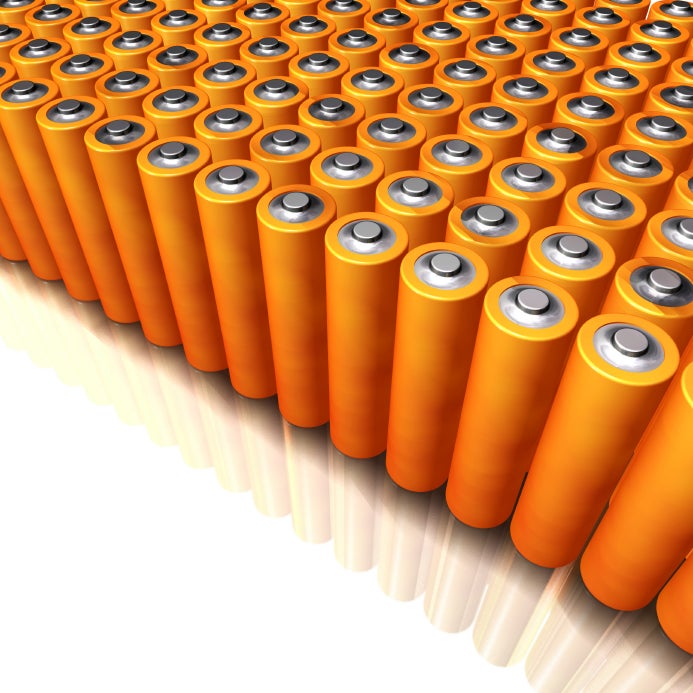
The Standard Bearer iStockphoto

I bet the ’80s was a good decade for Energizer, Duracell and their ilk. I mean, it was a good decade for sharkskin, too, but the ’80s had to be the absolute peak for these battery makers. Suddenly, it seemed like everything required portable juice: that new-fangled wireless TV remote, the Walkman, my futuristic calculator watch and, of course, all of those awesomely high-tech electronic toys like Simon (which actually had its launch party at Studio 54!).

Well, Energizer’s mascot might not have changed since then, but times sure have. Today, I can’t even count the number of portable electronic gadgets I own—each of them requiring its own on-the-go power source. And yet, I probably buy fewer than 10 batteries per year. Even then I’m only buying them for my two TV remotes, smoke alarm and flashlight—things that haven’t changed much since the ’80s.

Nowadays, proprietary batteries are forced upon us by the manufacturers of the very devices we need them for. What’s worse, these batteries are in many cases impossible to replace without performing major surgery on your gadget’s delicate innards (ahem, Apple). While this is quite the cozy and convenient situation for manufacturers, I can’t help but feel screwed. And I don’t like feeling screwed…

Where’s the beef? C’mon, that should be obvious. Anyone who’s ever traveled from Point A to B knows the misery of lugging around the cable salad of different proprietary chargers for a laptop, cell phone, digital camera, iPod and portable gaming unit. I roll up and pack each and every one of these chargers with me on even the briefest of excursions; I’m sure you do too. We’ve all been there. We’ve all had a gadget die on us and not had its charger on hand. For me, it wasn’t as tragic a scenario as having my digital camera conk out on vacation, but it was painful nonetheless. I recently traveled to Europe and, in the rush to get to the airport, neglected to pack my iPod charger. So, while I rocked all the way to Heathrow, the flight back was far less enjoyable. What were my options, after all? I could have gone without, or I could have purchased a new charger. For iPod owners, that’s now a two-part kick in gut: the USB cable, plus the USB-to-power-outlet thingamajig. That’s a £40 expenditure at the apple.com/uk store, so it would have cost me about $80. No thanks.

Page 1 of 2 12next ›last »
Want the latest news on grown-up toys and gadgets, product reviews, sneak peeks, and more? Subscribe to Popular Science and enter to win $5,000!

16 Comments

Well, it was only five minutes, but it wasn't a wast. You made a really good point there, and i really think someone should take action.

ok how bout this:

make every product powered by the same power source.

such as the grouse battery, small, lots of power that runs for hours or days, make it rechargeble and disposable so if ur not near a charger, make a quick stop in the nearest store and replace ur dead batteries to charge later.

or find someway to power something indefinitly.

While you're at it, why does everybody have their own power connector? It's not only the batteries, you need a separate charger for each device -- Most of which are shaped to take the maximum space in your power outlet.

Funny how anti green all of this stuff is.

I don't agree with government regulation in this case. If battery manufacturers were worried about a market contraction, they would team up with a device manufacturer and create a line of batteries specifically for that device, giving a portion of profits back to the device manufacturer.

But they haven't. So then the question is: why? Perhaps its because the majority of Americans simply don't like having to buy batteries all the time. Perhaps its because the batteries themselves are simply to expensive (unlikely.)

Clearly, if the demand was there, battery companies would be leaving money on the table by not creating such a joint partnership, and, presumably, electronics companies would also be foregoing profit. If the demand were there, an electronics company could boost its market share by including an easily available battery standard in its device, thereby boosting profits. My conclusion is that the demand simply isn't there.

A very good point made, but sadly the manufacturers will never standadize battery technology thats how they make huge prophets, but there are interim solutions,most all gadgets today use a usb cable, a 12v car charger with usb output can be had on ebay for $1.00 a usb cable with plug in adaptors for phones,ipods, pda,s mp3 players can be had for $5,00.
now the manufacturers by using a usb cable have standadized the imput voltage to 5v 200ma to 2 amps, a 110-240 adapter that outputs 12v through a car type socket for camping costs $15.00 so there you have it, one system that can charge all your gadgets when at home and when out and about and the 12v to usb car charger.Also if you buy a single AA bacup phone charger,ebay again you have total portable power,I have this system in a small bag that goes everywhere with me.There is light at the end of the tunnel,sometimes you just have to find the switch.
Ricky.

04heinm

from Brookings, SD

USB Chargers are the short term solution. (And the direction most manufacturers seem to be heading)

Most of our travel electronics have a USB cable anyway for data downloads.

I use a Polaroid USB Stick Battery Charger (for AA and AAA) combined with a Scosche USB Home/Car Charger Kit.
My next step is to pick up a Semsons' new Pocket Power Bank w/ USB port or equivalent device.

Also, NO Disposable please! I would much rather see a "trade-in" system developed.

...I trade in my drained battery for 50% NEW Battery price. Then I either buy a NEW rechargeable battery or a RE-charged Used battery for 25% off the NEW price. The store/vending machine makes 25%-50% off the transaction and never runs out of inventory.
WOW! I might have actually come up with a good business model for an "Automated Energy Vending machine".

the USB thing raises another issue, has anyone else noticed the growing number of types of these supposedly 'Universal' cables? they all have the standard USB male part at one end, but the other end varies. My phone, PSP and mp3 player are all USB charged, but they each need their own cable. Seriously, what is the point in a gadget specific universal cable?

Though it is an annoyance, I like the ability for manufacturers to control design of their device by controlling design of their batteries. The devices have ended up much sleeker and ergonomic (mostly) than their equivalent just a decade ago, let alone the '80's.

I think the solution has been mentioned. Instead of a standard form battery, how about a standard form power interface. I've read where most smart phone manufacturers are going to make their power design USB. The iPod was on the right idea before with their firewire interface, then they came up with their own proprietary form that still ends up just being USB.

All computers have at least one USB port, some, thats all they have, other than power. Esp with USB 3.0's specs increasing its power rating so that more devices can be powered solely by USB 3.0, it makes even more sense.

USB plugs are universal, you could use a multitude of USB battery packs I've seen (example: http://tinyurl.com/65ut52 ) which can then be swapped with as many batteries (rechargeable or otherwise) you care to purchase or carry around with you.

Standardization of plugs, not batteries is the way to go.

headustropus

from Diego Martin, Diego Martin Regional Corporation

I think a standard power/charging interface is a better solution for the following reasons:

1) This would facilitate a universal charger. Less chargers to walk around with.

2) It would allow manufacturers to continue to design batteries around space requirements for their products. A standard battery size would limit their product design flexibility.

3) It would make possible battery pack emergency power sources, where standard batteries could be used when one is in a jam.

Instead of regulation, you could just let market forces handle the problem by not purchasing gadgets unless they use standard batteries. After all, with the exception of cell phones, these aren't necessities we're talking about.

Canon's non-elph powershots use AA batteries. We have three of them in our family for this reason. But most people would rather buy the smaller elph cameras with proprietary batteries.

Don't overlook the Canon A-series and S-series cameras. They take 2 or 4 AA batteries each. And great photographs!

How come every time I read an article on batteries on PopSci.com there is some blurb by the author bemoaning the inconvenience of the endless variety of the free market? "Boo-hoo! Too many options!" Most of the world is rolling their eyes and saying "I'd like to have a problem like that!"

I do agree that the price of the wires and cords to recharge these devices are absurd, but I generally buy adapters to fit multiple devices or take special care to bring the charger. I have actually forgotten the individual device that I brought the charger for. I didn't buy a new one of those either.

Perhaps the manufacturers can be convinced to offer two variations of their products, an ultra small one with a built in rechargeable, the other made a little bigger to accept AA (AA rules! AAA drools!). I actively avoid buying devices that use AAA because the damn things die too quickly, so in that case, I'd rather have rechargeable.

I use the iGo system at igo.com . It eliminates some of my recharger problems.

LordConti

from Baltimore, Maryland

To make the following long story short, we could make the Grouse, find that it's annoying to have to replace the batteries all the time, build better and more specific batteries to mend the pain, and end up right back where we are today. Or we could take the next logical step that technology makes and create both/either better batteries and/or better built-in solar panels for such daily devices. I remember seeing a backpack that had a solar panel on it for exactly this purpose. Maybe the search for the affordable and trustworthy electric car will get us there.

If this wet your palette, continue reading for the more detailed version. This top part was just a summary for your convenience :D

There are some excellent solutions to the battery life woes posted here, so there's really just 2 cents I'd like to remind you all of in the battery area, and 04heinm has part of it.

The reason half the reason for smaller, non-"standard" batteries was application size. The other half was longevity. (arguably it's also the price of the battery after technology breakthroughs and vendor bargaining).

Imagine how many Grouses you would have to go through to power your laptop or even a PSP. Have you ever had to replace the stock battery that comes with your phone? The cost of spares for peace of mind can pile up quickly. Assuming the Grouse is as affordable as you envision it to be, there is really only one other issue you could run into: Waste. Heaping piles of spent Grouses (or batteries) filled with chemicals that shouldneed to be hauled off to a chemical decomposition plant for recycling and reusing. Even rechargeable ones will get there eventually.

But then we've fallen into a loop, no?

1.)The battery life just isn't cutting it, so I'll have to buy more.
2.)Things are getting pricey, so it'd be nice to have a more efficient battery that I didn't have to charge so often or buy more of every three days.
3.)Lets build a better battery at the expense of it's affordability. But wait, no one's going to keep buying an expensive battery just because it lasts a little longer, so let's make it more specialized to fit the needs of this particular device.
4.)The Grouse woes about not having standardized batteries.

Maybe the question should be changed to "Why don't we make the decent battery life we have now ten times better?" I think it would be a better idea to improve what we have now than take several steps backward. I'd like to see 14 to 20 hour laptop batteries that don't demand that I run my processor at half the normal speed(or less). I'd like to see phone batteries that last for several days while Not in sleep mode. I can only imagine that if these increases happened, our woes would decrease greatly. Hopefully the new age of electric car engineering will spur the technology and progress.

It would be best if there were about six different types of this so-called grouse battery. That way manufactures could maximize space and performance of their battery powered device. That way an exotic phone which would be small would use a tiny battery. Just the way common batteries are today. Lets face it, AA batteries are too bulky for most portable electronics today. But a revamped Li-ion battery would do the world some good. I use rechargeable batteries for my digital camera and I'm completely satisfied about my choice.

potblk

from Auckland, Auckland

I discovered a product called powermonkey which let you take a power source with anywhere you go.
It comes with various swappable connectors so you can recharge your iPod, phone or whatever.
They also have a solar slave which can charge the main unit with.


Download Our iPhone App

Stay up to date on the latest news of the future of science and technology from your iPhone with full articles, images and offline viewing


Follow Us On Twitter

Featuring every article from the magazine and website, plus links from around the Web. Also see our PopSci DIY feed


Become a Fan On Facebook

Share links with friends, comment on stories and more


December 2009: Best of What's New

In our December issue, Popular Science names the 100 best innovations of the year: bombproof wallpaper, self-parking cars, the fastest helicopter, and 97 more. Plus inventor profiles and videos.

Check out the best of what's new here.

Popular Science Photo Pool


Share your photos in the Pop Sci pool at www.flickr.com!
tags_sprite.png
POP_embeddedForm_cover_May09.jpg