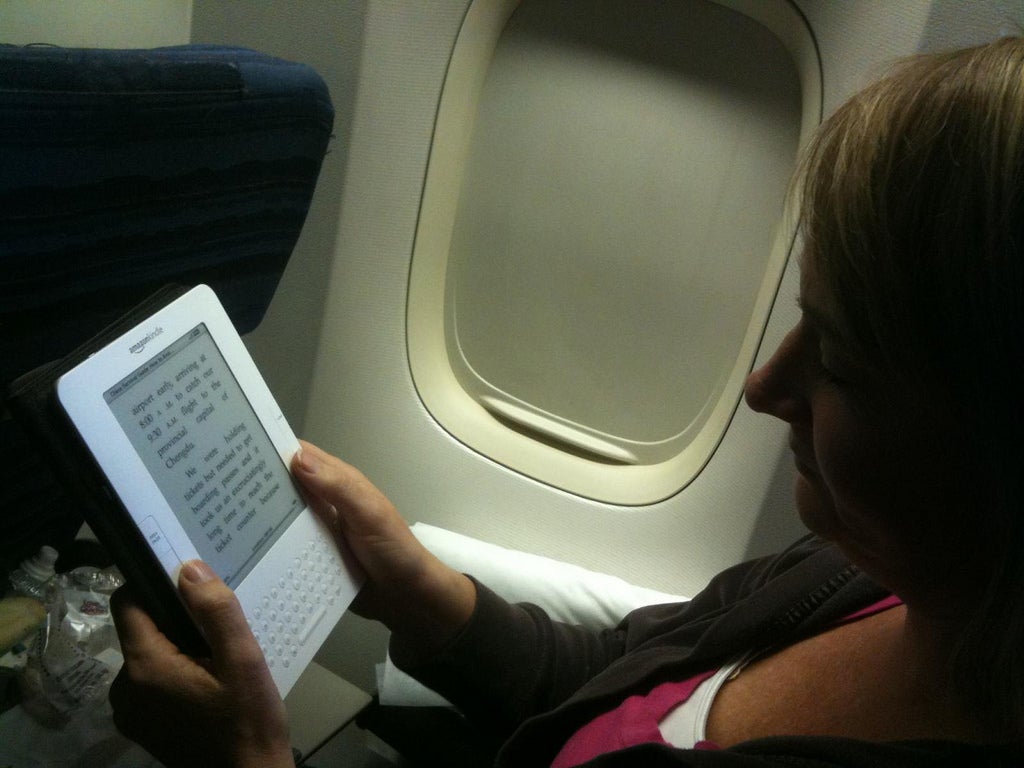
Not During Taxi, Takeoff or Landing Wesley Fryer via Flickr

Amid all the discussion about iPads in the cockpits of commercial and military airplanes, one question has remained unclear — what about during takeoff and landing? Passengers are supposed to turn these devices off, lest they interfere with aircraft avionics--at least, that's the line the FAA's been giving us, despite evidence to the contrary. Now the FAA is planning to investigate itself whether iPads, Kindles and other electronic devices really can harm a plane during crucial flight phases.

The FAA has not tested whether consumer gadgets can cause interference since 2006, before the iPad came out and before e-readers were so common, the New York Times reports. The testing process is lengthy and arduous, which partly explains the six-year break despite huge leaps in gadget availability. Smartphones won’t be on the list, however, so we won’t know the safety implications of insistently playing Words With Friends while taxiing.

The Times talked to several airline spokespeople, who explained that each airline would have to fly a plane with an individual gadget in operation, without any passengers, to validate the device’s safety. Each version of the Kindle, Nook, iPad or other similar device would have to be tested the same way, for every plane in every fleet of every airline. So needless to say, this is expensive and logistically challenging, especially for smaller airlines like Southwest, Jetblue and Virgin. The FAA is trying to figure out how to make the testing process smoother, working with gadget manufacturers, airplane instrument makers and other groups. It does not plan to include smartphones, in part because there are so many models — it would be next to impossible to test them all.

It’s not clear when the testing will start, but the FAA confirms it is “taking a fresh look,” according to the Times. Here’s hoping they figure it out by my next vacation, so I can go straight to my Kindle during takeoff rather than flipping through the SkyMall catalog.

[via New York Times]

11 Comments

THANKYOU! holy crap it's about time!

to mars or bust!

so they use them in the cockpit...not knowing its safe...and thats why i dont fly anymore...

that and the omfg ticket prices

Here is your more efficient method, put more types at once on a plane, if it goes down, then test them individually. After all these planes are going to be exposed to multiple devices when this inevitably passes inspection.

They should check each flight for how many passengers have what device, and have them activate the device upon taxing while checking all flight instruments that would be essential while flying. Of course there may be certain things they can't do, but at least this would be free and promising to whether or not it truly interferes. Then in it doesn't interfere they could completely offer wi-fi at 30,0000 while directly routing you to the first web page, "sky mall". If it does interfere then make a way for it to not. People would pay mad bucks to Internet it up up there.

Be nice to flight attendants! You be amazed how many passengers believe they are Kings and Queens in their own imagination. The job of a flight attendant is an extremely hard job and exhausting. My heart goes out to them!

I do not like electronic gadgets with passengers. Perhaps one day it will prove to be harmless in the radio frequencies they broadcast local to themselves and surrounding plane electronics. My long term worry in the future a terrorist and a high power smart phone will hack into a plane and intentionally cause problems. With the mindset of terrorist and the mindset of hackers, plus the additional growing capability of smart electronic devices, I consider this a real possibility.

If a pilot uses an electronic device to does their job better that is fine. I do not like planes that fly themselves mostly via computer. I want the pilot to be in 90% control of the plane. The computer has no vested interest in life and death, but the pilot always does!

.............................
Science sees no further than what it can sense, i.e. facts.
Religion sees beyond the senses, i.e. faith.

So why not use a frequency generator and test the frequencies generated by each device? Then they could test possible scenarios like malfunctioning transmitters.
They already test for possible interference when the planes were designed? That's why planes already have insulation against RF interference.

Okay, I'm no rocket scientist, but what do aircraft designers do to protect cockpit instrumentation from things like cell towers and radar installations (both located close to airports) and why can't they shield their instruments from ALL radio interferance in the first place? Seems a lot cheaper, and safer, than the alternative suggested in the above article as it would also protect against damaged or altered electronic devices that may have passed said tests while undamaged.

The FAA is just being overcautious as usual. In reality, you could have a full high-power radar broadcasting station on board the aircraft and it wouldn't affect the avionics in the least (ever heard of AWACS?). A thousand of your little 1/4 watt cell phones don't produce enough RFI to even make a blip of static on the high-quality, well shielded cockpit systems on board today's aircraft.
Anyone who has an understanding understanding about RF, waveform propagation, frequency response, and aircraft electronics would be absolutely stupid, or at the very least stupidly paranoid, to consider personal electronic devices dangerous to aircraft operations.

Electronic devices can interfere with avionics, if you include warning systems. That interference doesn't put passengers in any danger, except from skyrocketing blood pressure after they've gotten to number three for takeoff at JFK and the flight has to return to the gate for a spurious engine control warning the crew isn't permitted to clear. Or divert somewhere because the instrument redudancy system (comparator for you avionics types) tells the crew "no CAT III approaches today", and now you're going to Hartford instead of getting back to the aforementioned JFK.

There are valid reasons not to permit electronic devices during certain parts of the operation, but they involve dispatch reliability and on-time performance, not safety.

"that and the omfg ticket prices"

Adjusted for inflation, airline tickets are really, really cheap compared to the past. And insanely cheap compared to pre-deregulation prices.

I guarantee you that at least one of these devices is on during every takeoff and landing on every airline every day.

The problem is that the airlines really do not want to add to their security nightmare; whether their passengers want them to or not. I don't blame them a bit. There is NO WAY to tell at the security kiosk whether you are looking at the x-rayed guts of your average Macbook or something truly hazardous to passenger health. I'm not talking about the native frequencies put out by the normally functioning device here at all. I'm talking about making it OK for those that WE KNOW are indeed using the airlines this very day, looking for weaknesses; and the idea that we are now going to let them bring unknown electronic-mechanical capability onto our planes, in literally thousands of configurations. See, our security services aren't functioning as a law enforcement arm that needs no warrant. That ain't how it works. They don't get to see the actual data, nor custom applications in action. To me, if they can't make the planes' systems inviolable then the next best thing is to keep anything that COULD violate them away from there. If people can't stand to be without their damn iPad for a few hours then THEY NEED MENTAL HEALTH TREATMENT; not being catered to at the possible risk of everyone on the plane. We interfere with passenger choice as applies to cigarettes, and booze as well. We do it for the well-being of the other passengers, who may never have gotten cancer or emphysema or cirrhosis. This is no different in that aspect.

Popular Tags

Regular Features


June 2013: American Energy Independence

Five amazing, clean technologies that will set us free, in this month's energy-focused issue. Also: how to build a better bomb detector, the robotic toys that are raising your children, a human catapult, the world's smallest arcade, and much more.


Online Content Director: Suzanne LaBarre | Email
Senior Editor: Paul Adams | Email
Associate Editor: Dan Nosowitz | Email
Assistant Editor: Colin Lecher | Email
Assistant Editor: Rose Pastore | Email

Contributing Writers:

Kelsey D. Atherton | Email
Francie Diep | Email
Shaunacy Ferro | Email

circ-top-header.gif
circ-cover.gif
bmxmag-ps