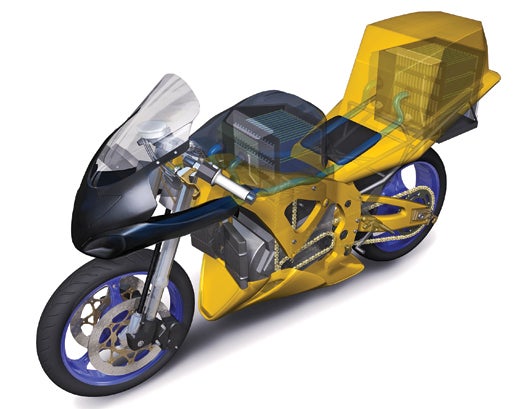
In November 2009, after spending three months recovering from a broken pelvis, Chris Yates, a motorcycle racer, engineer, and defense contractor, began staging his reentry into racing. This time, he chose a new niche, where his training as an engineer would be a particular asset: electric motorcycles.
He started by converting a gaspowered Suzuki GSX-R600 to run on a 194 horsepower electric motor that was built to power driverless U.S. Army tanks. Lithium-polymer batteries, 180 pounds of them, supply the charge. But to pack in even more power without adding extra battery weight, he designed a regenerative braking system that pulls otherwise wasted energy from both wheels to give the batteries a periodic boost. Yates and his team also custom-designed software that carefully manages overall energy usage. All that engineering was worth it.
In January, during a race against gas-powered Ducatis, KTMs and Hondas, Yates’s bike placed second, setting the fastest lap time (one minute, 39 seconds), and clocking a top speed of 158 mph. Here’s how.
A 180-pound pack containing 102 individual battery cells stores 11.7 kilowatt-hours of energy.
Kinetic energy recovery systems (KERS) harvest energy from decelerating wheels and then convert it to electricity. On motorcycles, KERS is usually installed only on the rear wheel. But when a motorcycle brakes, most of the weight shifts to the front wheel, which means if you can pull it off, that’s the place to recover energy.
Yates managed to do so by connecting counter-rotating shafts to gears near the front fork and linking another shaft to the electric motor with a chain. When he squeezes the KERS lever on his handlebars, the motorcycle slows not by physically applying the brakes but by using the momentum of the wheel to turn the electric motor, thereby generating electricity.
An onboard computer collects data from gyroscopes, sensors and GPS; it then calculates the bike’s location, the distance traveled and the speed of each wheel, and limits power usage accordingly.
Five amazing, clean technologies that will set us free, in this month's energy-focused issue. Also: how to build a better bomb detector, the robotic toys that are raising your children, a human catapult, the world's smallest arcade, and much more.


Online Content Director: Suzanne LaBarre | Email
Senior Editor: Paul Adams | Email
Associate Editor: Dan Nosowitz | Email
Assistant Editor: Colin Lecher | Email
Assistant Editor: Rose Pastore | Email
Contributing Writers:
Kelsey D. Atherton | Email
Francie Diep | Email
Shaunacy Ferro | Email
He managed to install an 11.6Kwh battery on a motorcycle, yet automakers continue to claim than an all electric vehicle with a reasonable range is impractical to produce...
My motorcycle weighs less than 400 pounds... my car weighs like 2530 pounds.
My motorcycle can carry 2 people, my car can carry 5 ppl + suitcases/groceries...
So, it's much more practical to create an electrical motorcycle than a cheap/useful electrical car. This is because the reason people drive cars and ride motorcycles are completely different.
even still. a power plant like this could power a house yet we are still fighting nukes from turning us all into glow in the dark zombies. can you say: suppression?
Wow- now this is the kind of stuff I read PopSci for! That battery back is only 15.4 pounds/Kwh! Hats off to you Yates Racing and keep up the good work!
@cadilac...?...power a house?...please explain
Here is a link to it in action!
I found a sweet video of in on youtube video id = wbYiX7cNH7o
www.youtube.com/watch?v=wbYiX7cNH7o
11.6 kw is about 15.5 horsepower. So, assuming that you could get a 100% full power discharge (you can't), you'd get 11.6 hours of 15.5 hp -- not much, even for a motorcycle.
I'm guessing that the discharge rate is normally higher than 11.6 kw to get the performance indicaed -- run time is shorter in proportion.
This is a nice bike, but the battery tech is probably not especially fabulous.
A nice achievement but there are some facts that are missing. First and foremost, the races are six laps! That is the current limit of this motorcycle. Also, it is not that great in the corners and relies on beating this class of bikes on the top speed in the straight. It is an important detail to state what kind of race this was. Perhaps a comparison to the track record would have been helpful. In any race there are limits to the type of gas-powered bike that can be put on the grid. It seems to me that if the electric bikes have no such limits, they will always be able to target specific races. Don't hold your breath waiting for a GP win! All that said, I'm thrilled at how the technology has progressed.
Here's a much better video of the bike in action.
http://www.wired.com/autopia/2011/01/electric-superbike-kicks-some-gas-bike-ass/
@ford2go...195 horsepower electric motor...read the article
@ford2go: That's actually 1 hour of 11.6 kw discharge, or possibly slightly less. During any race, the so-called throttle isn't always twisted to the stops; so the peak discharge rate will be around 15C (180kw = 240hp), but the race-average discharge rate may be closer to 3-5C, with regen braking extending runtime by 10-20%.
Yates has a technology he calls the "Race Finishing Algorithm" which calculates remaining range and reduces power accordingly - he's stated that he actually will not need to use this for the Pikes Peak attempt, as he has enough energy in the pack to run unlimited.
Barring a quick-swap battery pack or harnessed lightning for recharging, electric motorcycle racing will be limited by range for some time to come. And that's fine; many WERA races, point to point racing are largely (IOM, PP) doable with existing battery tech as-is. Continuing advances in battery tech will allow the bikes to either tackle longer distance races OR reduce their weight further.
kudos to chris yates.
how much will the motorcycle cost? approx cost?
how much will the 180 pound pack of Li ion batteries cost.
The front and rear brakes will be disc brakes?