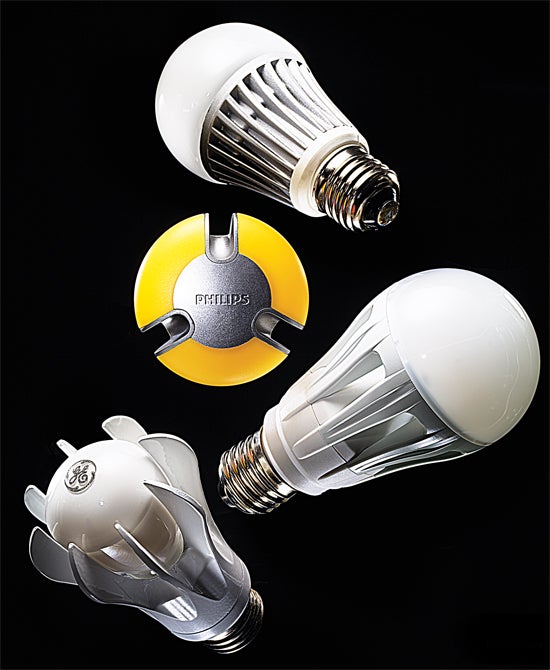
Never mind that twisty compact fluorescent. The new energy-efficient way to light your home is with LEDs. An upcoming crop of bulbs draw 12 watts or less, edging out a typical fluorescent, and they have a more conventional shape, contain no mercury, and last at least 25,000 hours, three times as long.
They’re among the first LED bulbs as bright as a classic 60-watt incandescent (about 800 lumens), and they address past problems with LEDs, such as bluish light, overheated chips and too-concentrated beams. Launch the gallery to find out how they'll do it, all within a 130-year-old form.
The incredible innovations, like drone swarms and perpetual flight, bringing aviation into the world of tomorrow. Plus: today's greatest sci-fi writers predict the future, the science behind the summer's biggest blockbusters, a Doctor Who-themed DIY 'bot, the organs you can do without, and much more.


Online Content Director: Suzanne LaBarre | Email
Senior Editor: Paul Adams | Email
Associate Editor: Dan Nosowitz | Email
Assistant Editor: Colin Lecher | Email
Assistant Editor: Rose Pastore | Email
Contributing Writers:
Kelsey D. Atherton | Email
Francie Diep | Email
Shaunacy Ferro | Email
What am I missing. The article ends with 'Here's how they do it" Okay how do they do it? Why is access denied to the Photo Gallery?
Still way too expensive. Get them down to about $5, then I'll take a gander.
Great! Now go back to the drawing board and let us know when you make it cheaper, Geeezzz!
LEDs are dirt cheap these days, so all the cost must come from the phosphors and the heat sink. At only 12 watts, the bulbs should not produce that much heat, but maybe LEDs have to be kept at a low temperature to avoid damage? Any electrical engineers out there know how much heat a LED can take before it degrades?
Personally I would think the large cost doesn't come as much from the materials used as it does from the fact that not that many are being sold. In any type of manufacturing until you can hit very large quantities, the costs are high.
Good. Charge a lot for them, make them last a long time and stop making so much trash.
I think the plasma bulbs developed by Luxim look promising.
The efficiency and life of these bulbs are great but, price and color rendering have been problematic. Bulbs that change color over time or don't have a pleasing color to begin with will never win the homeowners or business owners over, regardless of price. That being said, there are plenty of LEDs that have addressed the color problem but remain prohibitively expensive. Solve the color issue while bringing cost down to less than 2x the current prices of CFLs and I think you will have a hit.
As long as the light emitted is equal to that of standard bulbs, I can see paying $60 for one of these. The cost savings of using 12watts over 60watts for 250,000 hours (10,416 days or 28.5 years) would more than pay for it.
$60? rofl
Well, 25,000 hours, not 250,000, at a difference of 48 watts at NYs average per KW electricity price equals nearly $230 in savings over incandescent.
Home depot has GE 60W incadecents for $3.47 per 6 pack. They have a listed average life of 2000 hours each, so it will take 12.5 of those bulbs for 25,000 hours, so $7.23 in cost there. So, spend $60 more up front, to save ~$175 over the next 6-12 years [and probably change so few light bulb that you forget how :)]... sounds like a deal to me.
Granted, the real comparison should be to CFLs. Same site, has 4 packs of CFLs at 14w [60w incandecent equivalent], lasting 10,000 hours for $1.45 per bulb. The two watt difference over 25,000 hours comes to just $10. So the CFLs work out $45 less over 25,000 hours.
They have to come way down in price to compete with CFLs...
A standard Incandescent Light Bulb last about 2000 hours. These LED's last 25000 hours. That is about 12 times as long. I can get a four pack of Incandescent for 2.99. That is $.75 per buld. So $.75 times 12 times as long comes to....wait for it... $9.00. To compare in price to the Standard light bulb these babies got to come down from 60 dollars to 9 dollars. Ohh, but you say what about the energy savings?? Well electricity cost $0.08 per kilowatt hour. A 100 watt light bulb costs $0.50 per month in average use. So really we are talking pennies in savings per month per bulb. Not Hardly $51 dollars.
No thanks, I'll stick with 5000-6000K fluorescents, with proper daylight temperature rather than shitty 2700K yellow.
These LED bulbs sacrifice a great deal of their efficiency in order to immitate the colour of incandescent lightbulbs; they are only 2/3rds the efficiency of daylight fluorescents.
Guaranteeing long lifetime is very hard with these type of products, the correct cooling metals are expensive and proper Leds which have been fabricated properly need sophisticated manufacturing since minor inconsistencies in the production will cause non uniformities in the crystal lattice in the diode structure and it burns out quickly. The fact that these products do what it says on the box is a great achievment and I assume they have a decent ambient working temperature range is a bonus. So considering that prices will drop quickly once they become mainstream it is great.
"A standard Incandescent Light Bulb last about 2000 hours. These LED's last 25000 hours. That is about 12 times as long. I can get a four pack of Incandescent for 2.99. That is $.75 per buld. So $.75 times 12 times as long comes to....wait for it... $9.00."
A full accounting of cost also includes labour. Assume that it takes 3 minutes to change an average bulb(this obviously varies a lot depending on the particular luminaire; some are a real pain to change. Also depends on whether you have to rummage around to find your replacement bulbs). Assume further that you value your time at $10 per hour; that's another $6 cost of ownership for the incandescents but only 50 cents for the LED.
"To compare in price to the Standard light bulb these babies got to come down from 60 dollars to 9 dollars. Ohh, but you say what about the energy savings?? Well electricity cost $0.08 per kilowatt hour. A 100 watt light bulb costs $0.50 per month in average use."
Don't change the subject, stick with the lifetime comparison.
Over their lifetime the incandescents will consume 12 x 2000 hours x 0.06 kW x 0.08 cents/kWh = $115 worth of electricity.
The LED bulb will consume 24000 x 0.012 kW * 0.08 cents/kWh = $23.
Total cost of ownership over their lifetime if you include all the costs of ownership:
Incandescent: $9(purchase) + $6(Hassle) + $115(electricity) = $130
LED: $60(purchase) + $0.5(Hassle) + $23(electricity) = $84
"So really we are talking pennies in savings per month per bulb. Not Hardly $51 dollars."
Who, but yourself, suggested a $51 per month savings?
@ Soylent,
Your fuzzy math impresses me not.
One light bulb $0.75 PLUS not MULTIPLIED by
2000 Hours x 100 Watts = 200000 watts which equals 200Kw
So 200 Kw x .08 Kw/Hr = $16.00 NOT $115
SO TO RECAP
$0.75 PLUS $16.00 = $16.75 for the life and energy of ONE light bulb.
Do you work for GM or something or is your math just sorely lacking?
I mean GE.
I think that a lot of the cost is actually coming from the companies promise that the LED lights will last longer than the avg incandescent bulb.
Kind of like the Stride gum commercial...we made them too good and no one is buying any more.
Either way, I love the fact that they tried to pressure us (ie enforce laws) into using the mercury-using bulbs when they could have just waited a little longer for LED bulbs to become viable.
Yet another example of loud-mouth tree-huggers not giving technology a chance to come up with a better solution
(ie, replacing paper bags at stores with the oh-so-loved plastic ones).
$60 is extream, particularly since part of that longevity of LEDs is deceptive. Having multiple points of origination, a single failure does not stop all light production (unlike, say, the string in an incandescent bulb).
However, over time, cumulative failures will reduce overall light output - so while the bulb may not be dead - it could still be dying out for years of unsatisfactory, but "darn it, I paid for it," time.
I know there is also some decay in light production in other bulbs (Flourescent tubes, compact or not, a famous for it), but for a few watts, and that much cost, more is demanded.
Everything that I read is that Cold Cathode Florescent lamps produce more lumen's per watt. They are less expensive and produce light similar to what a home owner wants in a lamp.
CCFL's are better.
I did the math with my cheap Texas electric rate and I would save $3.79 over the lifetime of one LED bulb. So, even at $60 a piece, they are competitive, but the manufacturers are going to have to convince the consumer of this fact.
@trueperspective
I think Soylent has it right. He is looking at 12 years worth of 60W incandescents at 2000hrs/year (although I could argue few lights in my house stay on for 8 hours a day and I do use lights on the weekend).
2000hrs * 0.06kW/hr * 0.08$/kWhr *12 years = $115.2 over 12 years.
a 100 watt bulb costs $1.33/month to run assuming 2000 bulb years on average (this is a 5 day work week, 52 weeks a year, rounding down). Simply saying its 50 cents a day is a bit ambiguous. I'm not sure why anyone was discussing 100watt bulbs as the article only compared 60watt incandescents to LED lumen equivalents (and I'll believe 800 lumen LED bulbs when I see them).
The LED bulb is
2000hrs * 0.012kW/hr * $0.08/kWhr 8 12 years = $23.04
My real problem is that so far the CFLs have been a disappointment - I have five burned out ones sitting in a drawer and they are maybe two years old each. If the LED ones burn out too, forget it. The marketing jerks inflate things to the point you swear you are living inside a Dilbert cartoon.
The interesting thing is to look at the break even mark
$84 lifetime TCO = 2000 hrs * 0.06kW/hr * $0.08/kWhr *n + ($0.75 cost per bulb+$0.5 install cost)*n
N= 7.74 years. The LED bulb has to last that long, you have to live that long, and unless there is an adder to perceived property value (and there might be) you need to live in the house that long to end up in the black. The same might be said for determining what kind of hot water heater you might put in, too.
Oh, after tax, title, and destination charge, I pay $0.013/kWhr here in PA. I prefer to figure out my kWhr charge by taking my bill and dividing by the kW I used versus adding up the various fractions. Its more realistic to my bank account.
Huh - one other thought. At 10% interest/year (anyone got a good stock tip?!), I think an investment is supposed to double in 7 years, right? So because the LED lights have an up front $60 investment, at the end of 12 years (close enough to 10) you are really out $144 at the end of those 12 years. Now the LED lights really don't make sense because you have lost the opportunity cost of the $59.25.
But who wants to over-analyze?!
Ooops:
Not:
The LED bulb is
2000hrs * 0.012kW/hr * $0.08/kWhr 8 12 years = $23.04
But
2000hrs * 0.012kW/hr * $0.08/kWhr * 12 years = $23.04
"One light bulb $0.75 PLUS not MULTIPLIED by
2000 Hours x 100 Watts = 200000 watts which equals 200Kw"
No, it equals 200 kWh. Units matter. I also assumed you were sensible and compared 60W bulbs against 12 W LEDs, which are supposed equivalents.
"So 200 Kw x .08 Kw/Hr = $16.00 NOT $115"
$16 times 12 equals $192.
"$0.75 PLUS $16.00 = $16.75 for the life and energy of ONE light bulb.
Do you work for GM or something or is your math just sorely lacking?"
Over the lifetime of the LED you will need 12 incandesecent bulbs you cretin.
Many of you are forgetting that this may be the LAST bulb you'll ever buy in your lifetime, and $60 distributed over 30 years = less than .05/day to operate, if left on constantly.
If only bought and used for the rooms you use light in most for the longest stretches of time, it'll cost less than .05/day to own and operate.
Like my CFLs, these bulbs DO NOT have to remain behind when I move--I took my then-expensive CFLs to three states in three different moves, and they're still with me. When they finally die off, I'm going to replace the most heavily-used ones with these LEDs, and these will continue to go with me when I move again.
For me, these LEDs WILL MOST CERTAINLY be the last bulbs I ever buy for my living room lamps (the most used lights in the house). I plan on handing these bulbs down to my kids.
You know, these LED bulbs are bucking the trend. Usually things get cheaper and cheaper and become commodity items. We now have a paradigm shift and these bulbs may become family heirlooms!
Wenchypoo has a point. After all, reasonably our kitchen lights might see 5 hrs of use a day and they would be the most used. All of our 2000hr rationalizations are a bit pie-in-the-sky.
But at the moment we do not have a good sense of their longevity and we have to take it on faith that these bulbs will last as long as the mfgr says. I have had so many issues with CFLs (although almost everything we have is a CFL at this point) that I am leary of taking this on faith.
I don't understand what the problem is with existing CFLs. The energy savings would have to be really extraordinary to justify the changeover, even if it is to bulbs that you literally never have to change. (Not that I've ever had a CFL actually "go out," either....)
lnwolf41 The heat problem is the conversion of AC current to DC current. If they could make the changeover before the light fixture ie: have DC current flowing to the lamps; the bulbs could be cheaper and there would be no need for large heat sinks.
Oh fyi just had a cfl burnout it lasted about 3 years.
burning an average of 10 hours a day.
As for this you save ten cents a a day or buying it comes to just thirty cents a a day will they let you pay for it in installments of just $2.10 a week? Or do they want their money in full up front?
Looking at my electrical bill, I see that my cost ranges from $.18 to $.27 per KWH, not the $.08 figure that you all are using! Divide your invoice amount by the KWHs to get your cost/KWH.
CFLs cannot be dimmed. Many homes have dimmer switches to change the room's illumination. This is an unacceptable loss of feature.
LEDs usually are powered by DC voltages. To work with dimmer switches, the DC voltage to the LED will have to be under the control of the dimmer switch.
I've had several CFLs burn out after only 6-months (I write the installation date on each CFL).
"lnwolf41 The heat problem is the conversion of AC current to DC current."
Nonsense, they need cooling for the same reason GPUs and graphics cards do; they have very high power density. They put out 12 watts on a few tiny slices of silicon, most of which becomes heat rather than light.
The power density is far surpassing a hotplate(only ~10 W/cm^2) and probably also surpassing a nuclear fuel pellet(~30 W/cm^2). This wee beastie needs to be attached to a heatspreader otherwise it will let out the magic smoke and die. If it is attached to a poor heat spreader it will be less efficient and have a shortened life on average.
If you are looking for cost savings, well of course that will depend on what you are paying for your electricity. I'm not sure where the .08 is in the country, but the base rate for me in Northern California is just under $.12 per kWH. You really need to look for the rate, because if you just divide the amount you pay by the electricity used you will be a bit high because of all the fees they tack on (which are a fixed cost).
One thing I find interesting about this is scale/heat. If you take a LED flashlight you won't be able to feel the heat at all, but when you scale it up so that you have same light as regular light bulb then you start to really generate some serious heat.
But will the LED last as long as this good old fashion bulb
http://www.dailymail.co.uk/news/article-1243138/Still-glowing-strong-109-years-worlds-oldest-lightbulb.html
My community replaced those limited lifespan incandescents in our stoplights 2 years ago with the expensive "last for 30 year" LED's.
Think of the savings in energy and labor to replace we were promised.
Now 2 years later, virtually all of the LED stoplights have numerous dark spots from failures, some have close to 1/2 of the LED's dark.
It's pretty obvious that the LED driver electronics technology is not as robustly designed and built as people believe.
I didn't do much math as a building supervisor back in 1996. PL-7's and PL-9's were becoming popular then and for outside and wall washes, it was a no brainer to run them 24/7/365.
As I recall back then, they ran about 50,000 hours...the same as a hard drive or 5 years. The new CFL's in the higher wattage can look like a welder going to town. LED's are great for nightlights and taillights for now but I agree with most here that the quality for the price just doesn't cut it anymore than halogen promised in the 90's also. If you got 8~10,000 hours on them you were real lucky and you still had the electric bill and the heat to deal with.
It will be real interesting how far they can push a semiconductor before it just throws it's hands up in thermal runaway.
Anything is better than fluorescents. I won't have them at home and I remove them at work and every job I have ever worked. They just suck.
I was amused by a friend that HAD to save money on lighting by spending $35 each on 6w blue led's.Worthless.But still working after 4 years.He's still in the dark but (possibly) saving a nickel.
And yes- all math majors in here,if you only use the price per KWhr you are fooling yourself.The cost (joke) of delivering the juice to the bulb is adding to the bottom line also.So you MUST take the entire electric bill and divide the usage by the total to get a true KWhr cost.In NJ it's running around 17-18 cents per.
As some posters have said previously.
I have some of the early bulbs listed in the Gallery as "4 of 4", the 9w bulbs from LSGC.
These are available more cheaply and easily than indicated.
These bulbs are sold online via Home Depot with a 5 year warranty, for $19.97 each. Free shipping if you order $249 or more worth of them (at least 13).
It's the EcoSmart LED A19 bulb. (Model # ECS 19 WW 120 Internet # 202188260)
It's technically listed as a 40 watt equivalent, but based on the usable light output, it's more equivalent to a 55 watt bulb, if that beast existed. I've swapped them one-for-one where I use 60 watt bulbs, and I'm extremely happy with the results.
It's a color temperature of 3032K, which is a clean white light which doesn't feel at all blue. It's crisp rather than warm. I love that they work well on dimmers, and most especially love that they are instant-on, which is one of my biggest complaints with using CFL bulbs indoors.
Based on my electricity costs of 13.5 cents per KWH, replacing existing 60 watt incandescent bulbs with these gives me a break-even time of 2904 hours, on an expected average lifetime of 50,000 hours. After that first 2900 hours, the bulb has paid for itself, and is saving me money, without bringing mercury into my house.
Your calendar payback time will obviously depend on how many days it takes you to rack up 2900 hours of usage, and whether you pay more or less for incremental electricity than me.
For me, that's 4 months of 24/7 use, or a year of use at 8 hours per day by my math. That's plenty cheap enough for me, not to mention that I don't expect to ever have to change them again... unless I move, then I'm taking these good boys with me! (I've saved all of the bulbs that I've swapped out, and if we move I'm putting the old ones back in.)
All of the tech specs for these bulbs are available from the manufacturer at:
products.lsgc.com/product/difinity-a19/
Click on the far-right tab for "files", which has some incredibly detailed technical testing for the lighting gurus out there, including some nice spectral and chromacity plots.
I say get a couple and test them yourself in your house. They're certainly cheap enough to do so in my book.
FYI, I am in no way shape manner or form affiliated with the manufacturer or Home Depot. Just a big fan of these particular bulbs. I'll be looking for the higher-output bulbs when they come out, as well as ordering some of the $25 flood-lamp style to test those out too.
LED lamps are NOT yet ready for prime time. The excess heat comes from the LEDs being overdriven to produce more light at less cost.
You will find the efficacy of fluorescent to be very close to the LEDs. The quality of the light is not as good as fluorescent and the cost is much more.
The CITGO sign in Boston just had all of it's LEDs replaced after 5 years at a cost of 1M - the neon would have last just as long.
Manufacturers of LEDs keep changing the package and power supplies, while with an A19 lamp you will be able to get a replacement, in any custom lamp fixture you will NOT be able to get parts.
25,000 hour life? Ha. Some even advertise 50,000 hours.
I don't believe them.
They promised me seven- to nine-year life on overpriced, poor-color CFLs. Flat out lie. None lasted even a third the listed life and gave even worse light toward the end.
Mythbusters did a test on various light bulbs.
The CFL died prematurely due to being turned on and off. Maybe if you left it on continuously they would last, but that's not how lamps are used in a real home and ironically will use much more power, the very reason for using the CFL in the first place.
Really high output LEDs like the Cree 7090-XP-E Q5, while making for the best little AAA-powered keychain flashlight ever (check out the "iTP A3 EOS Upgraded"), generate a LOT of heat.
Stuff high powered LEDs close together and they will cook themselves and fail. When installed in professional video lights like the Comer 1800 that are designed to be on for hours, large heat sinks extend back from each widely-space LED to draw heat back and chimney it up and out of the vented rear of the light.
If the heat sinks in these closed-design A-21 shaped LED lamps don't draw the heat away, look for early failure. And pointing a closely packed array of LEDs down is also asking for trouble.
They installed LED stoplights over intersections only a few years ago. I'm already seeing several of the red and green LEDs flickering or altogether burned out within the green or red fields. And those were industrial quality and very expensive, no doubt.
Bottom line: I don't believe you'll get 25,000 hours for the $60. It's another scam to part a fool and his money.
Okay, we're saving a varying amount of electricity/money on these bulbs, fine. I'm no eco-whack but what about the energy/material production cost of both CFL's and LED's. I mean, a glass bulb with a bit of tungsten on the end of very small conductors compared to massive heat sinks or bits of (admittedly small) mercury everywhere. Point being, I guess, what is the driver behind all of this. Saving money or stroking some greenies butt.
There are two benefits to LED lamps that no one seems to have commented on - their ruggedness and low operating temperature.
I have two of those $60 LED lamps (Ecolux) in table lamps. When the kittens knock over the lights, instead of a broken bulb (and perhaps a fire), the light just keeps on illuminating. And when one touches the lamp with their nose, it's barely warm.
Those are benefits that are worth the price.
As an aside, one is a "warm white" that mimics an incandescent (very well, I would say), and the other is a "bright white" that matches sunlight very well (or so my camera's color balance indicates). So you can get whichever color of light you wish. If you venture into other form factors (such as MR-16), you can get virtually any color you wish (LED's come in many varieties).
An interesting thing you can do with MR-16 LED lamps is run them off 12v 'wall warts' that you happen to have left over from old appliances you've tossed. The opportunity for interesting mounting is endless...I've got a few hidden inside bookcases in such a way that they light up portions of the room without it being obvious where the light is coming from. One is a pure blue LED assembly, which makes a great night light, since it appears to the eye as moonlight. No danger of fire, since you can hold the lamp in your hand when it is on. Try that with your filament or CC lamps!
Given that my apartment lease states that I have to have light bulbs in all permanently installed fixtures when I leave, I hardly intend to leave them my expensive LEDs when I get them. I hope cheap incandescents are still available when I get around to moving. (You never know what stupid legal tricks they're going to pull next.)
Koblog wrote: "If the heat sinks in these closed-design A-21 shaped LED lamps don't draw the heat away, look for early failure. And pointing a closely packed array of LEDs down is also asking for trouble." and then "Bottom line: I don't believe you'll get 25,000 hours for the $60. It's another scam to part a fool and his money."
It looks like quite an interesting "scam" you're imagining in the case of the Definity bulbs. Let's assume a more-or-less worst case scenario. Let's assume that I'm not happy with the light output of the current $20 bulbs I have, and I decide I have to go with the $30 model instead which puts out 50% more light.
Scaling the power consumption up, we get 13 watts consumed in that bulb (instead of 8.6 watts in the current one I have), compared to the 60 watts consumed in an incandescent. That gives me a net power savings of 47 watts per bulb while in operation. At my current marginal rate that I pay for electricity (13.5 cents per KWh), I save 0.6345 cents per hour of operation.
At $30 per bulb, that's 3000 cents / 0.6345 per hour, for a break-even point of 4,728 hours. At 24/7 operation, that would be 197 days. Call it 200 to make it easy. At 8 hours per day, it's 600 days, 1200 days at 4 hours per day and so on.
Your concerns about early failure are largely moot (and FUD as well), because this bulb comes with a FIVE YEAR WARRANTY. That's 1460 days and one or two for leap years.
If this were a scam, you could run these 24/7 and get a 600% return on your investment on energy savings alone, and any early failures due to the sorts of design flaws you're imagining will get you free replacement bulbs. Keep swapping them until you get one that doesn't fail before then. Even at 8 hours per day, I'm getting a profit of AT LEAST 143% of cost after the payback period, even if they've found a way to magically have the bulb always self-destruct the moment the warranty is up (and they won't). I even profit at 4 hours per day.
Yes, if the heat sinks don't work, the bulbs will cook themselves. If the heat sinks in your PC don't work, you'll cook your CPU. If the lubrication in your engine fails, it will seize up. You can always say IF... that doesn't make it probable. The way we judge the likelihood of those events as consumers is to look at how long the product is warranted for. The manufacturer is stating that they are confident it will definitely last AT LEAST that long, or they'll take a bath on warranty returns.
Show me any other bulb that can match these characteristics, and I'll gladly buy them and test them right along side these bulbs:
1. Significant cost savings after payback while still under warranty
2. Excellent CRI, spectral and chromatic characteristics
3. No rewiring needed - one for one replacement
4. Lumen output high enough to meet everyday needs
5. Instant-on at full brightness level
6. No measurable reduction in life from on/off cycles
7. No health/disposal concerns from materials inside
8. Compatible with most current dimmer switches
If it's a scam, it's the weirdest one I've ever seen. These bulbs seem like strong winners to me. Look up the teardown of these bulbs. The contents are surprising, and almost certainly NOT what you expect. It's a very different technology that what most think of as LEDs. It's quite elegant:
blog.makezine.com/archive/2010/08/ecosmart_led_light_teardown.html
You can doubt all you want... I don't really see how it is that I'm going to "lose" on this "scam".
Wow, lots of comments. I'll avoid talking about costs because ultimately, the more this technology is adopted, improved, and developed, pricing will go down. However, what will happen is OLED's will come to play in this space? It will be interesting to see how it all pans out it 10 years.
If you want to get good information about LED's visit The Lighting Research Center (LRC): www.lrc.rpi.edu/.
In general, an LED lamp claimed to last 50000 hours will lose half it's life for every 10 degrees Celsius over a case temperature over 50 degrees Celsius. So, if you claim 50,000 hours and your case temperature is 60 degrees, your life will be cut to 25000 hours. Research at the LRC has shown that life estimates for LED Manufacturer's are "Ideal Conditions".
Thanks for that link, mljob, there are some excellent resources there. Here's one for the "doubting Thomases" like Koblog:
www.lrc.rpi.edu/programs/solidstate/cr_highfluxleds.asp
The money quote from there: "Data extrapolation indicates that the single-chip white LED will maintain 70% of its initial light output at 45,000 hours. The individual white LEDs on each array exhibited large color variations from the beginning. However, their color shift over time was quite small."
These are not marketing folks from a manufacturer putting out sales copy... they are scientists doing actual tests, as part of a project funded by the Department of Energy.
Keep not believing if you like, I'll embrace the technology.