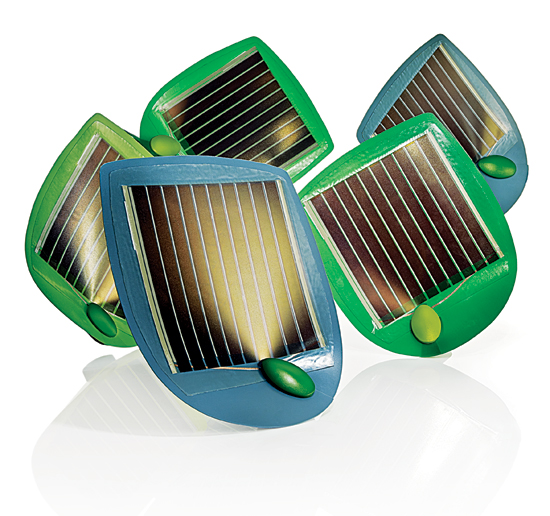
Solar panels are a common sight on rooftops but rare on vertical walls, which, being more or less parallel to the noonday sun, get less solar energy. Hoping to take advantage of this unused space, design start-up SMIT looked at how ivy plants nonetheless thrive on the sides of buildings. The company’s upcoming solar-energy system takes inspiration from the way a vine’s many leaves individually maximize their sun exposure.
Solar Ivy consists of thousands of four-ounce photovoltaic “leaves” that can be screwed into place on a steel-mesh wall covering. Exactly where each leaf is affixed to the grid depends on a pre-installation analysis: SMIT’s custom software calculates the angle that gathers the most light—in New York City, for instance, the leaves are tilted 49 degrees and rotated south—and a pattern that prevents the leaves from shading one another.
SMIT says 4,000 leaves will cover two three-story walls and generate 10 kilowatt-hours of power a day, a third of an average home’s needs. It is taking preorders for next year and is in talks to launch a pilot this month on the even more angularly complex geodesic surface of the Montreal Biosphere.Leaf Size: 8 by 10 inches
Leaf Power: 0.5 to 2 watts
Cost: Varies depending on size of project (est.$10-$15 per leaf)
More Info: s-m-i-t.com
138 years of Popular Science at your fingertips.
Each issue has been completely reimagined for your iPad. See our amazing new vision for magazines that goes far beyond the printed page
Stay up to date on the latest news of the future of science and technology from your iPhone or Android phone with full articles, images and offline viewing
Featuring every article from the magazine and website, plus links from around the Web. Also see our PopSci DIY feed
Science is reinventing play, from extreme sports to gamification to ridiculous roller coasters to the playgrounds of tomorrow, and this issue is chock full of fun. Also, on a less fun note: Did global warming destroy my hometown?
@ mad hatter
the point is to same the enviroment not your wallet. so if we have no planet then there is no point in saving money.
@ mad hatter
the point is to same the environment not your wallet. so if we have no planet then there is no point in saving money.
No shit. What a great value. Idiots.
Save the environment - WHAT THE HELL DOES THAT REALLY MEAN. I can take you to places on this planet belching sulfuric acid, others belching more carbon dioxide in 1 hour then man produces in a year. The politicians stressing SAVE THE ENVIRONMENT want to take the dollars from your wallet and don't give a damn about the environment. Wind, Solar and geothermal combined will NEVER provide the energy we need. The object of all this environmental crap is to make you feel bad so they can tax you more. If we put the amount of money into fusion research that we put into Yucca Mountain we would have unlimited free energy and could forget about these useless technologies that ALMOST do what we want ALMOST when we need it.
Yeah, that's absurd. And the next thing to consider would be how much of that array, if any, would actually survive 33 years of use, and what the environmental and energy cost of manufacturing is....
Green construction could easily shave 33% off the energy used by a home. Putting 40k of hardware onto an old building to make up the difference is just silly and not at all the environmentally-preferable option.
And, um, saving the environment? How does that work again? It's not as if distributed solar collection is the only clean-energy plan in existence.
Green is fine, but it doesn't have to mean rampant inefficiency. These things appear to be non starters
- The price is outrageous
- I doubt if there's been a study to show that they will last -- if they fail in a short period of time, then the manufacturing process will undo the green ness
- Most houses are 1 to 2 stories, and many have tree shaded yards
- What will the short winter day do to their 10KWhours
Eco friendly should have engineering requirements. Making something solar does not necessarily make it green
Well, there *are* requirements. Sticking these on an existing building without advanced insulation and such wouldn't qualify it as "green" anyway.
What everyone keeps forgetting is that it always cost more when you first start producing something. As you start making more of something it becomes cheaper to make after the R&D is paid off. After a few generations the price on these should go down to a couple dollars a leaf.
As to the people that don't believe about environmental impact studies, remember that the United States had some of the worst Acid Rain back in the 70's until we started removing sulfur from the smoke stacks and coke; and I don't even want to get started on what happens to the environment from digging for coal.
The are many existing solar products that could produce more energy for less cost. This product is stupid, a gimmick for people who wants to cover their house in "leaves".