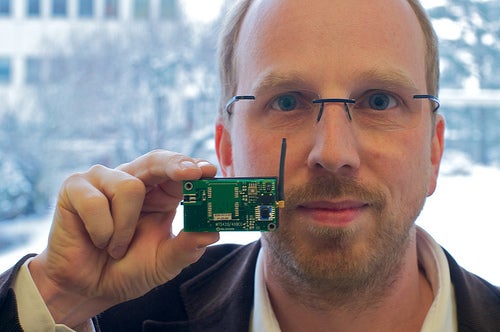
Mote Runner Dr. Thorsten Kramp, research staff member and co-developer of Mote Runner at IBM Research - Zurich, holds a mote programmed with Mote Runner to detect movement and light. IBM

In IBM's planned future, everything will communicate with everything. The company has now announced a new software development kit, Mote Runner, that will allow programmers to put anything from coffee makers to environmental monitoring systems on the "Internet of things."

Mote Runner -- nicknamed for motes, wireless sensor nodes that gather information and refer it back to a network -- can interlink any hardware equipped with wirelessly connected sensors. The extremely lightweight software is made to run on sensor chips tiny enough to be built into almost anything. IBM Research, which built Mote Runner, aims to increase adoption of such wireless sensor networks by making them easier to program and use.

Mote Runner apps can live in a tiny 64K of memory, and be written in standard languages like Java or C#. The apps can be debugged and deployed on simulated motes that run on a host computer.

In theory, motes can be connected across large or remote areas like agricultural fields, multi-story buildings, rainforests or glaciers, IBM says. Eventually, using chips that can connect any gadget, you could "talk" to all your home appliances from afar.

Mote Runner uses an 8-bit processor, 8 KB of RAM and a tiny 64 KB of flash memory storage. Its minimalist needs will allow it to run on small, inexpensive chips, which can be integrated into practically any device.

With the right app, Mote Runner could check on the status of elderly people at home, monitor agricultural processes, check building maintenance and security, and a host of other functions, Fast Company notes.

MEMSIC, a micro-electromechanical systems and sensor manufacturer, plans to offer Mote Runner on its popular IRIS sensor.

[IBM Research via Fast Company]

9 Comments

obviously this is skynet in disguise

..."8-bit processor, 8 KB of RAM and a tiny 64 KB of flash memory storage"...

Reminds me of my old Atari 800....Happier days...

Wireless medical devices have already failed in hospitals because of saturation of the bandwidth.

Are these devices akin to space junk, endangering useful orbits? What is the frequency and power?

I can't wait to hack your coffee maker "from afar"!! O_o

64kb is not that small, you can have a webserver in 32kb and have some space left...

More memory would lower demand for power as the unit could collect data save it to ram then when it starts getting full turn on the wifi and upload it all.

I wonder what kind of IO it has, can it take analog measurements naively or dose it just have a serial connection.

A wee bit of fpga on some IO ports would be cake.

Do you know more details about the application testing? I read somewhere that they are planning to develop mote applications in high-level object-oriented languages such as Java.
See Hungary: www.hungriabonita.com/hungria

I hope that it is easier to implement than General Packet Radio Server (GPRS) without the access point network connection. I don’t want to pay the cellular network for access to my Motes. You would still need a web page and some HTML code to collect (or send) all the data.

wow this is probably around the corner. I am already seeing commercials.
www.cheats4clubpenguin.com/club-penguin-alerts/

Popular Tags

Regular Features


138 years of Popular Science at your fingertips.

Innovation Challenges


Popular Science+ For iPad

Each issue has been completely reimagined for your iPad. See our amazing new vision for magazines that goes far beyond the printed page


Download Our App

Stay up to date on the latest news of the future of science and technology from your iPhone or Android phone with full articles, images and offline viewing


Follow Us On Twitter

Featuring every article from the magazine and website, plus links from around the Web. Also see our PopSci DIY feed


February 2012: The Future of Fun

Science is reinventing play, from extreme sports to gamification to ridiculous roller coasters to the playgrounds of tomorrow, and this issue is chock full of fun. Also, on a less fun note: Did global warming destroy my hometown?


circ-top-header.gif
circ-cover.gif