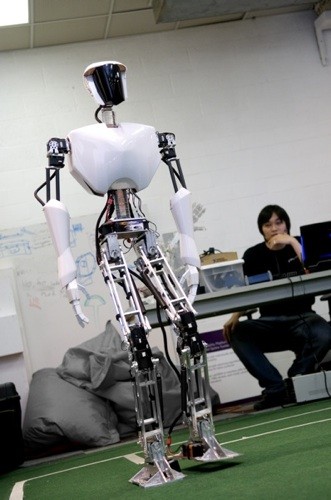
A group of undergraduate and graduate students at the Virginia Tech College of Engineering's Robotics and Mechanisms Laboratory (RoMeLa) have unveiled CHARLI, which they are calling the first full-sized, walking, untethered, humanoid robot, complete with four moving limbs and a head, to be built in the United States. While walking robots are nothing new, this one's humanoid counterparts, such as Petman and Honda's Asimo, are apparently disqualified for lack of height, autonomy, and nation of origin.
We can't verify the specs of every humanoid robot in every garage out there, so for now, we'll accept the university's claim that their machine is the first of its kind.
CHARLI (Cognitive Humanoid Autonomous Robot with Learning Intelligence) uses a built-in network of pulleys, springs, carbon-fiber rods, and actuators to move his limbs. At the moment, CHARLI can climb stairs and navigate uneven ground, which is more than most humanoid robots can do, and his engineers are working on technology that will allow him to talk.
CHARLI's inventors began developing him in 2008 under the guidance of Dennis Hong, associate professor of mechanical engineering, director of RoMeLa, and Popular Science Brilliant 10 honoree. While designing CHARLI, they drew inspiration from science-fiction films and from the input of their more artistic spouses.
"The environment we live in is designed for humans: The step size of stairs, the height of door handles, etc., are designed by humans for humans," Hong said. With that in mind, the CHARLI team focused on making a humanoid robot with motor skills that can handle human tasks. Despite the bar CHARLI has raised for other humanoid robots, its autonomy, hand movements, and overall intelligence, continue to present challenges for Hong and his colleagues.
There are two version of CHARLI in development: CHARLI-L, for Lightweight, and CHARLI-H, for Heavy. CHARLI-L, which will debut in Singapore's RoboCup tournament later this year, can walk indoors and on flat surfaces. In time, the robot, which stands at five feet -- towering seven inches over Asimo -- will be able to kick soccer balls.So far, CHARLI-H is just a leg, but upon completion, those legs will help him jump, run, and kick, as well as use customized actuators to stroll around the campus's hilly terrain.
Since they had only $20,000 in funds and some donated equipment from National Instruments and Maxon Precision Motors, CHARLI-L's inventors were forced to improvise on the usual mechanical issues. Check out the video below to see the robots in action and to hear the students talk about how they built CHARLI:
Granted, CHARLI has a ways to go before being ready to freely traverse the great outdoors, but Hong imagines that one day, he will put those moving limbs to good use by serving as a robotic housekeeper.
Correction: April 29, 2010
CHARLI L, the current robot, cannot walk on uneven ground. Down the road, that task will come from CHARLI H, who is just a leg so far.
Five amazing, clean technologies that will set us free, in this month's energy-focused issue. Also: how to build a better bomb detector, the robotic toys that are raising your children, a human catapult, the world's smallest arcade, and much more.


Online Content Director: Suzanne LaBarre | Email
Senior Editor: Paul Adams | Email
Associate Editor: Dan Nosowitz | Email
Assistant Editor: Colin Lecher | Email
Assistant Editor: Rose Pastore | Email
Contributing Writers:
Rebecca Boyle | Email
Kelsey D. Atherton | Email
Francie Diep | Email
Shaunacy Ferro | Email
this is so cool! i would really like to see this in person! i am so interested! i want to see the final product of the new CHARLI-H (:
petman roundhouse kicks this across the face
@funkyskunk2, I thought the same thing.
Very cool....looks like iRobot is around the corner :)
Ivan Malagurski
Japanese engineers from Honda made in 2006 or 07 human-like robot Asimo. It was full presentation with dancing and so on.
For 2010 it's kinda lame move, but for 30k it's really really great, because japanese cost around 300k.
pretty awesome :)
Big deal when a highly funded univ can make a robot. How about the african student who made it from old tv! (Goog: African student + tv + robot)
I agree with @chank. I'm much more impressed by the resourcefulness of Sam Todo to create his robot.
Just search Pop-Sci for "Togolese Student Builds Humanoid Robot From Old TV Parts"
Regarding the Togolese student good for him, but TV's do not have motors, actuators, gears, etc. to make the robot move. Right now, my 4yr old has a wind up toy that came FREE from a McDonald's happy meal that will walk straight. I made some pretty impressive stuff out of Legos when I was 7yrs old, before Technic and Mindstorm ever hit the shelf, but it never made it to PopSci.
Additionally, I did make a robot arm while I was in college and to those who have never done it, go try to make one before you belittle the university guys. That robot is pretty sophisticated for ~30K.
If it was so freaking easy, you would be able to buy "Rosie" from you local Wal-mart right now.
@2Adic2M, check your facts.
Honda has been creating and researching humanoid robots for around 20 years and has spent countless millions of dollars on the projects. For some students to create this type of robot for 30k is a great achievement.
Sunday, July 25, 2010
To my friends at Virginia Tech & in Japan: Asimo, CHARLI-L, HUBO, MAHRU, PALRO (and you other robotics geeks),…
Referring to the August 2010 issue of Popular Science, “The Loneliest Humanoid In America;”
As a person who has had great fun doing my share of robotics in the mid & late 1990’s, I’d like to offer a few tips. When, in Jacob Ward’s article, I read, “But if it encounters a closed door, the show’s over, because the calculations necessary to reach out, grasp the knob, turn it, and walk forward, pushing the door ahead of itself, are still too complicated,...”
I had to laugh. It doesn’t surprise me that we haven’t come farther with robotic technology given the fact that you feel you have to program it like that.
These days we don’t do the massive calculations for two dimensional movements across the screen to click an imaginary button. We calibrate the moving ball so that the calculations are done internally by the computer (so we never have to think about it again). Don’t try and program the robot to move, move the robot so it gets programmed!
It is almost certain that you will find through moving your bots that the center of gravity will be shifted causing it to fall over. The calves & feet need to be the heaviest, followed by the thighs (for low center of gravity). When it picks up a foot to try and walk, it needs to be able to tilt its upper body ever-so-slightly to maintain its constant center of gravity.
When I was working at OnTrak Systems in Milpitas/ Sunnyvale (now Lam in Fremont), we used Staubli robotic arms in our CMP wafer cleaning/ fabrication machines. With sensors on “Its fingertips,” (yes, I became very attached to it, almost like it was a child), it could grab a rack of 50 (almost complete) silicon wafers, whir them around at lightning speed and, with sensors and suction cups on its “fingertips,” gently lay them down into the chemical bath. After trying five times to “grab” a wafer to return it to the rack, and sensing no wafers were there, it knew that its job was complete.
http://www.ssirobotics.com/Staubli_Integration.html
You see that “arm?” If you were to get into the cage with it, it would continue going right on through you like you weren’t even there. And still could be taught to gently handle tens-of-thousands of dollars worth of wafers without breaking a single one!
(Now that’s cool sh!t, er stuff J)
Remember: ). Don’t try and program the robot to move, move the robot so it gets programmed!
Read more: http://blogs.myspace.com/index.cfm?fuseaction=blog.ListAll#ixzz0uh8vILmc