Future Human
The debates—and diagnoses—of the tiny Flores fossils rage on.
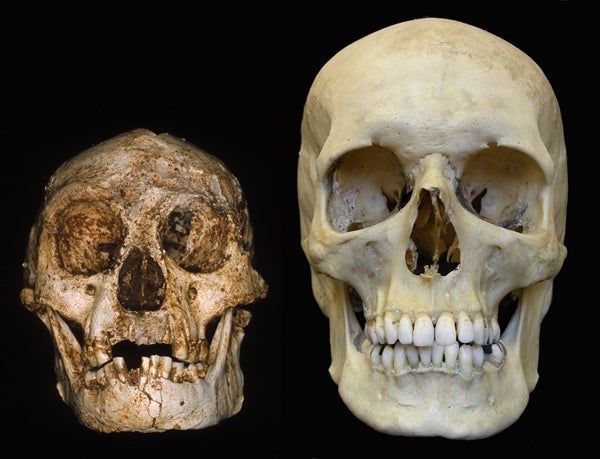
Skull Comparison On the left, the diminutive Flores hominids; a human skull on the right. Peter Brown

When there is only one skull to study and at least 65 scientists studying it, you bet there will be squabbling.

I’ve been following the scientific news of the diminutive Flores hominids—the meter-high beings with brains the size of an orange—ever since the astonishing fossils were first discovered on the Indonesian island in 2004. Recently, three new papers have emerged, and now things are really getting weird.

The discoverers and many other scientists think the so-called “hobbit” is its own species, Homo floresiensis. The bones, they say, resemble species much older than our own. Yet the Flores individuals lived as recently as 12,000 years ago, long after Neanderthals had perished in Europe. The find upended our smugness over the idea that Homo sapiens had remained the lone hominid on Earth since.

Some researchers propose the Flores fossils are Homo sapiens after all, victims of a disfiguring disease or malnutrition. Microcephaly has been suggested, as has a dwarfing disease called Laron syndrome. Each has been, or is about to be debunked by Florida State paleoanthropologist Dean Falk and colleagues.

The affliction-of-the-month—cretinism—is also poised to tumble. The growth of cretins is stunted from a congenital iodine deficiency. But a critical mass of others investigating the Flores fossils, including Stony Brook’s William Jungers, say they lack key features of this disease.

Provocatively, the cretin team also maintains that these beings turn up in Flores folklore as ebu gogo, or “greedy ancestors:”

“Unlike 'spirits', ebu gogo are described as mortal, without supernatural powers and no longer present. They lived in caves (lia ula, children's cave), were short, 'roughly built', hairy, 'pot bellied', stupid, the females had 'pendulous breasts', they stole food, could not cook and had imperfect language (Forth 1988). These characteristics are all consistent with ME cretinism...”

Two more studies—one published last week in Public Library of Science and the other published online yesterday in Proceedings of the National Academy of Sciences—take the pathology vs. new species debate even further.

When one of the first Homo erectus specimens was discovered in Java in 1891, it was deemed pathological by many; even called a "microcephalic idiot" by a prominent scientist of the day. And even as late as 1998, skeptics have suggested that Neanderthals were victims of cretinism.

I asked Jungers his take on the apparent urge to pathologize. “I consider it to be a scientific example of cognitive dissonance,” he said. “Here’s something out of the blue, no one anticipated; everyone’s got their mind made up about the course of [human] evolution. To have your scientific world view jarred like that is difficult to accommodate. It’s easier to dismiss it than to assimilate it.”

Skepticism, of course, is the muscle of scientific inquiry. But one wonders if the scenario of stunted, hirsute, potbellied misfits banished to a cave is too compelling to ignore, even when the bulk of the emerging evidence suggests that evolution alone—albeit a more complex version than we are now comfortable with—could have produced them. Perhaps Knowing Man’s (aka Homo sapiens) certainty that it knows itself is simply too hard to relinquish.


See the whole Future Human series here, where you can also subscribe to an RSS feed.

5 Comments

Well, how far do you want to take this argument -- that all variations in human form create beings which are necessarily "less smart" than Homo Sapiens?

For example, is a whale a retarded human? It's got the big head and flat face a Down syndrome? Is a chimp an ignoramus?

No, quite the opposite. They have "intellectual" skills which are now known to be in some instances superior to those of humans (chimps have cognitive recognition skills that are equal or slightly faster than humans).

Cretinism is usually caused by an inborn error of metabolism that causes the thyroid to produce insufficient amounts of the hormone thyroxin. Deficiency of iodine can INDIRECTLY cause cretinism, because thyroxin has FOUR iodine atoms in its structure. Iodine deficiency can cause the thyroid to produce insufficient thyroxin by depriving the chemical pathway that produces thyroxin of an essential substrate. Iodine deficiency is more likely to cause goiter than cretinism.

Endemic iodine deficiency always occurs in areas where the soil is deficient in iodine. Such areas are always remote from the sea. Sea water contains lots of iodine, which is aerosolized by wind and wave action and settles into the soil in areas near the ocean. This naturally brings up the question--how likely is it that a small island, with sea water on four four sides is a place where endemic iodine deficiency will occur?

David L. Kutzler

There is a precedent for the hobbit to be both a new species and a victim of a pathology.

One of the first Neanderthals skeletons found belonged to an old male later shown to have suffered from severe arthritis. His hunched posture, enlarged joints and knurled hands became the template for 50 years of scientific illustration about prehistoric humans. Indeed, the common conception of "caveman" comes from that one fossil.

Hobbits might be some already known species of humanoid but be afflicted with some disease.

"The find upended our smugness over the idea that Homo sapiens had remained the lone hominid on Earth since."

Thank goodness someone finally had the courage to call out Homo sapiens on their smugness. Whenever someone brags about some achievement here in our CPA firm, others will throw cold water on it by smugly declaring: oh yeah? Well Homo sapiens have remained the lone homind on Earth since the Neanderthas vanished. And I'm sick of it!

have been reading about the hobbits since they were first found. I find it interesting for several reasons. I am a hyperpurturty dwarf. age 46 wt 79lbs ht 4'9" I find it hard to believe that a whole group of humans will have the same type of dwarfism "caused by genetic or environmental" there are ex of populations of short people "pigmy’s etc” of animal populations in the fossil record "stunted dinosaurs etc" I tend to believe that was the case, it was natural selection on this one population. There are other examples of two or more human species in the fossil record, alive at the same time why not the hobbits and modern man. as for the notion that in some articles I read that the population my have been also mental retarded, they would not have been able to survive more then one generation in that condition expelly living with stone age tecnoly.


June 2013: American Energy Independence

Five amazing, clean technologies that will set us free, in this month's energy-focused issue. Also: how to build a better bomb detector, the robotic toys that are raising your children, a human catapult, the world's smallest arcade, and much more.


Online Content Director: Suzanne LaBarre | Email
Senior Editor: Paul Adams | Email
Associate Editor: Dan Nosowitz | Email
Assistant Editor: Colin Lecher | Email
Assistant Editor: Rose Pastore | Email

Contributing Writers:
Rebecca Boyle | Email
Kelsey D. Atherton | Email
Francie Diep | Email
Shaunacy Ferro | Email

circ-top-header.gif
circ-cover.gif