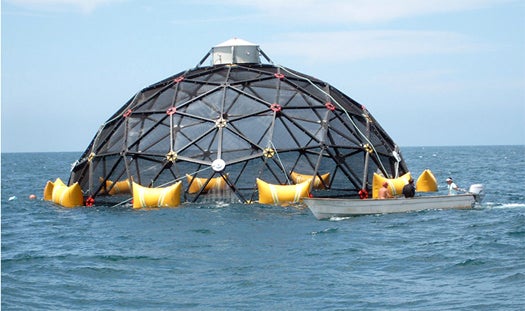
Aquapod Fish Farm Someday remote controlled motors could direct fish farms like this around the ocean. via Ocean Farm Technologies, Inc.

With over 70 percent of the world's natural fisheries taxed beyond the point of replenishment, the demand for farmed fish will only rise in the coming years. Unfortunately, the cramped conditions and shallow locations of most existing fish farms result in low yields and sickly, parasite-ridden fish.

That's where Cliff Goudey, director of the Massachusetts Institute of Technology's Offshore Aquaculture Engineering Center, comes in. He has attached robotic motors to a giant fish cage, allowing it to travel around the sea, rather than stay tethered in shallow water.

Goudey's specially equipped fish cage is the first step in a project to create giant mobile fish farms that would encase entire schools of fish, and travel with them through their natural migration routes. These "free range" fish would avoid the health and size problems associated with the current stationary fish farms, helping the farmers increase yield and relieving pressure on overextended fisheries.

So far, Goudey admits that the project is a little too futuristic to attract most fish farmers. But with plans to equip future models with GPS systems and radio transmitters, the day when a fisherman steers his fish towards his boat, not vice versa, may be approaching.

[via National Geographic]

Want to learn more about the environment, solar energy, sustainability, and more? Subscribe to Popular Science today, for less than $1 per issue!

13 Comments

In international waters? Seems a decent way to make farmed fish available to anyone who might take a boat out to the cage...

The picture seems material heavy, bulky, and small. While I assume that it normally is a submerged sphere, spheres are not necessarly the most efficient shapes to have for your aqua-farm.

A much larger, lighter frame in a more stationary position in an ocean current (for circulation) would be far more economical.

As for pirating, you would have to be a smart pirate to (1) hack the GPS (the ocean is much too BIG to just find stuff at random), (2) know when to go in (the fish have to be big enough to be worth harvesting, yet not already harvested, so a small window), and (3) in a ship equiped to haul such fish (which would not make for a speedy getaway).

While large scale open ocean contained aquaculture is clearly the planets long term solution to mass meat production, the economic reality is that until you cannot drag a net and not catch fish, tradition fishing is going to be cheaper (since any aquaculture requires some level of feeding in non-seasonal waters).

I wonder, when the fish farms become the size of cities in the ocean's rivers, is it likely that such structure will alter currents? How has deforestation changed the rivers of air in the sky?

Here are some questions:

How will you prevent other fisherman or pirates from stealing your cage? Being so small - will the fish within feel overcrowed and stressed? Disease or parasite prone? What kind of fish do you recommend for this?

Salmon wouldn't be happy in one of these, or would they? Would there be a signal beacon on each? Will these pods degrade? Will they be discarded in the ocean or abandoned?

Will they have any lead paint of noxious or toxic metals? How long would they last before replacement?

Would the fishfood contain factory farm waste/side products to cause the fish excrement to contain pollutants and spread them afar?

This seems like a very good idea... much better than shallow water coastal soon-to-be-dead-zones stationary areas.

But I still don't want farmed fish that are fed a chemicalized pellet from a ship. Sounds very contrived and subject to waste materials or unknown and suspect ingredients in the feed.

And I like podboq's question - how many pods would people want to throw out into the ocean - what kind of hazard do they pose for ships, boats?

Your cages certainly seem to be a better idea than what we have we have currently.

Thanks! : )

Cdin
------------------------
cdin.us/all
cdin.org
cdin.us/blogsites
: )

Really breathtaking further informative topic. Thank you seeing sharing this.certication.

I love the simplicity! I don't know how they'll handle food but the idea is delightfully simple.

Why is this too futuristic for most fish farmers? They're not exactly troglodytes. I assume that huge sucker comes with financing, it's own maritime license, and it's own insurance, so it couldn't be too much more trouble to run than a fishing boat or farm.

Healing Thoughts, HealingMindN

Rodger
MAKE IT MUCH LARGER,INCLUDE LIVING QUARTERS FOR SMALL
CREW AND SAVE ON ROBOTIC CONTROL AND STOLEN FISH COULD
EVENTUALLY EVEN HAVE PROCESSING PLANT ON BOARD

I'm sure it would take MASSIVE scale fish farming to come close to putting a drag on ocean current. It took how many trillions of tons of deforestation to shift wind currents a little? Water is much heavier than air, and thus even less susceptible to shift.

I'm not sure they would go to city sized either (though football field sized is a given). The bigger it is, the more drag the ocean currents put on it. A city sized outfit could not be reasonably anchored (to up current engines or the bottom substrate). I like the idea of a city sized farm with pontooned living, processing, and storage facilities built in (think of the facility in Deep Blue Sea, but with a larger contained area). Anchorage, though would keep it way too expensive.

Smaller ones (again, football field-ish) could be easily anchored, and a slow harvest/processing boat could rotate.

looks more like a climbing dome in the middle of the ocean.

my question is how the fish remain fed. most fish you would like to have be in these would be predatory like salmon. But it farming them in the open ocean doesnt really do much good if they dont have natural food, since we can already provide them with food that suffices. ..its just not as good as what they get in the wild.

It would have to be MUCH bigger..

Great ideas are often met with violent opposition from mediocre minds

We can stimulate fish repopulation, and more.

http://sites.google.com/site/stopglobalwarminginc/

Commercial fishermen are doing this with blue fin tuna. They corral them in open water with nets and keep them enclosed until they are ready to slaughter them. Because of the unplanned nature of the corraled tuna sample, too many young male tuna are being slaughtered. This results in less tuna growing to full size and is affecting the size and health of new tuna. Factory fishing operations will eventually ruin normal fishing and bring about more aquaculture.


June 2013: American Energy Independence

Five amazing, clean technologies that will set us free, in this month's energy-focused issue. Also: how to build a better bomb detector, the robotic toys that are raising your children, a human catapult, the world's smallest arcade, and much more.


Online Content Director: Suzanne LaBarre | Email
Senior Editor: Paul Adams | Email
Associate Editor: Dan Nosowitz | Email
Assistant Editor: Colin Lecher | Email
Assistant Editor: Rose Pastore | Email

Contributing Writers:
Rebecca Boyle | Email
Kelsey D. Atherton | Email
Francie Diep | Email
Shaunacy Ferro | Email

circ-top-header.gif
circ-cover.gif