John B. Carnett, PopSci's staff photographer, is using the latest green technology to build his dream home. This is the first entry in his new blog tracking the build--follow along at popsci.com/green-dream
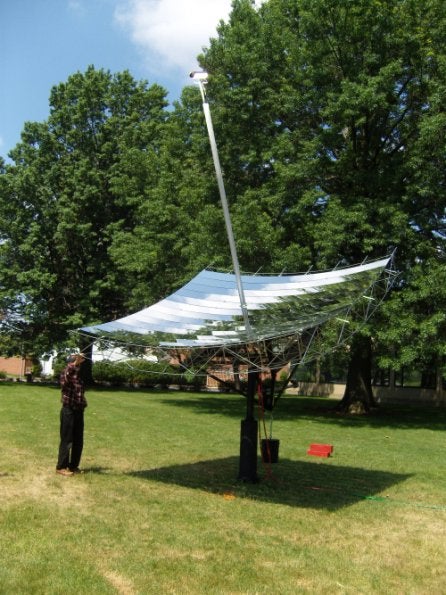
No, it's not a death ray. The folks at RawSolar are creating what looks like a very affordable solar thermal tracking dish. This is a mini version of the concentrating solar power systems you see commercially in the 25 kilowatt range.
This sort of technology is game-changing. The 12-foot-diameter mirrored dish uses a patented process to flex a flat mirror into a parabolic shape. That process, combined with the lightweight frame, should give it a very high efficiency at a very low cost. The company was started by Spencer Ahrens, a 23-year-old mechanical engineer, who, in between bouts of burning wood with the thing, got his masters degree from MIT. With the dish, you can make steam for directly heating and cooling your house, or run the steam through a turbine to make electricity.How much will it cost? How much power can it generate? I want one right now! I sent them an e-mail and am waiting...

Stay up to date on the latest news of the future of science and technology from your iPhone with full articles, images and offline viewing
Featuring every article from the magazine and website, plus links from around the Web. Also see our PopSci DIY feed
Share links with friends, comment on stories and more
In our December issue, Popular Science names the 100 best innovations of the year: bombproof wallpaper, self-parking cars, the fastest helicopter, and 97 more. Plus inventor profiles and videos.
Check out the best of what's new here.
I want two!
better still if the mirror was hydrophobic, it'd be self-cleaning, maybe it is...
Just to give everybody an idea of how much power it may generate, here's a few facts.
According to the RawSolar website, the mirror can heat water to 212-750°F (100-400°C), making steam. The Waste Heat Engine (WHE) by Cyclone Power Technologies, which runs on steam as low as 225°F can produce up to 16hp at the maximum efficiency obtained at 600°F. This is enough horsepower to run a 10kw generator. The NetZero home concept by GE expects to use solar panels to generate the 3-4kw its home requires.
These are all numbers I pulled off the various websites, there may be some loss of efficiencies when the systems are combined. In addition, this sort of system will more than likely operate at less than peak performance for large portions of any given day.
How will these dishes affect aircraft pilots and satellite photos? Will the glints be a problem?
The amount of power possible is a function of aperture (mirror collector area). 1-square meter produces 1000-watts. Minus losses from the reflectivity of the mirrors (which are at the most 95% reflective) and heat loss to the environment. So, in reality, the most you could really get would be about 500-watts per square meter.
A horsepower is 746 watts, to to have usable 16-horsepower, you would have to have a massive dish 23.8 square meters (about 5x5 meters). Or 24 one-meter dishes.
Note that it would only produce this while there was direct sunlight, which would be somewhere about 8 hours a day in Arizona. So in these ideal conditions, to produce 16-horsepower for a 24-hour day, you would need a dish a whopping 192 square meters - or 13.8 meters by 13.8 meters (that is 45.4 feet by 45.4 feet).
This is the biggest challenges with solar.
Thank you 3DTOPO for the added expertise. I have very little myself and was relying entirely on figures from the various websites. May I ask if there's a link for the the 1000-watt per 1-square meter figure that you used? Specifically, I would like to know if the wattage is determined by the standard type of turbine used, or is 1000w/meter squared a direct measure of the energy contained in the sunlight?
Nevermind, I used wikipedia and found that you were in fact referring to a direct measure of watts for sunlight itself.
Correct, if we could attain 100% efficient transfer from sunlight to energy the most you could hope to get would be 1000-watts per square meter of collector surface area. That is why I said you would be lucky to harvest 500-watts per square meter...
There is an Israeli firm doing the exact same thing
www.zenithsolar.com
Really nice... Solar is the best energy for environment, and im happy to see that things are going in the right way... Keep up the good work :)
http://www.tendances-de-mode.com
Here's a helpful link for determining how much solar energy your area receives on average for each month of the year. The statistics are in terms of kilowatt hours per meter squared per day.
30-Year Average of Monthly Solar Radiation, 1961-1990
http://rredc.nrel.gov/solar/old_data/nsrdb/redbook/sum2/state.html
'TrueGreen' Same thing?
I just sent an e-mail to Zenith Solar to see what the power and cost would be on the Z1. It looks like they have a neat preformed plastic solution that can control the production costs to some degree- I'll let you know if they respond..
Staff Photographer
Popular Science Magazine
How many people will die per megawatt produced? People seem to want to ignore just how immoral these "green" alternatives are. No "evolution scientists" need apply. No one is interested in voodoo.
jisom: what on earth makes you think that people would die from using solar collectors?
3DTOPO We are very aware that the concept is NOT NEW - What is NEW is the fact that RAW SOLAR seems to be saying that they have created a VERY cheap solution-(ability to form the surface, light weight, can use low cost motors to track). As you can imagine VALUE is very important- If cost and performance are as good as they seem to be suggesting- that is the point of my post- I have yet to get any data from them to support the cost / value but when I do I'll let this group know-
Staff Photographer
Popular Science Magazine
I like how my comment does not show up but your privileged response does.
I think it might be more responsible to have that data before publishing an article that supports a company's marketing agenda claiming that it is "game changing technology".
I would be willing to bet that the cost per watt of usable electricity would be around the same price or more as photovoltaic cells (don't forget to factor in a turbine, inverters, and so on).
3DTOPO Take a moment to look above my note and you will see that your comment was not removed- I may be on staff but we run a very open form of communication- The Raw Solar BETA unit exists and is sitting at MIT. It was made out of very cheap materials- is very light and thus easy and cheap to steer - My use of "game changing technology" is related to what was done in the creation of the BETA and my strong feeling that in mass production they could only do better... You are correct and I don't have one in my yard at this moment and can't tell you exactly how it is doing- It offers more than power- it offers the ability to heat -My goal with this blog is to help inform folks about the technology that interests me and to allow folks to be apart of the journey...
I expect that folks will have different opinions- I hope for a give and take- I also expect to have experts from all sorts of different areas come aboard and chime in-
Everyone is welcome here- J
Staff Photographer
Popular Science Magazine
John: Be sure to get detailed info on the TYPE and SIZE of the turbines--this would make a big difference on how much actual power we might get after all mechanical & electrical losses are factored in.
It has been mentioned we might get 10-16 KW?? I think that is awfully optimistic from the mirror size that is mentioned. Most homes would require 2-3x that to be independent of the electrical grid.
Keep us updated, please. Thanks.
Folks- It's been five long days since I contacted the company via the general "info" e-mail address- NO REPLY. I tracked down the founders personal web site and sent him a note today. I understand they were in the middle of moving so stand-by as I continue to try to get hold of the data that we all want to know-
Staff Photographer
Popular Science Magazine
'TrueGreen" I contacted ZENITH
They are saying that they just installed a pilot 248 kWp, combined electrical and thermal system at Kibbutz Yavne and are starting to look at the global market- They have no plans currently to be in the States but said to check back in early 2010. I get the feeling that if they go global that they are looking at larger scale field installs than say one in my backyard!
The search continues...
Staff Photographer
Popular Science Magazine
If the pole were a yard higher, it could be used as a patio. Then with three or four of those, one could shade a yard party.
Too bad it just makes hot water. Another one with photocells could produce electricity, but converting it to a usable form (120 v. 60hz) would be another trick, and then integrating it into power from the commercial line would be yet another.
why are they just now figuring out that it would really cut people coast down by putting one of theis in thier back yard
what id really like to know is how much were spending on electricity in irac and if this can safely be deployed in a combat zone or military base
ps. if your really an employee see if you can get the forums back
jerrydd
A much more simple unit would be a 200sq' trough collector which would put out about 3kw of electric and 9kw of heat. This would make 9-24kwhrs/day of electric and 27-72kwhrs/day of heat. Enough for most eff home and at a good site, enough to make money from plus all your power needs.
It's just a 5hp steam/Rankine engine, a collector, 3kw alternator and condenser, easily built for $6-8k in mass production. Why are these not widely available?
I believe one will be one of the first Cyclone products. I use to work building large innovative yachts for the Cyclone inventor and he is a very smart, reliable person.
But most A/C unit with minor mods could be Rankine engines, making power instead of using it.
CSP units drive alternators so don't need inverters, just a anti islanding switch to hook to the grid. And they can be fired by wood pellets/biomass gasifiers or any other fuel if one needs power and the sun doesn't shine.
Solar power is much more valuable because it mostly happens at peak power consumption times.
"How much will it cost? How much power can it generate? I want one right now! I sent them an e-mail and am waiting.."did they respond with the cost and power generation? I am thinking of installing landscape lighting outdoors and am curious about solar power options...
http://factoidz.com/a-guide-to-installing-low-voltage-landscape-lighting/
Thanks to Craigslist Free Section and the outdated Satellite Dish Technology, you can get a structure to make your own, very easily. Yeah and many mirrors to cut and attach, with scrap piping to make a Stirling engine, and a treadmill motor to generate the electricity.....it might take a while, but almost free is so much better, to me at least it is...
John, it seems to me that if you want to do this thing in any reasonable amount of time you would probably have better luck with trying to get Zenith Solar to give you a special run at their technology. They may be more receptive if you let them know that how large your audience is. I am sure they would welcome the exposure you could give them in the United States. Also, considering they already have an installed and running solar plant based on their Z10-40 solar concentrators they would be more likely to be able to help you with any engineering or installation challenges which you may experience. Another factor in their favor is that they utilize both solid state photovoltaics and heat to boost their efficiency to 75%. 75% total efficiency is quite an impressive number. Photovoltaics will also give you immediate usable energy without having to run any kind of mechanical system that is more prone to failure and more expensive than solid state technology overall. Total cost of ownership would be substantially lower. The heat gained from cooling the photocell might be put to good use in an absorption refrigeration air conditioning unit. Have you considered utilizing a absorption refrigeration unit to make effective use of the solar heat energy? A refrigeration technology that I find quite impressive is the Einstein Refrigerator (http://en.wikipedia.org/wiki/Einstein_refrigerator). It is an absorption refrigerator that requires no moving parts and only a heat source to operate. It was invented by Albert Einstein and Leó Szilárd in 1930. What this means is that it is possible to design a home solar power and refrigeration system that will never break down due to moving mechanical parts such as compressors or power turbines. The fact that such a refrigeration unit would not use a chlorofluorocarbon would certainly add big time to your desire to make this all a truly "Green Dream."
This kind of technology is already in use in rural India. Remote, rural applications may be the strongest ones, in addition to some military ones.
Nation-building may well be a mix of both 19th century technology and 21st century to provide locally sustainable solutions.