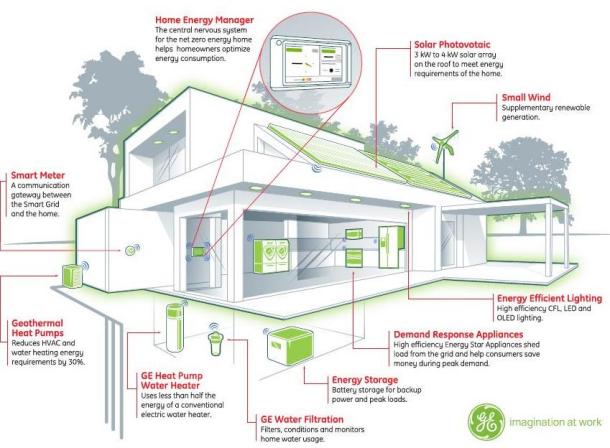
By 2015, if General Electric has their way, all our homes will be running on smart grids with mini-turbines and solar panels to produce electricity, consuming zero net energy in the process.
GE says that their smart energy system, dubbed the Net Zero Home project, will center around a $250 central management hub that will allow all of a home's networked appliances and on-site power-producing equipment talk to each other, as well as to the smart grid outside the home..
GE's push comes at a time when power conservation is valued more than ever, and smart energy innovations are pouring in by the day.
The goal here is to make people more conscious of how much power they're using and how often they're doing it. By enabling a home's appliances to scale down their performance or power state during peak hours, cities will not only conserve energy, but consumers will save money.
[CNET]
138 years of Popular Science at your fingertips.
Each issue has been completely reimagined for your iPad. See our amazing new vision for magazines that goes far beyond the printed page
Stay up to date on the latest news of the future of science and technology from your iPhone or Android phone with full articles, images and offline viewing
Featuring every article from the magazine and website, plus links from around the Web. Also see our PopSci DIY feed
Science is reinventing play, from extreme sports to gamification to ridiculous roller coasters to the playgrounds of tomorrow, and this issue is chock full of fun. Also, on a less fun note: Did global warming destroy my hometown?
Beautiful idea.
Next we need massive joint efforts to build entire towns on this technology.
What happened to greenville...?
Great idea. I call it the mini (private) power plant.
Milieunet Foundation is a non-profit organisation focused on awareness and change of behaviour by means of communication about waste, energy, sustainability, nature, environment, climate, human rights and international development cooperation.
Where is the electric car?
Where is the electric motorcyle?
These are critical if you want to be free.
The best way to be free of the insanity of Middle Eastern turmoil is to have no reason to be there.
GE MUST get vehicles integrated with its big picture so it can look the hero that saved the USA or maybe even all democracy.
Or put differently, GE is positioning itself to save energy or save a few bucks. Interesting but hardly heroic.
But with GE's engineers enthusiastically integrating electric vehicles into their big picture they could literally being saving their country.
Not to be too cynical about it, but I suspect that GE is trying to position itself for the expected marketplace -- and make a few bucks.
It would be nice to see the spec sheets and proposed prices for this concept. (Also the geographic areas that would work with some of the concepts, such as the solar roof and mini turbine).
I have a quick question.
im not trying to be cynical but who's the information gonna go to when they say:
"networked appliances and on-site power-producing equipment talk to each other, as well as to the smart grid outside the home"
so is some one else or a computer going to be looking at your energy usage and tell you to use less or what?
and if so are we going to have a choice on saving energy or is it going to be mandated?
I work for GE and you can bet some money will be made - I mean would "You" do it for "Free". And what is wrong with making some money and Research is not cheap?
rnojonson: hold the phone folks the wonders of new technology are put on hold because of the overwhelming cost of retrofitting reality. I am talking about pushing technology down into the fabric of society where they are usually stuck with energy sucking appliances, leaky inefficient houses and minimum wages to where profits are thin. They make up the majority of homes in most already built cities and towns.
Green just can't be a rich boys dream time play ground and the word "cost competitive" is tainted by the high profit motive. A big wealthy company doing green shouldn't overly pass the cost on to folks to where they can not enjoy the cost savings they are hoping for. The cost savings over time formula is thrown out by folks who live pay check to pay check. This is why green to us is saving plastic bags, cans and trying to justify swirly fluorescent bulbs when incandescents are way cheaper.
I would put a not so smart 12-24 volt DC subsystem in average homes sort of like whats in RVs. Then attach every low power appliance and lights and computing and communication on that system. A single house converter handles solar/wind/battery for the subsystem and the grid supplement tie-in when necessary. The big appliances stay on the grid until further development. There should be an incentive to move all equipment to the low power sub-system and also to raise the green power input to that system.
In this light, OLEDs are innovation and solar/wind/batteries are practical in places where the sun doesn't shine so much. But you got to put green in better reach of the masses else the pie in the sky's cream will drip in the eye obscuring the vision and 10 years later we are still grid slaves.
In Louisiana we have a few home builders offering energy efficient options. Notable among them is a company called Road Home Builders (www.roadhomebuilders.com), they broke ground on a net zero home a few months back. I imagine it's done by now but their hasn't been an official announcement on their site yet.
Here's a link to the story about their net zero home:
www.roadhomebuilders.com/news/going-green-in-new-orleans-with-net-zero-house/
Shocking - what garbage. This is what happens when engineers think they can design a house. Stick to what you know - packaging, wiring, dashboards and brake lights. The need for a house to be energy efficient does not mean it has to look like a storage unit. Architects spend 6 years in college learning how to understand design, then another decade before some become good at it. Homes are where American families bring babies to grow into children and healthy adolescents, do homework and one day introduce their future husbands or wives. Where people fall in love and live their dreams as they grow old together. This looks like a place where animals are housed between drug fueled runs in their mazes. I don't disagree that it's our fault. The American Institute of Architects is famously bad at communicating with the public. One reason for that is that it's mostly run by those with time on their hands - which is rarely the best us. ..and the public has little interaction architects. Unless you're wealthy or a high level executive, you may never meet an architect your entire life, let alone know what we do. But what we spend all that time learning and finally create cannot be cranked out by Joe 12 pack who just spent $49 on do it yourself house maker software any more then a taxi driver can design a race car. Whether GE, Edison or Pop Sci, I urge you to spend a little time learning about where architecture really comes from. Look for your local AIA chapter and search for 'design awards' to find firms near you that would be happy to help.
@shepard150
Actually, the "Joe 12 packs" of the world have been building their own homes for centuries without the help of architects. They have very often produced well thought out, lovingly built homes that last for decades.
Architects do very nice work sometimes but have always seemed to be artists whose medium is houses and buildings. They have about as much to do with what people on this planet live in as a fashion designer who works with super models does with what the average person wears.
With over 7 billion people on this planet we need efficient durable inexpensive housing. If we have to wait for architects to design a home for each individual, we all better get used to camping. It's gonna be a while.