Wind Power
Turbines to take root in the sea
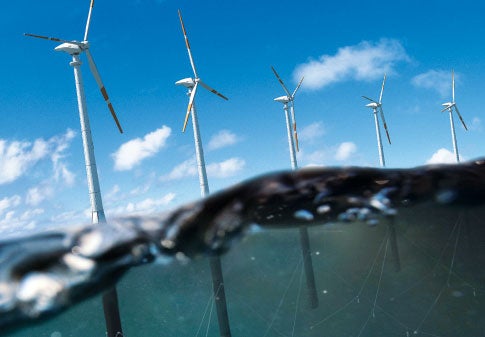
The Big Picture: Wind power is all about location — getting turbines where the breeze blows steady and strong. One of the best places for that is far out at sea. And because one of the biggest obstacles to expanding wind power is overcoming the objections of residents who don’t want wind farms blocking their views, deepwater wind, which is invisible from shore, has dual appeal.
Where We Are: 94 GW
What We Need by 2050: 2,000 GW
Tech to Watch: Deepwater Wind
According to the U.S. Department of the Interior, seabound wind farms off the Pacific coast could generate 900 gigawatts of electricity every year. Unfortunately, the water there is far too deep for even the tallest windmills to touch bottom. An experiment under way off the coast of Norway, however, could help put them anywhere.
The project, called Hywind, is the world’s first large-scale deepwater wind turbine. Although it uses a fairly standard 152-ton, 2.3-megawatt turbine, Hywind represents “totally new technology,” says Walter Musial, the principal engineer for ocean renewable energy at the National Renewable Energy Laboratory of the U.S. Department of Energy. The turbine will be mounted 213 feet above the water on a floating platform, or spar — a technology Hywind’s creator, the Norwegian company StatoilHydro, draws from its experience as Scandinavia’s largest gas and oil company. The steel spar, which is filled with ballast and extends 328 feet below the sea surface, will be tethered to the ocean floor by three cables; these will stabilize the platform and prevent the turbine from bobbing excessively in the waves. Hywind’s stability in the turbulent, wintry Scandinavian sea would prove that even the deepest corners of the ocean are suitable for wind power. If all goes according to plan, the turbine will start generating electricity six miles off the coast of southwestern Norway as early as September.
To produce electricity on a large scale, a commercial wind farm will have to use bigger turbines than Hywind does, but it’s difficult enough to balance such a large turbine so high on a floating pole in the middle of the ocean. To make that turbine heavier, the whole rig’s center of gravity must be moved much closer to the ocean’s surface. To do that, StatoilHydro plans to engineer a new kind of wind turbine, one whose gearbox (the mechanism that transfers power between the rotor and the generator) sits at sea level rather than behind the blades.
Hywind is a test run, but the payoff for perfecting floating wind-farm technology could be enormous. Out at sea, the wind is often stronger and steadier than close to shore, where all existing offshore windmills are planted. Deep-sea farms are invisible from land, which helps overcome the windmill-as-eyesore objection that has derailed wind farms in the past. If the technology catches on, it will open up vast swaths of the planet’s surface to one of the best low-carbon power sources available.