Even if we tap every renewable power source available, it won't mean a thing without a final, crucial step: reinventing the grid

The Next Grid:  Nick Kaloterakis and Kevin Hand (See an annotated version of the next grid)
The American electric grid is an engineering marvel, arguably the single largest and most complex machine in the world. It's also 40 years old and so rickety that power interruptions and blackouts cost the economy some $150 billion a year. The idea of building a connected "smart" grid that can route power intelligently is beyond daunting, no matter how much stimulus money gets thrown at it. But if we want to cut carbon, we have no choice. Today's grid simply cannot handle a large-scale rollout of the clean-energy sources outlined in this series.

In part that's because we need new high-voltage power lines to connect parts of the country where renewable resources are abundant (the sunny Southwest deserts, the windy Great Plains) to the cities and suburbs where more people live. But the more fundamental problem is that most renewable power sources don't behave like fossil-fuel sources — they can't be turned on and off on demand. Wind farms produce power only when the wind blows; solar, only when the sun shines. This is problematic, because power demand is twofold: We need "baseload" power that's predictable and steady, and "peak" power for daily spikes in demand (when, say, everyone arrives home and turns on their air conditioning). Intermittent renewables are not well suited to either. But with more power lines connecting power sources over a broader geographical area, renewables can simulate baseload power. (The wind is always blowing somewhere.) And a smarter grid cleverly shifting power demand around can redirect enough clean electricity to handle it when demand increases suddenly.
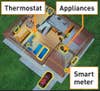
At a Small Scale: sensors will connect each appliance in your home to a smart meter. The meter will serve several purposes. One, it will provide detailed information on how much energy you’re using at any given time and what it’s costing you. Two, it will allow you to control your energy use remotely — from your office computer, for instance. Three, it could allow your electric utility to regulate your energy use for you, reducing power flow during peak demand hours  Nick Kaloterakis and Kevin Hand

The idea behind the smart grid is to embed the system with sensors and computers so that utilities and consumers can precisely control power usage and delivery. Wireless nodes (on substations, transformers and wires) and smart meters (on homes and businesses) will communicate over the Internet to you and your electrical supplier. That way, when everyone turns on the A/C, the electric company can lower the power headed for other appliances, or even draw electricity stored in the battery of your plug-in hybrid, which, when parked, would act as a backup power source.

Rebuilding the entire grid and all its components could cost trillions, and it will require the coordinated efforts of hundreds of state and regional agencies, power-plant owners and electrical utilities. But the smart grid is already appearing piecemeal. By 2012, Southern California Edison, one of the country's largest electrical utilities, will install 5.3 million smart meters throughout San Diego and Los Angeles that will tell homeowners exactly how much power they're using at any given time — an important first step. The city of Boulder, Colorado, will soon finish building the country's first smart grid, with smart metering and a variety of sustainable energy sources. And President Obama's stimulus package includes $11 billion for smart-grid technology, to be used for research and demonstration projects.

Finally, a smart grid and a new network of high-voltage power lines to support it will make rolling brownouts a thing of the past. Let's get to it.

Return to the Future of Energy 2050 Roadmap

Want to learn more about the environment, solar energy, sustainability, and more? Subscribe to Popular Science and enter to win $5,000!

10 Comments

I would create some special type of accumulation power plants. When the power is plenty this Accumulation Power Plants will extract energy from the grid and will spin flywheels. When the power is needed it will be delivered back into the grid. Some more methods of storage can be envisioned.

... you know they exists in real life. In fact I was just at one of the largest one: http://www.power-technology.com/projects/tianhuangping/ Instead of flywheels water is use, which can hold way more power.

"Three, it could allow your electric utility to regulate your energy use for you, reducing power flow during peak demand hours."

This sounds more like another invasion of privacy than a way to reduce energy. The last thing I would want to happen is have the power company turn off my playstation lol.

It shouldn't be anybody's business what your appliances are doing or what your thermostat is set at, most especially the power company or the government.

As for turning down the power when they want, remember that summer in Europe where 30,000 people, mostly elderly, died because of the heat? It will be interesting when the power companies can't build enough power stations due to "Global Warming" and have to turn off your air conditioner to keep from crashing the grid during hot days.

How many people will die? Go ask the "cap and traitors".

What a wonderful world we live in. Why not work on the one thing that would be cheaper for everyone? I have said it before "Self Powering Magnetic Dynamo's" for every single house and eventually car in the states would elminate the need for about 2/3 of this supposed new grid. We have long been victims in this country of the "status quo", the established scientific theory that says that any form of zero point energy is a ridiculus notion. I have worked the theory out for the past 5 years and I can tell you that there is no reason it should not work. Were I to construct a prototype I am confident that I will never pay for electricity again. Sadly were I to release my discovery, if I didnt get laughed out of the scientific community, I would most certainly dissapear courtesy of the United States government. Pray for me and yourselves this new grid path is just a slightly longer dead end path than that of fossil fuel.

Magmonster: The limit is not the amount of generation, it's the transmission. A wire can only take so much juice before it gets fried, and we need bigger wires to bring the power from where it is (like the abundant wind in the Midwest) to where it's needed in big cities. This is just a no-brainer to get cheap, abundant American energy to the folks who need it.

Also, I'd be up for a program to voluntarily reduce my energy use at peak times and use cheaper electricity when demand is low. That's how a market works, balancing supply and demand through pricing. Right now, our system is almost socialism, where you don't have to pay more when people demand more.

It would be better to have a decentralized power grid. While we need to have a better power grid for commercial users, local or at home production of power (at least enough to run lights, frig, microwave) thru solar,wind geo ect. would help in cases of natural, terrorist disasters. This coupled with more efficent houses (that are worth what they cost) passive/active solar ect. this could be done with a change in the building code in conjunction with agreements with alterative energy companies to lower costs for tax breaks to increase production at lower cost. this would also produce more jobs at a very low cost to the Gov.

I agree, getting off the grid is the BEST way to solve our problems.

http://classic-car-parts.tumblr.com/

Kids...Your never ready I dont care who you are. I hope they burry it all. As I heard it all the poles were supposed to be temporarry. This alone would create alot of work for a fool like myself. Also lessen any real weather related problems related to downed lines and what not. As far as the actual generation and storage of the energies why not set the whole thing up like a big flashbulb or something. I'm not by anymeans a scienctist or a good speller, but there has to be a proper mechanical or chemical type of storage that is capable of holding all the energy for a short time till the people turn on the lights. I suppose we need to first intorduce the energy then worry about the storage. Transmission shouldn't be this complicated. Computers will do most of the thinking and solong as it is all intertwined there shouldn't ever be a "blackout". And for the help being given by the Government to create this proposed New Grid, it means jobs. That is the real bottomline. Again start making the power and the rest will come as it allways does....Through necessity.Let's just encourage all the different forms of energy production and wait for the best to come to the top.

I see no reason for anyone who wants to get off the grid not to have the ability to just get off of the grid. Calling your local power company and telling them to turn off power to your home takes only a few minutes. There is nothing which requires anyone to be hooked up. Problem solved for the "off the grid" and "decentralized" people. What added value are the comments of getting off the grid for those who need just the electricity through a centralized transmission system than the hassle of a do it yourself system?

There are none.

Some day there will be made available economical systems so that everyone can have an easier choice.

@EParker: Now your talking. More energy cheaper to more people. Through wires! sounds to me like a grid.

The grid actually does not need greater transmission capability. Storage of energy would solve that problem. There is so much energy that can travel through thin wire if the resistance is controlled. Transmission can be done 24 hrs. a day from storage depot to storage depot and then into a section of the grid accessible end users. The problem now is rush hour or peak time without storage depots. On the superhighway of electricity the problem becomes demand. High demand creates a pull from the user rather than a push from the available power which is computer controlled to make the power according to demand. This translates into resistance that exceeds the thin wire capacity. There are several ways to hold energy but everything requires investment in a system that will not give investors the profits they are looking for.

Most people do not know that electricity moves slow like mud through a pipe and demand is like trying to suck on a milkshake that is too thick to easily move. That is where the heat becomes a problem.

There is several companies that store energy as compressed air in large underground caverns that are sealed and hold 1200psi. They fill at night and in the day are ready for the peak hours. There are many ways to make things better but the businesses that are already in place like their positions and do not want competition. Placing several systems that hold energy in an easy way to transform into electricity such as water and compressed air would be more difficult to control by those who already control because who then would send the most important part of electricity to the consumer which is the electric bill.

No one cares about the consumer of electricity except for when the consumer is writing that check. So I do actually see why people want to get off the grid. But the grid is not the problem. Energy storage is as much a new frontier in the now visible need to better manage what has been known for a very long time by those who have seen energy consumption on it's way to overtaking production and transmitting of energy. The greatest problem is the greed that energy companies have been allowed to enjoy as the saying is that "business is business and nothing personal" and that is a motto that all Americans love to live with.

And things like "Don't take it out of my pocket". So the problems for the majority will remain as they must continue to count on the grid while getting mad that someone has a hand in their pocket.

There are those who hate what I say. I am just writing to say hello to them. I love you all.

Cheers.

Robonvac.


Download Our iPhone App

Stay up to date on the latest news of the future of science and technology from your iPhone with full articles, images and offline viewing


Follow Us On Twitter

Featuring every article from the magazine and website, plus links from around the Web. Also see our PopSci DIY feed


Become a Fan On Facebook

Share links with friends, comment on stories and more


December 2009: Best of What's New

In our December issue, Popular Science names the 100 best innovations of the year: bombproof wallpaper, self-parking cars, the fastest helicopter, and 97 more. Plus inventor profiles and videos.

Check out the best of what's new here.

Popular Science Photo Pool


Share your photos in the Pop Sci pool at www.flickr.com!
tags_sprite.png
POP_embeddedForm_cover_May09.jpg