Our reporter is at the International Scientific Congress on Climate Change, part of the lead-up to the United Nations COP 15 climate talks in December, where there is tons of information -- little of it heartening
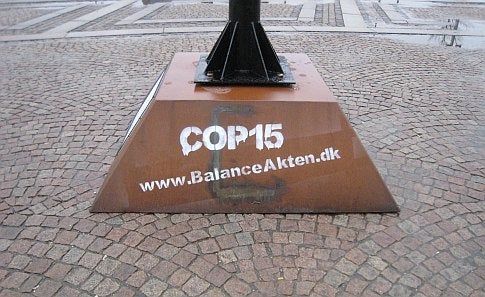
Graffiti in Copenhagen Anticipates December's COP 15 Climate Conference Seth Fletcher

"There is not a lot, if any, good news that will be presented in the coming days," said Katherine Richardson, the University of Copenhagen oceanographer. So began the International Scientific Congress on Climate Change, a gathering in Denmark's capital city of scientists from around the world. The purpose of the conference is to synthesize the latest research on global warming. A summary of the findings will be distributed to the global policymakers who will meet here in December at the United Nations's COP 15 meeting. There, if all goes according to plan, those delegates will produce a climate treaty that will replace the 1997 Kyoto Protocol.

The team tasked with condensing this flood of findings into a politician-proof summary has a hell of a job ahead of them. This conference is enormous -- a deluge of information on melting ice sheets, sea acidification, second-generation biofuels, wind power, electrical-grid efficiency, biodiversity, carbon sequestration and just about anything else related to the future of the environment. Attendees use a 71-page book to navigate the event; it takes an additional 43-page guide to find your way around the poster sessions.

Despite the mass of information, the first day yielded a few unmissable pieces of emerging common wisdom. They go something like this:

Even if every nation in the world throws everything they've got at reducing greenhouse-gas emissions, we'll probably be stuck with a planet that is, on average, 3.6 degrees F warmer at the end of the 21st century. Both polar ice caps, and Greenland, are melting; Greenland alone is shedding 50 to 70 cubic miles of ice each year. Since 1993, sea levels have been rising by approximately a tenth of an inch per year -- which is faster than the rate of rise observed through most of the 20th century -- and that is likely to accelerate. Ocean levels will rise by as much as a meter by 2100. That will wreak havoc on people living in low-lying countries. "Coastal flooding events that today we expect only once every 100 years will happen several times a year by 2100," said oceanographer John Church, of the Center for Australian Weather and Climate Research. That, alas, is only the beginning. Even if we seriously rein in carbon emissions, ocean levels will probably keep rising for centuries, and that rise will most likely accelerate over time, according to Stefan Rahmstorf of the Potsdam Institute for Climate Impact Research.

To anyone who's seen An Inconvenient Truth, this may sound pretty familiar. But the real news of the day seems to be that all the bad stuff we knew was probably happening is definitely happening, and more quickly than we had thought. Here, scientists are using several years of fresh data to give the most recent Intergovernmental Panel on Climate Change report an unnerving new chapter. It's a good thing this conference is being held at a convention center a solid train ride away from central Copenhagen. If we were in the city center, this barrage of reality might have sent half the audience straight to the pub in search of a pint of Tuborg.

The "good news," perversely enough, had to do with the recession. In the afternoon plenary session, Richard Levin, president of Yale University, said that the financial crisis has a silver lining -- it provides a chance for transformation that in better times might not be possible. Retrofitting buildings, mass transit, vehicle fuel efficiency, smart grids, wind, solar, biofuels: all will stimulate the world economy, Levin said. The timing of COP 15, then, is oddly perfect. As Levin put it, COP 15 is a "critical opportunity not to be missed."

Tomorrow, the news promises to be less grim. Talk of solutions begins first thing in the morning. I'll be racing from session to session on biofuels, carbon capture and plenty of other cool low-carbon tech, and reporting on it here.

Want to learn more about the environment, solar energy, sustainability, and more? Subscribe to Popular Science and enter to win $5,000!

10 Comments

JPB

from Colby, KS

I am afraid there is little we can do about climate change. It is history repeating it self. See Chart http://www.scotese.com/climate.htm

I hope your little greenie idiots can keep you profitable, because one more article like this and I am not coming back. I am tired of the propaganda. We don't have NEAR enough information to say that the globe will warm by 3.6 degrees. Period. Once you decide to quit pushing this crap let me know and I will come back and subscribe to your magazine again.

Meanwhile, on the other side of the debate:

"Scientists meet to dispute global warming theory"
www.onenewsnow.com/Culture/Default.aspx?id=439146

Maybe we could get some equal coverage?

Copenhagen? The last time us taxpayers sent this special interest group (the IPCC) on vacation it was a 5-star resort in Bali. Must be nice being a fearmonger on the "research grant" gravy train.

The IPCC uses old junk science based on pre-2007 inputs like the de-bunked "hockey stick graph". LOL

Here is the latest hard science from NASA (no computer-models):

www.science.nasa.gov/headlines/y2008/23sep_solarwind.htm

Nasa says the sun is suddenly losing power and it is already "13% cooler". This explains all the record snowfalls and record low temps in 2008-2009.

Throw another log on the fire. It's record cold where I live.

Peace

Alarmism and sensasionalism. Journalism at its best, science at its worst. If I don't see an article on the climate conference going on in NY City I am done with this magazine. Science is about debate and there is clearly debate going on out there - Note to POPSCI: SHOW IT!

Observations are one thing. The causes are entirely conjectural. Future predictions are even more uncertain. I am a supporer of clean water, clean air and energy independence. I support new technologies. However, I believe using man-made global warming as a reason to push these ideas is destroying the reputation of science as an institution.

I think its great that Boston Harbor is cleaner than it has been in over 100 years. We can swim in Winthrop Beach again and see deeper into the water than we could 30 years ago. But the rock in the surf I used to stand on as a kid 40 years ago is still above water! I know this is anectodal but according the Gore and Hanson, this rock should be under water.

Only peer reviewed research and rigorous debate of the facts can reveal the scientific truth. Sensationalism is not scientific.

Please ignore the climate change denialists -- ideologues are not, by definition, amenable to evidence that might contradict their most cherished prejudices.

As for your piece: this is an excellent summary, and I'm glad to see PopSci has someone in Copenhagen to cover this very important conference.

I hope you'll give the solutions part of the conference more than just one post -- it's very important that people get the message that we already have the technology to solve this problem and that it's simply a matter of mustering the political will to get it done:

An introduction to the core climate solutions
http://climateprogress.org/2008/10/22/an-introduction-to-the-core-climate-solutions/

Well, I'm glad to see after five in a row of the usual clique, we finally had a sensible response. Man, I take a week off, and they just go to town. With responses like "greenie idiots," this so-called debate from the denialists can only aspire to the level of elementary school taunting. Right now it's about equivalent to the scatological hurlings of monkeys at the zoo.

The science supporting a global warming trend is pretty much ironclad by this point, such that citing the numerous articles from Popsci, Scientific American, Nature, Science, and more scholarly works is redundant. And since the best computer models have ruled out every other alternative but the oh-so-coincidental matching rise in carbon and methane emissions from human activity, I'd say the evidence for human causes of global warming is just about as certain. But if you just love being the contrarian in every crowd, may I suggest the Flat Earth Society? I hear that due to declining membership over the past couple of centuries, they've got a great recruitment program, and it might just be up your alley.

It's depressing when you come to terms with the fact that there is virtually nothing humans can reasonably do to stop global warming, but there is good news: You can spend more time worrying about other things now. If it helps, you can read through some of the studies and discover that the theory that humans caused global warming has little to support it so far.

Just for fun, I took NASA's GISS temperature graph from 1978 to 2008 and extrapolated it for another 100 years. GISS temperature graphs always show more warming than the generally accepted ones produced by the NOAA and other reliable sources. (I'm sure it has nothing to do with the fact that James Hansen, the Father of Global Warming, is the director.) The GISS graph shows roughly a 0.9 F warming for 30 years. If you extend that for 100 years to 2108, with no attempt to curb global warming, that comes out to 3 degrees Fahrenheit. How did you come up with 3.6 F even if every nation does all they can to slow warming?

It's always illuminating when you look at the data yourself and figure it out rather than trust others' inflated numbers or guesses.

laurena7 - the temperature increase is not linear, it is accelerating, that is how they get the 3.6 increase. Even if all nations reduced CO2 emmissions it would accelerate before it slows down.

jward23 - None of the temperature time series plots I saw of the last 30 years showed accelerating warming. It was linear.

Most of the reconstructed historical temperature time series--ranging over hundreds of years--also don't show accelerating warming, although a few of the ones based on tree ring measurements do.

The only place warming always accelerates is in computer models. Those models are still a long way from matching the observed temperature data.


Download Our iPhone App

Stay up to date on the latest news of the future of science and technology from your iPhone with full articles, images and offline viewing


Follow Us On Twitter

Featuring every article from the magazine and website, plus links from around the Web. Also see our PopSci DIY feed


Become a Fan On Facebook

Share links with friends, comment on stories and more


December 2009: Best of What's New

In our December issue, Popular Science names the 100 best innovations of the year: bombproof wallpaper, self-parking cars, the fastest helicopter, and 97 more. Plus inventor profiles and videos.

Check out the best of what's new here.

Popular Science Photo Pool


Share your photos in the Pop Sci pool at www.flickr.com!
tags_sprite.png
POP_embeddedForm_cover_May09.jpg