EarthTalk
Could CO2 emissions from the earth be bigger greenhouse-gas culprits than humans?
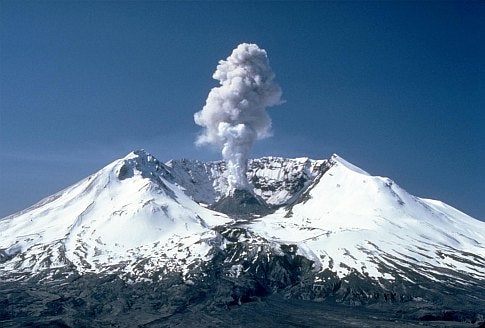
Volcanic Emissions Lyn Topinka, courtesy U.S. Geological Survey

Dear EarthTalk: Could it really be true that a single large volcanic eruption launches more greenhouse gases into the atmosphere than the amount generated by all of humanity over history? -- Steve Schlemmer, London, England

This argument that human-caused carbon emissions are merely a drop in the bucket compared to greenhouse gases generated by volcanoes has been making its way around the rumor mill for years. And while it may sound plausible, the science just doesn't back it up.

According to the U.S. Geological Survey (USGS), the world's volcanoes, both on land and undersea, generate about 200 million tons of carbon dioxide (CO2) annually, while our automotive and industrial activities cause some 24 billion tons of CO2 emissions every year worldwide. Despite the arguments to the contrary, the facts speak for themselves: Greenhouse gas emissions from volcanoes comprise less than one percent of those generated by today's human endeavors.

Another indication that human emissions dwarf those of volcanoes is the fact that atmospheric CO2 levels, as measured by sampling stations around the world set up by the federally funded Carbon Dioxide Information Analysis Center, have gone up consistently year after year regardless of whether or not there have been major volcanic eruptions in specific years. "If it were true that individual volcanic eruptions dominated human emissions and were causing the rise in carbon dioxide concentrations, then these carbon dioxide records would be full of spikes -- one for each eruption," says Coby Beck, a journalist writing for online environmental news portal Grist.org. "Instead, such records show a smooth and regular trend."

Furthermore, some scientists believe that spectacular volcanic eruptions, like that of Mt. St. Helens in 1980 and Mt. Pinatubo in 1991, actually lead to short-term global cooling, not warming, as sulfur dioxide (SO2), ash and other particles in the air and stratosphere reflect some solar energy instead of letting it into Earth's atmosphere. SO2, which converts to sulfuric acid aerosol when it hits the stratosphere, can linger there for as long as seven years and can exercise a cooling effect long after a volcanic eruption has taken place.

Scientists tracking the effects of the major 1991 eruption of the Philippines' Mt. Pinatubo found that the overall effect of the blast was to cool the surface of the Earth globally by some 0.5 degrees Celsius a year later, even though rising human greenhouse gas emissions and an El NiƱo event (a warm water current which periodically flows along the coast of Ecuador and Peru in South America) caused some surface warming during the 1991-1993 study period.

In an interesting twist on the issue, British researchers last year published an article in the peer reviewed scientific journal Nature showing how volcanic activity may be contributing to the melting of ice caps in Antarctica -- but not because of any emissions, natural or man-made, per se. Instead, scientists Hugh Corr and David Vaughan of the British Antarctic Survey believe that volcanoes underneath Antarctica may be melting the continent's ice sheets from below, just as warming air temperatures from human-induced emissions erode them from above.

GOT AN ENVIRONMENTAL QUESTION? Send it to: EarthTalk, c/o E - The Environmental Magazine, P.O. Box 5098, Westport, CT 06881 USA; submit it at: www.emagazine.com/earthtalk/thisweek ; or e-mail: earthtalk@emagazine.com. Read past columns at: www.emagazine.com/earthtalk/archives.php.

Want to learn more about the environment, solar energy, sustainability, and more? Subscribe to Popular Science today, for less than $1 per issue!

23 Comments

To start with, a report in the journal NATURE this week claims to prove that Antarctica is warming. It is not. What Eric Steig at the University of Washington and chief collaborator NASA scientist Drew Shindell did in this paper was to go back and make East Antarctica colder in the years 1957-79 by extrapolating (another word for making up) data points to plug in the largely empty data field that represents the huge expanse of East Antarctica.

East Antarctica is actually the bigger part of the continent, but there were very few measuring stations between the EA coastline and the South Pole back in the 1950's, 60's, and 70's. Steig and Shindell made up an explanation to allow them to make up and plug in numbers in the empty data field that would, when re-averaged, make the majority of the continent relatively warmer compared to the period that they monkeyed with. THIS IS DONE DESPITE THE FACT THAT TEMPERATURES AS ACTUALLY MEASURED IN EAST ANTARTICA AND THE SOUTH POLE INDICATE A SLIGHT COOLING in the years 1979 to the present day!

In Western Antarctica a slightly different statistical trick was employed. The west coast of the frozen continent has always been warmer than the rest due to warm ocean currents from the Pacific and Indian oceans rubbing the shore. The big question is how far this local shoreline warming really penetrated inland towards the South Pole? Once again, no measuring stations were in the right place to give us real data, so Steig & Shindell made up some numbers to plug in, based on their opinions about what satellite temperature measurements of the upper stratosphere mean when extrapolated downward, plus a rather funny claim that studies of ice and snow layers can nail down temperature variation to one degree C. or less, which is what is at issue.

I believe that there are two problems here: one of which the article fails to address, and another the author addresses incorrectly.

First of all, volcanic eruptions over history certainly may account for far more CO2 than humans have ever produced, because it is an anual output over a great amount of time, but that does not mean that each year the volcanos produce far more than we ever produced.
Our assumption is that the ecosystem is capable of handling normal volcanic CO2 production, and not current levels produced by humans. The author fails to clarify the difference.

Secondly, there are eruptions of supervolcanoes that we have never witnessed that in one eruption (or series of eruptions) can produce the equivalent of 3000 times the CO2 that the human race has produced in the last million years. The assumption being made is that the ecosystem can rebound from such events - however the situation is horrific - leading to mass extinctions - something we might not survive.

To address the first response to the article, or rather add to it...

Climatologists jumping on the global warming bandwagon are combining modern satelite temperature readings with archaic satelite readings from the 70's and 80's with pre-satelite era ground temperature readings dating back a hundred years, and archeological data of dubious origin. This mixing of data is desperate filling-in those blank areas. A new controversy has sprung up around satelite readings versus ground readings.

Simply, satelite data shows a warming atmosphere, while the ground data is showing a cooling atmosphere. The jury is out on this phenomenon. That is one reason that we are hearing so many contradictory headlines. ANother problem is the archeological data that assumes that growth patterns on seashells indicates temperature because the descendants of those organisms exist today. The scientists assume that, because they look the same, they are exactly the same. Has anyone heard of the word "adaptation"? How about the word "ass-u-me"?

According to some data, the sea levels are too low. Normally between ice ages the sea level is up to 65 feet higher than it is today, and probably much warmer. So is our planet just warming up like it should? Are we in the middle of an unusually cool period between ice ages? If so, the assumptions of global warming are rubbish. Our planet is supposed to be much warmer.

Who says that our planet's ice caps are always supposed to be covered in ice? How do you date ice? You ASSUME a constant snowfall like current rates and work backwards, assuming things were the same in the past. There is so much we do not know...

For the past 5 years I have been hearing that the ozone hole is growing and shrinking (at the same time!). It depends on what you mean by ozone hole. Depending on what selective altitude you look at, the hole is getting smaller each year, or bigger. The truth is, we really don't know what its 3-dimensional shape is supposed to be. Maybe it is supposed to be that way. Maybe it is falling apart.
I appreciate all the alerts about the environment, and I believe that we need to seriously change our habits, but it is also extremely important to get it right. Scientists that make these headlines (one way or the other) are doing a great disservice to science and humanity. Eventually we may tune out and realize that they don't have any idea what they are talking about.

You date snowfall the same way, precisely, as you date wood... by its rings, or layers.

On Mt. Rainier, in the spring, you can read each snowfall of an inch or more for the whole winter season, in the plowed areas.

Ever hear of an ice-core?

Also, the world may handle our CO2 output a bit better if we'd QUIT CUTTING DOWN ALL THE DAMNED TREES.

I know, I know, there's billions of trees, we've barely scratched the surface of our forests, BULL. Places we think are naturally tree-less usually aren't. Any place with rainfall over 20in a year is naturally covered in trees.

I don't care what ANYONE says, mankind's activity is changing the planet adversely. Anyone who can't see it is blind, and those who deny it are liars.

and yea, i'm mad about it.

Out of curiosity, podboq, have you ever been to the plains or the high mountains? Some areas of the former and most of the latter have around 20 in of rainfall, if not more, but, for other reasons (besides human activity), are not covered in trees. Rainfall and lack of humanity are not all that trees require to grow.

Also, do you have any suggestions for humanity to right our wrongs, or is our very presence on this planet destroying it? ALL living things change their environment: ants, termites, birds, you name it. Four billion years ago, our atmosphere was devoid of oxygen. It was a poisonous emission of the primitive bacteria of the day. Life was devastated at first, but adapted and flourished quickly. Our small, if any, effect cannot compare. Life on earth will outlast us. It is arrogant to think otherwise.

I think podboq stated his/her philosophy pretty clearly: "I don't care what ANYONE says..."

That pretty much negates any possibility of reasoned discussion and self-classifies their writing as a thoughtless rant, doesn't it?

Again, the assumptions...

Rings on a tree? Ice does not grow, it accumulates during storms. There are no seasonal growth rings. Scientists can assume that differences in the layers indicate seasonal changes, but climate has varied greatly in the past 120,000 years, from ending one warming period, to an ice age, and now our warm period. Different layers in snow deposits may indicate different things, a fluctuating weather system with greatly varied snow deposits, perhaps.

What are seasons like during ice ages? How many little ice ages have we had in the past 8,000 years? 1, 2, 3, or more?

We don't really know the answers. Science makes great assumptions which we constantly have to change according to new evidence and guess-work.

Paleo-archeologic evidence tells us that sea levels have been much higher in the past, and temperatures much higher during periods between ice ages. Certainly the glaciers must have melted. Right?

Then we hear climatolgists claiming that we are destroying glaciers that are millions of years old. What?

Do these scientists get together and listen to each other?

Maybe these "rings" aren't what they appear to be. Ice is not carbon-dateable. Dating the organic matter found inside it may give unpredictable results. We don't really understand what the climate was truly like.

A new solar theory predicts that the sun's output varies over time, from producing strong visible light, to periods of reduced visible light and increased ultraviolet radiation. What effect do such changes have on carbon dating assumptions? Could they make things seem younger or older than they really are? Does ozone build up and affect the amount of radiation the planet receives?

Questions, questions, questions.. make no permanent assumptions.

Read everything, doubt everything, and then you are on the correct to be a true scientist.

I recently saw a show about the history of the formation of the Badlands and how one scientist went against the scientific community by proposing a major cataclysmic event that created the terrain. Up until that time, scientists believed in slow processes occuring regularly. All of their science required predictability. Eventually the evidence could not be disputed. But recently, the veiw has be overturned, somewhat. We realize, now, that not one single cataclysmic event create the Badlands, but many smaller events that occured fairly regularly.

Was the ice age a steady event, or was it abrupt, varying?

An interesting point about the ice age, which ended about 8,000 years ago. An enourmous glacier covered over the northern part of the US, miles thick in higher latitudes. It pressure scouring the surface of the earth cleaned our ecosystem, pushing soil south. That means that immediately after they melted, the northern part of our continent was bare bedrock.

Our great forests are all younger than 8,000 years. In 8,000 years our ecosystem was created from scratch, according to the prevailing theory. I find that wild. Is that true?

I knew the 'we're not causing the filth and problems we live in' group would show up, LOL, too predictable.

Ice doesn't grow, that's BRILLIANT! Of course it doesn't grow, it accretes, and can be read as layers, wait for it, Just Like the Rings on a Tree.

No, all the information contained in ice cores isn't infallible, since ice periodically melts, that information is either lost or blended into the layers that didn't melt. I mentioned Mt. Rainier, because I've been up there myself to see it, when it snows 10 ft in a single season, you can cut vertically down through the snow pack, and read exactly how many times it accreted more layers.

Now, if we have layers of snow, interspersed with layers of snow with pollen, or soot in it, we can roughly gauge that the pollen came during warmer periods, and soot may have come from times of fires or volcanic eruptions.

The point being, you can read the layers.

There's a lot to be said for listening to the earth. It seems all the nay sayers and 'we're not befouling the earth' people only listen to themselves.

Would YOU drink water from a creek on your property? Why not?

I would not drink out of ANY creek before filtering, podboq. Does giardia ring a bell?

Anyway, the whole problem with "listening to the earth" is that it is more like an abstract painting or inkblot than a whisper. Almost everyone (yes, even reputable scientists) who gets the data either plugs it into their models or interprets it differently. Science is, by nature, fallible. In the absence of these concrete facts, people often read what they want to into weather data. For instance, much of the heating that people point to in cities over the past century and a half can be explained by increasing development causing the heat island effect. Saying "listen to the earth" is synonymous with "look at your emotions, ignore any contrary facts, and follow my thinking."

justin's off the deepend.

Animals drink untreated water ALL the time and don't get sick. Are we not animals?

Listen to the earth isn't some cute idea, it's looking at rivers and seeing how foul they are, it's seeing once endless forests replaced by clearcut and farmland; you can't change the land without it changing the weather patterns that made it fit to live in in the first place.

I never said science was infallible.

1. Animals do get sick. How do you think water-borne diseases started? Most animals have a disease or parasite in them at one point in their lives. As humans, we try to live at a higher standard. I, personally, want to live to middle age, a rarity in nature

2. That farmland feeds millions and provides their livelihood. Will you tell them just to starve or dive deeper into poverty so that the forests can remain "endless"? Nature will always reclaim that land.

3. I have not gone off the deep end. Every word that I have said is based off of logic or what I have seen.

A lot of issues came out in these responses. Let me say about satellite temperature measurements that about a decade ago global-warming advocates got their way and were able to force a mass re-calibration of all satellite and high altitude balloon temperature measurements to make them warmer. This was done on the claim that problems with the instruments and the interpretation of the data had made the "archaic" measurements too cold.

So, arbitrarily and by hand, things were warmed up in the outer stratosphere. The changes only amounted to a degree C. or so, but little changes like this make Big Headlines that brainwash the gullible. The great Antarctic ozone hole relates to this issue because not only do CFC's allegedly cause ozone depletion leading to the hole, COLDER TEMPERATURES IN THE STRATOSPHERE ALSO GROW THE HOLE!

So, the reason the ozone hole is still around is probably because the stratosphere over the South Pole is still pretty darn cold and not because CFC's with some difficulty and great issues of cost effectiveness were banned from asthma inhalers. At ground level the South Pole itself seems to be growing steadily colder.

My point is the way people do things can be done better with less harm to nature.

We've given a lot of our work and livelihood, as you refer to, to corporate farms who farm with petrochemicals that simply aren't necessary. We build things out of materials we don't have to, for the livelihood of those who bring us the materials, they could be doing other things and we could be protecting our environment better.

Just like all things, we usually take the easy way out. Easy? 1000 acres of corn worked by 5 people can feed 100,000 people, while befouling and over-using the water supply, instead of 100 people working it and keeping the water cleaner than it would be otherwise.

Maybe I'm using bad examples, I don't know.

Living beyond your natural years... is that really a good thing?

1. The form of farming that you rail against, podboq, is the most efficient we know today. Get rid of the petrochemicals, and more people will starve as food prices rise. The "easiest way out" is used for a reason. It minimizes human effort, freeing us and our intellect to contemplate more than simple survival. Science, civilization, culture, and all their benefits owe their very existence to our ancestors taking the "easy way out."

2. I come from a farming area, and I can attest that there are few, if any, 1000 acre farms employing 100 people.

3. How many "natural years" do we have? In nature, dying of old age is unheard of. Disease, predators, accidents, or natural disasters always get you first.

There wouldn't BE so many people if we hadn't started using petrochemicals. And people breed too much.

It seems like the point you're tryin to get across is we're doing the best we can, and the mess we're making can't be helped.

Are you republican?

No, I am an independent conservative who does not favor euthanasia or birth limits. Once you start telling people how many children to have, what next? What they can drive? How much they can make? Who they can vote for?

The point that I am trying to make is that the mess is not as bad as you think, and that the blame is going to the wrong places. To use your words, we are animals, and animals change their environment to suit our needs.

FYI, I'm not in favor of government enforcing birth limits, I'm in favor of people controlling their own breeding. And I don't think the blame is going to the wrong places.

As smart as we think we as a species are, we're not half as smart as we can be.

Use petrochemicals to farm easier, to make more money, because you sold more food, more people think hey, there's enough food for my 10 kids, then bam, a freakin sunspot happens, and they starve to death in some huge public tragedy, because they exceeded the natural limit on production through artificial means in the first place. Tell me the United States, as a prime example, isn't living beyond its means, or suffering because of it.

As an observation, it seems to me that religious peoples are doing their damnedest to force God into action through whatever means. Bail us out! Ain't gonna happen...

The article failed to mention that water vapor makes up 95% of the greenhouse gases in the atmosphere (gases with 3 or more nuclei). It also failed to mention that CO2 from human activity is only about 4% of the total CO2 emitted annually. Finally it failed to mention that Ocean warming causes the release of CO2 while cooling causes the Oceans to absorb CO2. That is why CO2 increases lag world temperature increases. The Warmests have the cart before the horse. It's like observing that people are crowding the beach in warm weather and are not at the beach in cold weather and jumping to the conclusion that if we just kept the people away from the beach, it would stay cold.

Flying over the upper US this past week, I could not help but realize that while fields covered with snow were reflecting sunlight back to space, those with trees were absorbing it. Then I remembered as a youth that it was always warmer in the woods than in the fields in winter. So if we just cut all the trees down in northern climates we will get colder winters and stop global warming...

Industrialized societies have seen their birth rates fall below sustainable levels. Countries like Japan are aging. Europe and the USA would have falling populations if not for immigration. In third world countries where you have 100 people farming those 1,000 acres, the populations are increasing and they are moving away to industrialized nations. Logically then the only hope for saving the Earth from overpopulation is to allow industrialization to encompass the world.

awful, LOL, I love when people put a spin on things for the sake of absurdity.

Seriously, that was good :D

Woods are warmer in winter, not so much cause they absorb more heat, but that they dampen wind, although absorbance is part of the reason.

I guess I'm in support of letting those who breed outside their means to take care of themselves to die of whatever kills them. That's not harsh I think, it's just, logical. If you can't support yourself, you've no business having kids. 3rd world countries included.

Podboq, where do you see anyone begging God to "bail us out"? Also, America is not suffering because we produced too much. It is because of people confusing want with need financially. Also, sunspots do not kill off crops. Finally, you've no business telling others how they should live their lives. Just live yours your way and let others take care of their own.

Where do I see it? Everywhere, people behaving as if nothing matters but money, that someone will come in and save us from ourselves. The world IS suffering because it artificially produces too much, and what it does produce it doesn't distribute evenly. Our excess of production has 'raised the world's standard of living', and what happens when production falls, or fails? Those dependent on it suffer.

If you don't understand allegory, don't bother arguing against it. Sunspots don't kill crops, LOL.

Who does have the business of telling others how to live? I certainly am allowed to speak. Speaking out is a basic human right, no?

We see people suffering for lack of infrastructure EVERYWHERE. The problem isn't the lack of infrastructure, the problem is human infrastructure replacing nature's, and people becoming dependent on what they have created.

It really baffles me, considering the helpful-not helpful numbers, that more people side with those who believe we're doing just fine and it's not our fault, rather than those who believe we're causing our own problems. I don't deserve you people, and the world certainly doesn't. Your stick-togetherness is gonna carry civilization right over the edge... I hope you all live to see it.

uuuummmmmmmm.......ok, so supposing that the volcanoes do put out that much greenhouse gasses.....well......what are we supposed to do about it? put a little cap on the volcanoes to keep it from doing it again? dont think so....ya know? i dont see that working out to well....so horray, it does it! whatcha gonna do? well.....if anybody comes up with a way to keep thoose things from going off....let me know, ok?


June 2013: American Energy Independence

Five amazing, clean technologies that will set us free, in this month's energy-focused issue. Also: how to build a better bomb detector, the robotic toys that are raising your children, a human catapult, the world's smallest arcade, and much more.


Online Content Director: Suzanne LaBarre | Email
Senior Editor: Paul Adams | Email
Associate Editor: Dan Nosowitz | Email
Assistant Editor: Colin Lecher | Email
Assistant Editor: Rose Pastore | Email

Contributing Writers:
Rebecca Boyle | Email
Kelsey D. Atherton | Email
Francie Diep | Email
Shaunacy Ferro | Email

circ-top-header.gif
circ-cover.gif
bmxmag-ps