Energy-efficient tech dims Edison’s bright idea
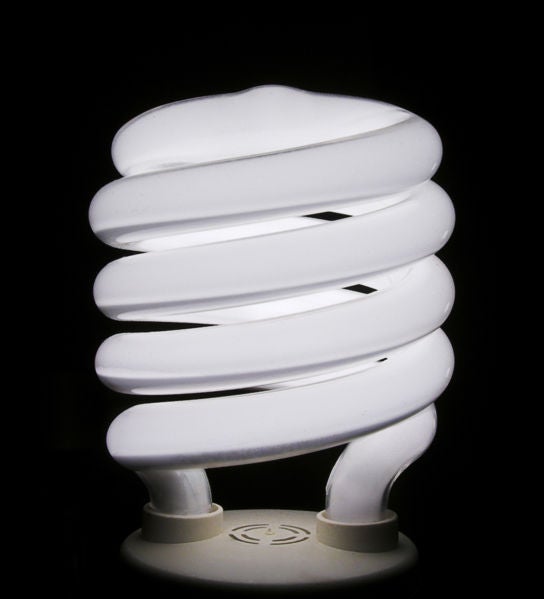
compact fluorescent bulb PiccoloNamek

On March 1, the Republic of Ireland becomes the first democratic country in the world to ban the traditional incandescent lightbulb. Stores there will no longer carry the century-old technology, which converts only between 5 and 10 percent of electricity into light, losing the rest as radiant heat. (Compare this with the 40 percent efficiency of compact fluorescent bulbs.) In its place, hardware stores will stock shelves with compact fluorescents, halogens and LEDs.

The U.S. is making the switch too, albeit more slowly. By 2014, most light- bulbs will be 30 percent more efficient than those currently available. "Incandescents aren't going away," says Peter Banwell of the Environmental Protection Agency, "but they will have a minimum efficiency level they'll need to meet."

Read more of Popular Science's predictions for 2009.

Want to learn more about the environment, solar energy, sustainability, and more? Subscribe to Popular Science today, for less than $1 per issue!

17 Comments

I'm sure I'm not the first person to question this type of action. Sometimes I wonder if the added complexity of including a ballast in every unit is a huge drawback to the technology. Being from Canada I question how reliable this type of bulb would be in hash winter conditions. I hope that our government does not ban incandescent bulbs. While incandescent bulbs may not be the best choice for all situations, there are many situations where incandescent blubs simply do the best job.

In Canada, many people still heat their homes with electricity. Wouldn't using incandescent bulbs in the winter just mean that their electric heating is used less due to the heat created by the lights? This would make the bulbs more efficient in reality than they are on paper. If this is the case, than using the good old bulbs would be better in that situation, since disposing of the old bulbs is a more simple process?

I do agree that it seems silly to turn on the AC in the summer in a room filled with incandescent blubs, but wouldn't the cost of electricity help people make the more energy efficient choice, with a bit of education?

I know that every little bit helps, but sometimes I feel that the government is resting all it's hopes for reductions in energy consumption on Joe the homeowner, while the big consumers are free to act how they please.

Around 60% of residential energy in Canada goes to heating, and 20% or less goes to lighting. Somehow the savings seem less significant when you consider the other ways you can reduce energy consumption in the home. Like the use of better insulation.

Somehow I feel like the developed world keeps placating itself with solutions that really arn't getting root of the problem. We keep using more energy, more efficiently, instead of using less energy, more efficiently?

Tim

Eggman002 (not verified)

I would like to see a study to determine if it is more cost/energy efficient to use Incandescent bulbs for heat vs. switching to Compact Fluorescent and just turning up the heat.

I enthusiastically switched to the compact flourescent bulbs and found that they seemed to be very dim and the advertised bonus that they would last ten times longer than a "regular" light bulb seems also to have been a bit of hyperbole.

Having now built some test lamps, the simplest possible way [the 'ballast" is 3 parts]- I have a great work lamp for the Luxo style lamp at my bench, and it draws at most 16 watts. Low power led's in clusters do not require heat sinking as do the higher power ones.

The ballasts and connections in CFL's are the failure mechanism I have seen over and over; the heat from the lamp rises and adds to that in the ballast, often in enclosed fixtures with nowhere to escape.

"The Duty of Privilege is Absolute Integrity." John O'Donohue, poet, philosopher.

I think a ban is premature...

Do they save energy? YES. But....

CFLs break VERY easily, they do not fit in half of the fixtures in my home, and are unusable below 66 degrees (which is half my home from Oct to March).

They work GREAT for families that have rooms where the lights are always on... but the savings are lost on those who are single and tend to be better about turning lights off (as on/off burns them out prematurely).

Halogens cost 15x as much (as incandescent) and burn out twice as fast.... (and use rare materials)... (having 2-3 burn out in a week can totally screw up a budget!)

LED lights cost 1,000 as much and provide 1/2 the light (and use precious materials)...

So - CFLs are not a panacea for the world's energy woes.. more like a short-term ploy to get rid of some of the competition in the saturated bulb manufacturing biz.

I agree that legislative action like this is premature, given the problems with predicting the weather long term and large scale, not to mention the unintended consequences of abruptly changing the manufacturing/packaging/application/disposal paradigm. I'm all for careful and measured approaches to conservation, but the current pseudo-science the public sees in the Media and Hollywood has created a nearly mindless paranoia.

Low Pressure Sodium light bulbs are 3 times more efficient than Compact fluorescent light bulbs. they emit 3 times more light than CFL lamps that are the same power.

why dont everyone use them? are everyone idiots exept me?

Yakir - I believe metal halide (ie sodium/mercury) lamps are the same issue...

They may have more C02 built-into their manufacture and disposal than they'd save (due to mining and special handling of materials).

Same holds true for hybrid cars... unless you drive a lot, you may never make up the environmental burden of mining, purifying, producing and disposing of the batteries and electric components...

People just need to educate themselves as to what the technology is MEANT to achieve and buy it for the RIGHT reason... not just to be trendy.

The worst method of valuation is the one that ignores the cost from raw materials to installed product to disposal.

Unless you work up the costs from mining right through disposal there is no way to accurately calculate the true cost of any produced item.

CFL have an environmental cost that has never been publicly calculated, actually there are two, one short term medical, one long term health hazard.

The frequency of the flicker rate in CFL has never publicly been considered as to the long term damage to the eyes of the beholders.

Then we have the Mercury, that is needed in each and every Florescent light.
No report issued (so far) has yet to estimate the long term damage to our environment as we dispose of these bulbs in land fills. That Mercury will and does leach into the water supply and back into our children and animals.

We know for a fact that if we are warned against eating fish more than once a week for fear of Mercury poisoning then we ought to be paying close attention as to how CFL can affect everything eles in the food chain.

Bad accounting once more lists effency by short counted measurements of value and cost.

You will put less mercury into the environment by using a CFL. Unfortunately, for a vast majority of people in America, a great percentage of their electricity comes from coal.

One of the lovely things that is put into our environment when coal is used to make electricity is mercury! The amount that is the difference between powering an incandescent bulb and a CFL is greater than the amount actually contained in CFLs. CFLs should be disposed of properly instead of being thrown away, but even if they are thrown in the trash, they will still do less damage to the environment than the incandescent bulb.

In terms of the heat given off by light bulbs, remember that unless you live the Artic, for part of the year that heat is not welcome in your home and will be cooled off with more energy. Additionally, light fixtures on ceilings and those that are placed at a high height in a room are only heating the ceiling. As I'm sure you know, heat rises.

Lastly, CFL technology continues to improve, and I personally do not own any that flicker. If you buy good ones, the light that is given off is not any different. My favorite is ecobulb plus, by Feit electric. I got them at Home Depot.

My mother was very opposed to CFLs, so my father only changed the bulbs in their house that she couldn't see: those covered by shades and glass coverings. As they did not flicker and gave off the "same colored" light (the old CFLs, and some current bad ones have that eerie glow), she had no idea.

The only bad thing about a ban on incandescent bulbs would be that some lampshades cannot go on CFLs. Otherwise, you should all be using CFLs!!!

Oh yeah, and CFLs work under 66 degrees! My apartment has gone into the 50s, and I haven't had any problems.

Last comment, I promise. I keep forgetting things! Also remember that not giving off heat is much safer. This is especially true for lamps and light fixtures where the bulb is exposed, as is the case in many floor lamps. This is not only about not burning yourself and preventing children from getting burned. Fires do start because of the heat given off by light bulbs, especially when there are curtains nearby.

I just can't stop with the benefits of CFLs. Yet, everyone seems to be bashing CFLs without actually knowing the truth about them. Please, educate yourselves and stop making excuses for not wanting to make a change. Of course, then again, that is the beauty of a discussion board.

CFLs are detrimentally affected by low temperature. Even though you do not notice, the light output is reduced. This is why in cold environments you do not see exterior CFLs. As for Low/High pressure sodium lights, there is a concern with the cost of the lamp and the quality of the light (someone wearing a bright red or green sweater under a LPS lamp will look brown).

CFLs are efficient because the phosphors are focused on producing visible light (Red, Green and Blue) and try to exclude the other frequencies. For some functions, the loss of these other frequencies is not acceptable. I would not encourage a surgeon to perform under a CFL lamp.

I have CFLs in my detached garage and they still work even when it's been below 0 F during the day. I wouldn't put them outside in the elements but inside they've never quit on me. If you don't notice the reduced light output then why does it matter? You're still saving energy.

Most CFL have standard ballasts which are rated down to 40 degrees. Those CFL are to be used indoors only. If you want to use CFL for other applications use the right ones that are rated for such as CFL with "cold weather ballast" those are rated for use in temperatures as low as -20 degrees. They have outdoor use CFLs(for outdoor use only).

All new CFLs produced today have Electric ballasts ,they DO NOT flicker or produces audible sounds. The ones that do flicker are using old type of ballast ,they are called magnetic ballast, which is also being phased out of production and you will not find them in new fixtures anymore.

There are different types of CFLs for light outputs
Soft White , Cool White , Warm White , and Daylight and they all have different CRI(Color Rendering Index).
Most commercial buildings uses Cool White type of fluroscent
For kitchens the best use of CFLs in it is Warm White
For Workshops and Reading the best is Daylight type.

The Mercury the CFLs contains about 4mg of mercury and when use the amount of power from the grid from a coal fired plants to light it will be about 2mg for a total of 6mg
As for incandscent they draw more power and uses about 10mg of mercury from coal fired plants in the same amount of time.

For reference and further reading about CFLs
http://en.wikipedia.org/wiki/Compact_fluorescent_lamp

"Coal-fired power plants contribute only a small part of the total worldwide emissions of mercury. The estimated 48 tons of mercury they emit annually is about one-third of the total amount of mercury released annually by human activities in the United States." - DOE Website

I have CFL bulbs in the fixture outside my house that illuminate the front door, and they burn all year long. And I live in New York City, where tonight the temp is 25 degrees Fahrenheit. I've never been told not to use them outside and have never had a problem. Plus, the bulbs burn all year long. When I used incancesdents I had to change them a few times a year.

New York City has a specific program for recycling CFL bulbs, so that the mercury inside is safely handled.

I swear by the bulbs for most situations, but admit sometimes an old Edison bulb is still necessary.


June 2013: American Energy Independence

Five amazing, clean technologies that will set us free, in this month's energy-focused issue. Also: how to build a better bomb detector, the robotic toys that are raising your children, a human catapult, the world's smallest arcade, and much more.


Online Content Director: Suzanne LaBarre | Email
Senior Editor: Paul Adams | Email
Associate Editor: Dan Nosowitz | Email
Assistant Editor: Colin Lecher | Email
Assistant Editor: Rose Pastore | Email

Contributing Writers:
Rebecca Boyle | Email
Kelsey D. Atherton | Email
Francie Diep | Email
Shaunacy Ferro | Email

circ-top-header.gif
circ-cover.gif
bmxmag-ps