In these three planet-fixing projects, eco-engineers draw inspiration from snakes and toothpaste
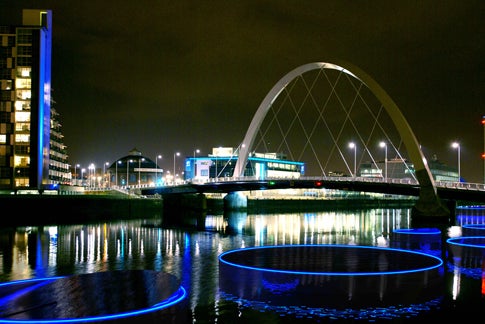
River Dance: Man-made lily pads on the River Clyde harvest solar power in the day and glow at night Photo courtesy ZM Architecture

Lily Pads as Power Outlets

Solar panels don’t have to be eyesores. The city of Glasgow is considering the installation of giant, glowing solar "lily pads" on the River Clyde. Designed by Scottish firm ZM Architecture, the circular floats are made of steel and recycled rubber and range in diameter from 15 to 45 feet. Motorized disks covered with solar panels track the sun and angle themselves for maximum exposure. Once panels soak up enough rays, the energy is converted to AC/DC power and transferred to the city’s grid, where it will help offset Glasgow’s electrical bills.
Lily Pads as Power Outlets:  Photo courtesy ZM Architecture

Page 1 of 3 123next ›last »
Want to learn more about the environment, solar energy, sustainability, and more? Subscribe to Popular Science and enter to win $5,000!

8 Comments

DarkFx

from Winnipeg, Manitoba

Finally some vision

As an engineer I applaud anyone who shows some original thinking. But while all of these ideas may have some technical merit, they make absolutely no sense from an economic standpoint. The only way they will be successful in the marketplace is through government subsidies extorted from unwilling ratepayers/taxpayers. Show me someone with a "green power" concept that is economically competitive with, say natural gas (let alone coal), and I'll show you someone who will soon be a multi-billionaire, without any "help" from the government.

Eventually, free-market forces will (and should!) determine when and where alternative energy displaces conventional energy sources. Until then, no amount of government subsidies or legislation will overturn the immutable laws of physics and economics.

As an engineer, you should then understand the implications of long term costs/versus short term costs. With a sound understanding of economics as well, you'd understand that successive short term financial gains are what drive free market forces. You'd also understand that long term maintenance of a product, be it large or small scale, devastates its economic potential since it is a constant capital sink (yet the original contractors or production company don't feel this immediately since they make their immediate profits in the short term). Normally, if the long term disfunctions caused by a product (or say something of larger scale like light rail transit) are a result of short-comings by the contractor/production company, then the only solution would be case by case litigation to decide which consumers/purchasers should get compensation for shoddy work or planning. In terms of pure free market economics, which you seem to be a major proponent of, this is one of the few ways of deterring companies from being so short sited (since I assume you don't seem to support up front regulations).

Now, let's compare this directly to the situation. You say we should continue powering our society with the cheapest and (currently) most economical sources available. If we did that entirely, then cities around the world would all look like Beijing with hazy brown-gray skies. Sick days would increase, health care costs would rise, and productivity would likely fall. This wouldn't be a deterrent to the power/energy companies unless there was a possibility of huge litigation - which would bankrupt the corporations since the costs caused by suing for damages caused by the pollution; like increased rates of cancers, asthma, bronchitis, etc; would far surpass the profits made by following the most economic path for them in the short term (that is, assuming you actually allow people to sue for the damages caused by the pollution).

A big resounding Yes! to alternative sources of enery.

However, wouldn't this pose as somewhat of a hazard for ships or boats that would be travelling in the water. Unless they are placed in such a way that they free up enough space for boats and/or ships to travel freely then I guess it would be ok. But putting them up in random places might make "dodging" these things very cumbersome for those vehicles mentioned.

Great Idea though, looks so nice at night =)

Of cource energy need to be as cheap as possible. What about need to be environmentaly friendly? We need reevaluate our knowledge and do not forget that knowledge and information are different things.
About global warming we can found millions of articles. Each of them is information with knowledge what author thinks about global warming. Usually most of that authors, even if they are Bill Clinton, Tony Blair, Mihail Gorbachev, McCain, Obama and many-many others authors in the world – all of them repeat mistake of Al Gore that only carbon dioxide responsible for global warming. In this case conservation of energy is only one choice. Fortunatelly it is not true.
Read more:
www.ductworkinstallation.com/EnergySaving/EnvironmentPage/tabid/89/Default.aspx

this is such cool technology but how soon will it be used abroad??

Are these floats equipped with plug-ins for passing sailors? If not, I'd call them inlets, not outlets. And what is this AC/DC electricity? I've seen universal motors, but not power grids.

Bob Stuart

We can change anything.
But we can never change
just one thing.

Impressive... nice to seem some out of the box thinking.


Download Our iPhone App

Stay up to date on the latest news of the future of science and technology from your iPhone with full articles, images and offline viewing


Follow Us On Twitter

Featuring every article from the magazine and website, plus links from around the Web. Also see our PopSci DIY feed


Become a Fan On Facebook

Share links with friends, comment on stories and more


December 2009: Best of What's New

In our December issue, Popular Science names the 100 best innovations of the year: bombproof wallpaper, self-parking cars, the fastest helicopter, and 97 more. Plus inventor profiles and videos.

Check out the best of what's new here.

Popular Science Photo Pool


Share your photos in the Pop Sci pool at www.flickr.com!
tags_sprite.png
POP_embeddedForm_cover_May09.jpg