When I was eight years old, my uncle told me that I’d get a solar-powered car for my sixteenth birthday – and that it would be affordable. When I turned 16 in 2002, though, solar power was still inefficient and expensive, and I landed a bike instead. It's taken impossibly high fuel costs, global warming, and some serious engineering developments, but six years later, solar power is finally becoming a viable alternative to oil.
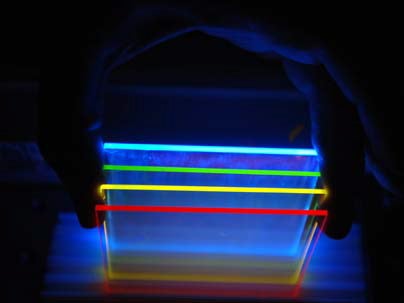
MIT engineers have recently helped up the feasibility of widespread solar power by developing a new “solar concentrator.” The concentrator, which is a flat glass panel spread across a large area, gathers light at the edges of its surface. Expensive solar cells only need to sit on these borders – a difference that lowers costs and increases efficiency by 10 to 15 percent.
Scientists rerouted light to the panel’s edges by painting the surface with two or more organic dyes. By joining forces, these dyes absorb light from different wavelengths, thus harnessing as much power as possible. The panels can even be placed on existing solar-power systems – which could increase each cell’s power-capturing ability by 50 percent. Meaning maybe that car's not such a pipe dream after all.
Via PhysOrg
Will the Northwest Passage be used for commercial shipping purposes by September 30, 2008?
This proposition will pay out at POP$100 per share if oil from a rig in the Lomonosov Ridge, the Beaufort Sea or the Chuckchi Sea is produced and packaged for export by January 1, 2010.


Comments
Looks promissing.....One wonders if this technique will allow windows to be turned into solar panels.
How cool would that be.....................
5 out of 6 people found this comment helpfulIt is always good to see development and advancement in solar energy. Hopefully this will actually go somewhere. Get outta the way oil companies solar is coming through.
1 out of 2 people found this comment helpful"Get outta the way oil companies solar is coming through."
This would be a more interesting comment were it not for the fact that the "oil companies" have been spending a *lot* over the past couple decades on developing solar and other non-fossil-fuel technologies.
Arco and BP, for example, have been major players in photovoltaic and solar-dynamic power generation tech.
3 out of 3 people found this comment helpfulThis new trick for concentrating solar power is nice, but it doesn't do a darned thing for solar power's chief weaknesses-- feebleness and fickleness.
Solar power is very dilute-- only about a 1000 watts per square meter at noon on a summer day at mid latitudes. Your average car has maybe 10 square meters of surface area (EFFECTIVE) to play with, so it will only intercept about 10,000 watts of power. Even assuming an optimistic conversion efficiency of 30%, that's only 3000 watts, or 4 hp, to run the car. That's not nothing, but it might as well be nothing-- you'd be lucky if the car could maintain a steady 10 mph ON LEVEL GROUND. So much for solar-powered cars.
Solar power is also unreliable-- flicking a switch or turning a key does not cause the Sun to shine. Batteries help with that, of course, but they aggravate the weight-and-power problems in a vehicle.
This is a neat trick, but it ain't gonna revolutionize *anything*. Central-station power-- whether coal-, oil-, or nuclear-fired, is going to be with us for many generations to come.
1 out of 3 people found this comment helpfulfrom lagos, lagos
the beauty of solar power is that it is free.
i live in the country ''we Nigerians'' call the giant of Africa. in my country, we have been suffering from poor electricity supply since i was born. Say average 10 hrs daily back then.
that wouldn't have been too much of a problem if the situation was improving. Sadly, i now get electricity for an average of 4 hrs or much less in a 24hr day. and these 4 hrs come up usually in the wee hours of the morning, when most humans are asleep.
of course I'm excited about solar power and its improvements in the US, Japan and UK. perhaps one day scientists would be able to use 75 or 80% of the sun's power. the good news is that all technology eventually get to Africa/Nigeria, and we have too much sun than we need.
1 out of 1 people found this comment helpfulHale, fortunately for everyone cars don't have to refuel on the go. Do tanker trucks follow you down the road and transfer fuel directly into your fuel line? The 10 square meter system you describe could be stationary anywhere. If my numbers were right, converting the U.S. average of about 5kWh/m2/day at 30% would give you 15KWh per day. This is enough to drive the Tesla Electric Roadster about 45 miles under normal driving conditions. Now a 3kW system is pretty large and expensive right now for just 45 miles of driving. This is where this solar concentrator becomes extremely useful!
2 out of 2 people found this comment helpfulyeah if you could turn windows into solar panels you could make large sunroofs of cars and , when they are closed thay could help power an electric car. it probably would not be able to poer the entire car but it could make the battery last longer.
2 out of 2 people found this comment helpfulfrom BOCA RATON, FL
SFSELIG THINKS BOTH ARTICLES ARE IMTERESTING AND DESERVE TO BE IN POPSCI MAG
0 out of 0 people found this comment helpfulSolar Power is Practical !!!!!!!!!!!!!!!!!!!!!!!!!!!!!!!!!!!!!!!!!!! Just think...if everyone covered there roof w/ solar panels...just think. I read somewhere that if we ,haveing our solar panels today, covered all of the earth w/ solar paneles for a few minutes, we would have enough energy to last the WORLD a year!!! now think of that on a smaller scale-only being about 10-20% of the world covered (tops of buildings). A few days of direct sunshine could power the WORLD for like....2 years!!! just think... Now..i assume all of you have questions...i will try to "nip them in the bud" right now.
(1) You: Solar Panels are expensive! Me: Ya? So is the house you are living in and the computer you are using right now to read this...so a roof of solar panels costs about the same as....a brand new big Windows vista computer-about $2000(i'm guessing here so if i'm wrong don't get extremely mad). So just dont upgrade to the latest model of computer... wait a year-they will have something else out then and use the money u saved to buy some solar panels
(2) You: Well...i'm not going to go cover my house w/ solar panels because you say so.... Me: I think that if nations want to stop completely destroying the only world they have..they should say "Screw the cost! i want my world clean!" They should pay for at least half the panels on any house-unless the owner is completely able to pay for it themselves.That would also solve the first problem. The goverment of said nation should do anything-and i mean ANYTHING- to improve the world any way they can!
I hope this rant made sense to you and if not.....sorry. I'm just trying to say that if the world works together...THEY CAN DO ANYTHING!!! Think about it...(and if you have some contact in politics-please ask them to bring it up at the next meeting or whatever they do-eternal thanks-)
PS: thanks for letting me vent =)
C-YA and happy letting the energy crisis ruin your important lives!
1 out of 2 people found this comment helpfulThough I would like to see solar power everywhere, the cost IS the driving factor behind the slow spread. Regardless of the efficiency, it would NOT cost $2000 to cover my roof with solar panels. I'm sorry, but that is just wrong. As an electrical engineer, I have considered the alternatives, made the correct calculations with the highest rated panels available to residential consumers in mind, and come to the conclusion that it would take me 26 years of living in my house with no increase in electricity demand, expected yearly increases in electric cost, and zero maintenance costs for the panels to make up for the cost of the panels and installation. This simply will not do.
As for vehicles, that's all fine and dandy if you want to drive 4mph on flat terrain and live in New Mexico. I live in Ohio, where the number of sunny days is far lower than the number of cloudy days ( which I prefer anyway ). I do not use my car all day ( and I only live 2.5 mi from work ), so it can charge while I am in the parking lot. That's great, but all that does is lower the amount of electricity I would need to charge it at night, which means less burned coal ( sorry, but Ohio's electricity is mostly coal ) in the long run. But that doesn't change the fact that I need batteries to run my car. What happens to batteries when you 'recycle' them?...certainly not the same thing that happens to plastic bottles or paper bags. Hybrid vehicles? Are you kidding? I would rather you buy a gas guzzler than put another one of those batteries into the environment.
Solar is great, and it is my favorite solution. But it is not real-time energy effective. It is for storage of electricity in batteries to be used later. Unfortunately, what is holding us up is the battery technology. If you really want to make a difference, don't call your senator and tell him to demand solar power, tell him to demand battery research. We have tons of ways of making electricity, but every one of those ways requires storage in batteries for portable use.
Make a difference; inform your political friends, activists, and leaders that you demand new battery technology, for example, Advanced Polymer Battery-Capacitor Hybrids. Good luck.
Peace, vive le roi, Alive
0 out of 0 people found this comment helpful