Jellyfish Invasion
Between massive swarms and habitat invasions, jellyfish are changing ecosystems, stinging beachgoers, and causing millions of dollars’ worth of damage. Using high-tech underwater gadgets, scientists are racing to understand one of the most common, mysterious—and destructive—sea creatures
Bad Catch
For most of us, jellyfish are nothing more than a nuisance. They drift toward beach shores and into our consciousness each summer near the end of their life cycle, making a refreshing dip in the water a bit less carefree for a few weeks. But that may be changing.
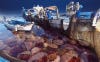
Last November, a 10-mile-wide and 42-foot-thick swarm of baby mauve stingers (Pelagia noctiluca) decimated Northern Ireland’s farmed-salmon population. Overnight,120,000 fish were reduced to a floating mass of carcasses by billions of the small jellies native to warmer waters thousands of miles to the south. The salmon, which were killed by stings and oxygen deprivation, had a market value of $2 million.
Since 1996, massive “blooms” of mauve stingers have also plagued Mediterranean beachgoers. In previous decades, the jellies showed up along the French Riviera every 10 to 12 years and remained for about four years before retreating. But that pattern changed in the 1990s as the time span between the infestations shortened and jelly numbers shot up. In 1996, the Mediterranean coast experienced its largest blooms ever. The jellies retreated in 1998 but returned in even greater numbers just five years later. In August 2006, 60 million jellyfish reportedly swept up on Spanish beaches and stung more than 70,000 people, causing swollen limbs and allergic reactions. Beaches were closed throughout the entire region.
Europe’s mauve stingers aren’t the only jellies wreaking havoc. From the U.S. to Japan to Australia and beyond, several species of jellyfish—and their gelatinous cousins that are often mistaken for jellies—are expanding their numbers at a rapid pace and moving into foreign waters. Far from a simple nuisance, the creatures are dramatically changing marine ecosystems, costing commercial fisheries millions of dollars, and invading tourist destinations. Notoriously understudied, jellyfish are now attracting growing scientific attention.
Giant of the Sea
More Than Meets the Eye
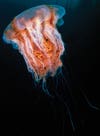
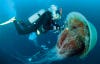
Jellyfish are opportunistic creatures; the key to their 500-million-year success is their adaptability. The 200 classified species range from the fingernail-size star-shaped stalked jellyfish (Haliclystus auricula), which is native to northern Pacific waters, to the giant Lion’s Mane (Cyanea capillata), which lives in Arctic waters and can grow up to eight feet in diameter, with tentacles spanning 100 feet. Some jellyfish are luminescent, others live upside-down, and some possess stingers that can cause excruciating pain for weeks—even months—on end.
Water makes up about 96 percent of a jellyfish. The animal’s gooey mass includes the familiar bell-shaped body that houses a mouth (which doubles as the anus) and a stomach pouch, which digests the plankton, small fish and roe that jellies eat. “Oral arms,” which are used for defense and digestion, extend from inside the bell. In most jellies, thin stinging tentacles dangle from the bell’s perimeter.
Although jellies appear extremely simple, scientists believe that there’s a lot more going on than meets the eye. “Jellyfish aren’t just blobs,” says Jennifer Purcell, a marine scientist at Western Washington University who studies the creatures. “They have a nervous system. They sense light. They sense gravity. They probably smell chemicals in the water. They may even have a sense of taste.”
Jellyfish belong to the invertebrate phylum Cnidaria. True jellyfish (which aren’t fish at all) fall under the class Scyphozoa. Other gelatinous cousins are often also referred to as “jellies” or “sea jellies.” The Portuguese man-of-war (Physalia physalis), a strikingly beautiful creature with an agonizing sting, is one such cousin. It’s also a Cnidarian, but it belongs to a different class than true jellies like mauve stingers and moon jellyfish (Aurelia aurita), a common species found on the eastern and western coasts of the U.S. Other cousins, like comb jellies, lack stinging needle cells—one reason why they’re classified separately from Cnidarians. Altogether, true jellyfish and their cousins account for up to a third of the world’s marine biomass, according to some experts. And they all have voracious appetites.
Proper Fit
A Tale of Two Jellies
Comb jellies provide a dramatic example of invasive species at work. The American comb jelly (Mnemiopsis leidyi), sometimes called the warty comb jelly, has been spreading to foreign habitats for 26 years. Native to the Atlantic Ocean, they first appeared in the Black Sea in 1982. They had stowed away in a ship’s ballast water, which is used for stabilization. When the water was dumped, the species eagerly took up residence in the area.
Jellies eat by filtering food from water. In their constant search for grub, small species like American comb jellies sift through approximately a gallon of seawater every day, says Keith Bayha, a marine biologist at the University of California at Merced. A gallon may not sound like a lot, until you consider the sheer number of individuals eating their way through the food supply. By 1989, when the Black Sea’s population of the invasive species peaked, some areas held more than 14 jellies per square foot. This caused a total collapse of local fisheries specializing in anchovies and sardines—fish that feed on the same plankton the jellies eat. To add insult to injury, the jellies were devouring not just the fish’s food, but their eggs and young as well.
The species went on to invade nearby waters—including the eastern Mediterranean and the Caspian Sea, which borders Russia to the east and Iran to the south—with similar environmental and economic damage as in the Black Sea. In 2006, biologists sounded the alarm farther north when American comb jellies were first discovered in Dutch, Danish and Swedish waters. One study found approximately 25 of them per cubic foot off the coast of Denmark last year. Experts fear that such swarms may threaten the area’s cod population, which has already been depleted by overfishing and pollution.
Ironically, it took one non-native species to conquer another. The American comb jelly’s arch-nemesis is the brown comb jelly (Beroe ovata), which feeds on it. Scientists introduced brown comb jellies to the Black Sea in the 1990s, successfully checking the American comb jelly invasion. According to Bayha, plans may now be under way to bring brown comb jellies to the Caspian Sea to remedy the problem there, but there is no guarantee that they won’t become invasive themselves. As for the rest of Scandinavia, certain comb jellies are native there, but biologists do not yet know if they will prey on the invading species. Harsh Scandinavian temperatures during the winter may limit the American comb jellies’ success there, since they seem to thrive in warm conditions. Only time will tell for sure.
Understanding the Shift
The introduction of comb jellies into new habitats by ballast water isn’t an isolated case. Two non-native jellyfish were brought to North America at least in part by ballast water, according to the Nature Conservancy, a Virginia-based environmental organization. In 2000, scientists observed one of these two species, Australia’s spotted jellyfish (Phyllorhiza punctata), in a bloom of approximately 5.5 million jellies across 57 square miles in the Gulf of Mexico near Alabama, Mississippi and Louisiana.
And ballast water isn’t the only way ships transport species. Some jellies hitch rides attached to ship bottoms, a practice called “hull-fouling.” A recent Nature Conservancy report found ballast waters and hull-fouling responsible for 69 percent of non-native marine species worldwide.
Once jellies get to a new habitat, “they’re very good at sliding in and taking advantage of excess food,” says Monty Graham, an assistant professor of marine sciences at the University of South Alabama whose team sighted the massive spotted jellyfish bloom in 2000. Excess food, according to Graham and other researchers, is often a result of overharvesting of the fish that feed on the same resources. Eutrophication, a process in which nutrient-rich runoff from agriculture, sewage-treatment plants and other sources boosts algae growth, also contributes. The algal blooms, as they’re called, reduce the amount of available oxygen in the water, thus killing off competitors like fish. Jellyfish, on the other hand, can thrive in this oxygen-deprived environment. The dwindling numbers of predators, especially the critically endangered leatherback turtle (Dermochelys coriacea), is another factor.
Jellyfish must attach to surfaces during the flower-like polyp stage at the beginning of their life. (The familiar mushroom shape occurs later, in the medusa stage.) Increased waterfront construction creates more surfaces that the polyps can attach to and may play a part in the growing presence of jellies near shores, according to Shin-ichi Uye, a scientist at Hiroshima University who has studied Nomura’s jellyfish (Nemopilema nomurai). In the past five years, hoardes of these giant, native-Chinese jellies have invaded the Sea of Japan. Uye suspects that waterfront construction in China is, in part, fueling the population boom. Fishermen are feeling the sting, as they inadvertently haul in thousands of the jellies, which each weigh up to 440 pounds and span six feet in diameter. The nomuras slime or crush the intended catch while destroying nets, and in 2003, Japanese fishermen lost $20 million in damages.

Mooning
Eutrophication, overfishing, and a warming climate may also be to blame, according to Uye. Rising sea temperatures may improve conditions for the creatures. Over the past 50 years, the top 1,000 feet of the oceans has warmed an average of half a degree Fahrenheit. And for at least 13 species of jellyfish, according to Purcell, warmer waters are associated with larger populations. Shorter cold seasons also appear to be contributing. In recent years, mauve stingers have stuck around Mediterranean shores later than usual.
Although global warming is suspected by some, scientists are hesitant to make a direct connection for now. There simply isn’t enough research out there. “Lots of evidence exists showing that in some areas, jellyfish are on the rise, but in some places, they’re actually on the decline,” says Kevin Raskoff, a marine-biology instructor at Monterey Peninsula College. “There is a good possibility that changes to the food chain that are direct responses to climate change might have very real consequences for the jellies, but we are far from finding direct links.”
Master Shot
High-Tech Research
Despite the attention jellyfish have been getting lately, they’re actually one of the seas’ most understudied creatures, in part because they’re just plain hard to handle above water. But developments in manned and unmanned submarines, remotely operated equipment and deep-sea diving are changing that by allowing biologists to observe, mark, capture, and track jellyfish in their underwater element.
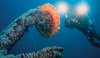
Researchers at the Monterey Bay Aquarium Research Institute (MBARI) in Moss Landing, California, one of the world’s leading jellyfish-research facilities, sometimes trawl for jellies with nets, but only robust specimens can be brought up from the deep sea in this way without damage. Instead, the scientists often tag specimens while snorkeling or diving, and use remotely operated vehicles (ROVs) to bring jellies up from as deep as 13,100 feet. In the past, costly manned submarines have been used, giving the researchers an awesome view of their subjects and their habitat.
To track a jellyfish, MBARI researchers wedge a small sonar sensor, which transmits sound waves, into a genital pit on the underside of the animal. When a “ping” sounds, the scientists know the device has been successfully placed. A type of aquatic microphone called a hydrophone is lowered into the water to receive the sound waves, which allow the scientists to measure the water temperature and depth where the jellies are located.
Kim Reisenbichler, a senior research technician and diving-safety officer at MBARI, uses a special respiration chamber about the size of a bass drum to learn about jellyfish metabolism. An ROV carries the chamber to between 300 and 4,260 feet below the surface. The scientists then locate a specimen using the vehicle’s high-definition camera. Once a jellyfish swims into the chamber, the ROV pilot snaps the door shut and interior sensors register changes in oxygen concentrations in the water around the animal. The breathing patterns help scientists understand their metabolic rates and digestion.
Experts say that a greater understanding of jellyfish basics—including their ideal water temperatures and feeding habits—is necessary to determine with certainty what’s causing the recent massive blooms and to come up with ways to combat the invasions. Preventing the introduction of new invasive species is also important.
The Nature Conservancy and other groups are working to educate governments and the international shipping community about the ill effects of ballast-water dumping and hull-fouling on ecosystems. Emptying out ballast water before approaching the shore (which is already mandated for ships entering the Great Lakes) would reduce the effects of non-native animals like jellyfish. This May, invasive species will be addressed at the United Nations–sponsored Convention on Biological Diversity in Bonn, Germany. Says Jennifer Molnar, a conservationist at the Nature Conservancy, “It will be a great opportunity for the world’s governments to take action on the issue.”