Return of the (Televised) Nerds
CBS's The Big Bang Theory brings nerd culture, with science chops, back to mainstream TV
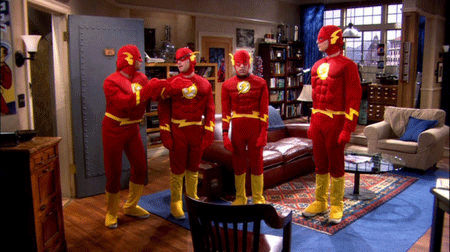
I love nerds. I loved nerds even when it wasn’t cool, so it’s nice to see them coming into their own on network TV. I remember a time when I was hard pressed to find one real nerd on prime time, never mind a quartet of physics-spouting, Klingon Boggle-playing super brains. Let’s face it: Charlie Epps has nothing on the characters of CBS’s The Big Bang Theory, a show full of loveable (albeit incredibly awkward) nerds. The show glorifies those of us who remember old school Ataris, the Flash, and know exactly how we roll in the Shire.
The show not only delivers a healthy dose of nerd-culture references, it also offers up some legitimate scientific content, something that’s pretty rare in mainstream television. How many TV nerds do you see engaging in real scientific banter? It’s more than the big words and convoluted sentence structure; the dialogue actually contains scientifically sound ideas.
UCLA Professor of Physics and Astronomy David Saltzberg is the science man behind the curtain, and many of the punchlines. He also writes equations on the set’s white boards. “Physicists love to nitpick, so for the 100 in the 10 million people who might watch the show, I try to get it as close to 100% accurate as I can,” Saltzberg commented in an interview with USA Today.
In one episode, the character Sheldon showed up to a Halloween party dressed as the Doppler Effect. In another, the boys compete in a physics bowl, complete with real questions and equations. When analyzing their interactions with their attractive neighbor Penny, the boys often use scientific terminology to describe their emotions. They talk about heart rates, pupil dilation, and hormonal imbalances, where others would simply discuss “feelings”. One of my favorite moments involves Sheldon’s discovery that someone altered his work on beta function of quantum chronodyanmics. When he confronted his nemesis, Leslie Winkle, as the perpetrator, Winkle replies, “Yeah, I noticed it when I got up to get a glass of water, so I fixed it, and now you can show that quarks are asymptotically free at high energies. Pretty cool, huh?” Yes, it is. And the science is correct, which makes it even better.
The Big Bang Theory airs on CBS on Monday nights at 8pm.