EarthTalk
Are cloned animals as good to eat as conventionally bred ones?
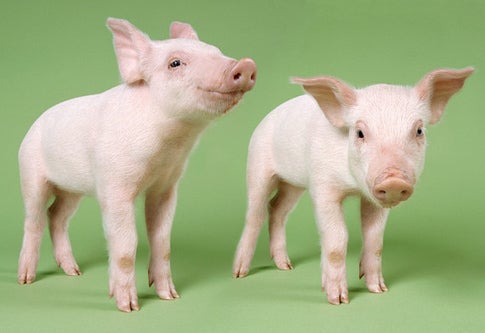
Pigs Getty Images

Dear EarthTalk: What's the story with animal cloning? Is the meat industry really cloning animals now to "beef up" production? -- Frank DeFazio, Sudbury, MA

Cloning has been controversial ever since Scottish scientists announced in 1996 that they had cloned their first mammal, a sheep they named Dolly. While Dolly lived a painful, arthritic life and died prematurely, possibly due to the imperfections of cloning, industry nonetheless began seeking out ways to capitalize on the new technology. Meanwhile, critics bemoan cloning as immoral, and eating cloned meat a potential health and safety risk, given the as-yet-unknown consequences of eating foods generated in this way.

In January 2008, the U.S. Food and Drug Administration (FDA) approved the sale of cloned animals and their offspring for food, despite fierce opposition from animal welfare and consumer advocacy groups, environmental organizations, some members of Congress, and many consumers.

"Our evaluation is that the food from cloned animals is as safe as the food we eat every day," said Stephen Sundlof, the FDA's chief of veterinary medicine. Meanwhile, the U.S. Department of Agriculture has asked that producers withhold cloned animals, but not their offspring, from the food supply while farmers, processors, grocery stores and restaurants decide how they will respond to the FDA's landmark decision.

Unsurprisingly, industry groups also argue that beef and milk from cloned animals is safe to consume. They cite a 2005 University of Connecticut study, which concluded that beef and milk from cloned cows did not pose any health or safety threats to people consuming it. But critics say that the oft-cited single study was far too limited to yield any meaningful conclusions: Milk and beef were taken from just six cloned animals, and the study did not take into account whether clones were more susceptible to infection or other microbial problems, as many scientists suspect. Other researchers have noted severe deformities in many cloned animals, as well as a higher incidence of reproductive, immune and other health problems.

The Washington, DC-based Center for Food Safety, in a petition it filed in late 2006, declared: "The available science shows that cloning presents serious food safety risks, animal welfare concerns, and unresolved ethical issues that require strict oversight." The group announced on September 2, 2008, that 20 leading U.S. food producers—including Kraft Foods, General Mills, Gerber/Nestle, Campbell's Soup and Ben and Jerry's—had agreed not to use cloned animals in their products. "The move by these companies represents a growing industry trend of responding to consumer demand for better food safety, environmental and animal welfare standards," the group said in making the announcement.

Given the FDA's green light, consumers' only hope of avoiding cloned animal products may be to appeal to businesses directly not to peddle such items. The Pennsylvania-based American Anti-Vivisection Society, which opposes all forms of animal research and testing, has mounted a campaign to urge McDonald's to forgo cloned animals in its 30,000 restaurants worldwide.

GOT AN ENVIRONMENTAL QUESTION? Send it to: EarthTalk, c/o E - The Environmental Magazine, P.O. Box 5098, Westport, CT 06881 USA; submit it at: www.emagazine.com/earthtalk/thisweek; or email: earthtalk@emagazine.com. Read past columns at: www.emagazine.com/earthtalk/archives.php.

11 Comments

Anything genetically altered, or cloned belongs out of our food supply.
Dustin H

Dustin,

While everyone is entitled to their opinion, how about backing up your statement with some reasons? This is, after all, a science web site. Your comment, although perhaps not intended as such, comes across as a knee jerk response not founded on reason.

While I agree that cloned animals should be further studied before allowing them to be in our food supply, it seems very unlikely that there will be any scientific basis for keeping them out of our food supply.

And saying that "anything genetically altered" should be kept out of our food supply shows a distinct lack of understanding about genetics.

Humans have been eating genetically altered animals and plants for thousands of years through 2 processes: cross breeding and selective breeding. Genetic manipulation done through more modern methods achieves the same ends but with more specific "edits" to the genetic code.

Are there genetic changes that could negatively affect food quality or safety? I'm sure there are, just as it's possible to cross breed or selectively breed animals or plants and end up with something that is less suitable to commercialization.

But that doesn't mean we should not do it. Genetic manipulation offers us an incredible opportunity to work on the problem of world hunger and many other "good things" too.

Eggman002 (not verified)

I am not sure I understand the point of cloning animals for food.

Nature has this amazing technology that is cheap, easy to use, and quite safe. Natural Reproduction.

I can't imagine that hiring a lab tech and setting up the lab to clone a sheep is cheaper than just putting a male and a female together.

I suppose if you want a higher pregnancy rate, the artificial method might be better, but then why not use simple artificial insemination? There is no moral or health issues that I am aware of.

Man should never play god, we always get the bill in the end...

"Play God" Think about what those words mean, and how they apply to this specific situation. As Robert mentioned, the manipulation of genetics has been taking place for generations. Mankind has been actively manipulating the bloodlines of the K-9, literally, for millennia.

For many people, Future Tech like cloning might as well be magic. It is a mysterious force that they don't understand, and thus fear or admonish. Where do you draw the line?

Is picking specific bloodlines of an animal to breed too unnatural? No? What about feeding those mothers vitamins so that their milk is full of nutrients and their young grow healthier and stronger? No? Even if those vitamins are completely synthesized? What if these animals were directly manipulated so that their milk would produce these nutrients naturally? Too far?

Why does the use of technology inspire the use of the phrase, "Play God"? Science exists around us in all things; we are governed by its laws, and the world we live in acts and reacts based upon its principles. The simplest machines; the lever, the wedge, the inclined plane- do these stir up our superstitions?

No?

Perhaps we should contemplate what it is about more advanced technology that causes unrest in our souls? Maybe it’s just the most natural human reaction. Perhaps it’s fear of the unknown.

I understand genetic coding very well, actually. My major issue with it is not the modification it's self, but a bug. modern marvels doomsday tech, high tech famine. Genetically altered wheat crops eliminate world hunger. A long inactive gene reactivates, and causes 3 billion people to have allergic reactions. I think that it does have a future, but for now, stick to natural ground. Look at what happened to starlink, corn genetically modified to produce it's own pesticides, it was accidentally released into the human food supply, and sickened thousands. I don't want that happening with the world food supply.
Dustin H

Dustin,

First of all, allergic reactions are rarely fatal (besides peanut type allergies and bee sting allergies and the like). I am an allergy sufferer and have been all my life, I don't even try to avoid my allergens...I just deal with the symptoms.

I'm fairly certain that the hundreds of millions of people in the world who do not have enough food to eat would not care in the least if they might have to suffer through some allergies to keep from dying of starvation.

But more importantly, unless you have a reliable source indicating otherwise, the information you posted about Starlink isn't even accurate. According to a CDC report, 28 people reported apparent allergic reactions related to eating corn products that MAY have contained the Starlink protein. However, the US Centers for Disease Control studied the blood of these individuals and concluded there was no evidence that the reactions people experienced were associated with hypersensitivity to the Starlink Bt protein. (I added the capitalization of MAY for emphasis...it's not even certain these people ingested corn with the genetic modification.)

Starlink was taken off the market because the FDA had only approved its use in animal feedstocks because there was a concern that it might cause allergic reactions in a small percentage of people. No one even studied if it would, because when the modified protein started showing up in corn for human consumption, it killed the product completely. (The company apparently didn't take enough precautions to prevent cross pollination to other, non-modified corn plants.)

I'm going to have to give modern marvels a call... and I was actually referring to severe reactions like peanuts and bees.
Dustin H

Eggman002:

The point behind livestock cloning is the same as that of using growth or milk-producing hormones; to control and increase the yield and thereby increase the amount of profit that you can make from each animal.

Let's say that you raise 1000 cattle, and 100 of them are bigger than the other 900. Wouldn't the idea of copying those 100 head of cattle 10 times be more attractive, from an economic point of view, than leaving it to nature and chance?

well if you asked me what they do isn't really fatal since your just copying the genetic code of a DNA and transferring it to a blank cell so whatever features does the cloned pig has entirely depends on the pig which they took the DNA cause they both share the same genetic code

also acme, cloning isn't playing God since we're not making a new type of species or hybrid for that matter They're really just modifying the structures of an organism so i don't think we're not messing with the balance of nature and acme a normal pig is different from a cloned pig but they're still both pigs

Though the idea of cloning is interesting, it saddens me to think that we have gone to the extent that we might use it for food. As an ex-vegiterrean I think it is questionible to bring somthing into this world simply bring a life into this world only to kill it in the end. Disrupting for our food will be going to far. Nothing ever good happens when we screw with nature. Think of how much we have distroyed by simplie introducing a speices into a place that is not its native home? Mass cloning is asking for trouble.

Let nature take its course, Wu Wei.


June 2013: American Energy Independence

Five amazing, clean technologies that will set us free, in this month's energy-focused issue. Also: how to build a better bomb detector, the robotic toys that are raising your children, a human catapult, the world's smallest arcade, and much more.


Online Content Director: Suzanne LaBarre | Email
Senior Editor: Paul Adams | Email
Associate Editor: Dan Nosowitz | Email
Assistant Editor: Colin Lecher | Email
Assistant Editor: Rose Pastore | Email

Contributing Writers:
Rebecca Boyle | Email
Kelsey D. Atherton | Email
Francie Diep | Email
Shaunacy Ferro | Email

circ-top-header.gif
circ-cover.gif