It’s not unlikely that your grandparent used canning jars for their original purpose: canning. But here in the twenty-first-century kitchen, the hard-to-destroy, easy-to-seal jar has become valuable for many more purposes. We love it — and not just because one of the most popular models is manufactured by aerospace pioneer Ball.
The jars are cheaply available by the dozen, and replacement lids are even more cheaply available, so you can keep an array of lids on hand, customized for different purposes.
Here are a few of our favorite things to do with jars. What do you do with yours?
Vacuum Storage
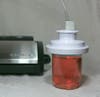
With an affordable home vacuum apparatus like a FoodSaver, you can seal up meats and such in plastic bags, for storage or sous-vide cooking. But you can’t seal up liquids, or anything that’s even somewhat liquidy, because the vacuum slurps the juice right out of the collapsing bag and into its pump. But a little attachment allows you to vacuum-seal a canning jar, which instantly makes the FoodSaver a lot more useful. Vacuum-sealed in a jar, fresh juice stays remarkably fresh-tasting in the fridge for days on end. The easiest way to make custard, for ice cream or for its own sake, is to cook it sous vide at 82°C (179°F) — but you need to vacuum-seal the jar to keep it from floating in the bath. It’s also a great way to get the carbonation out of beer or champagne, if you want to cook with those ingredients. Just vacuum out a jar full of beer — you may have to repeat a couple of times — and it gets as flat as you could ever desire.
Blending
File this one under The Lazy Person’s Kitchen Innovations You (Probably) Never Knew Existed. Way back in 1858, Mr. John Landis Mason, the Scottish farmer who patented this eponymous glass canning jar, had the remarkable foresight to make the thread count of the jar’s neck match of a blender bottom cap. (Actually, it was probably the other way around, given that electric drink mixers, the precursor to the household blender, didn’t come about until 1921.) Anyway, no need to get out the goggles for this ultra-simple hack: Simply screw a blender bottom onto the top of a jar, careful so the rubber gasket doesn’t fall into the spinning blade when you hit “Pulse,” and you’ve got a self-contained unit for smoothies, spice mixes, or piña coladas. Note: This does not work with wide-mouth jars or Vitamixers.
Fermentation
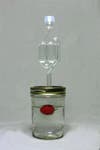
Fitting a brewer’s airlock into the lid of a Mason jar is another quick and easy modification that turns the jar into a fermentation chamber. The airlock is a little plastic device with a volume of water in it, such that CO2 can pass out through it, but no air can come back in. This lets you set your pickles, beer, or whatnot to fermenting and allows them to emit carbon dioxide smoothly without letting in outside contamination. Below is my recipe for a fermented hot sauce, in the style of Tabasco (Tabasco ferments for three years in oak barrels). 1. Punch a round hole in a Mason jar lid, 1 centimeter in diameter, to accommodate your airlock. 2. Wash, halve, and remove stems from a volume of hot peppers that will fit into your jar. I use half-gallon jars, and red (ripe) jalapeno peppers, or rocoto peppers, or infinity peppers if I’m making it for an enemy. Use proper pepper-handling techniques at all times. 3. Weigh the empty jar. 4. Put the peppers in the jar, and fill with warmish water almost up to the level of the peppers. 5. Weigh again, and calculate the net weight of peppers and water. 6. Add to the jar a weight of non-iodized salt equal to 5 percent of the weight of the peppers and water. In a half-gallon jar, this will be about 5 tablespoons of salt. 7. Add a tablespoon of plain yogurt, to inoculate the jar with Lactobacillus. Adding a peeled clove of garlic for flavor is optional. 8. Put a non-holed lid on the jar and shake it to distribute and dissolve the salt. 9. Replace the lid with the prepared one. Fill the airlock with water and insert the airlock into the hole in the lid, where it should just perch snugly. 10. Leave the jar on a shelf for 4-6 weeks. The airlock should bubble occasionally as the bacteria excrete CO2 11. Open the jar and carefully drain the liquid out into a separate container, like another Mason jar. 12. Puree the pickled peppers in a blender, adding back in some of the liquid to achieve the consistency you want, and adding vinegar — sherry vinegar is excellent — to increase tang if desired. 13. Optionally, while it’s spinning in the blender, mix in 0.1 percent by weight of xanthan gum to reduce syneresis (a.k.a., separation of the liquid from the solids). 14. Bottle, store in the fridge, and enjoy. The reserved brine can be used to make a new batch of pickles. Sandor Ellix Katz is a great resource about delicious home fermentation.
Cold Smoking
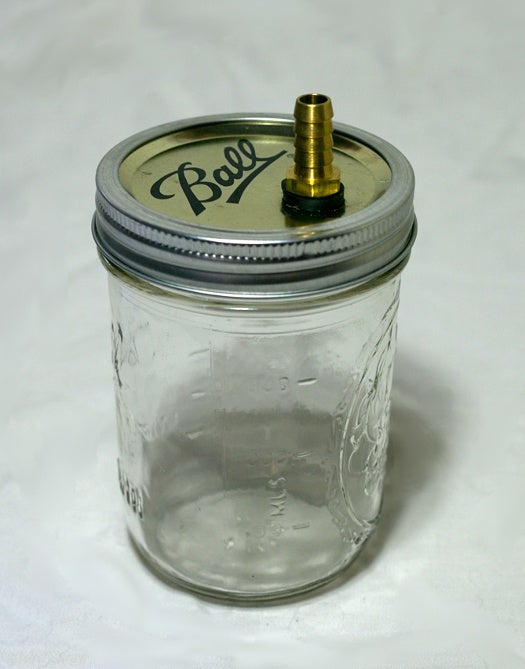
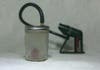
A cold-smoking apparatus like the Smoking Gun or Super-Aladin pumps smoke from burning sawdust through a tube, but what happens at the business end of the tube is your business. Some people like to direct the smoke into a big mixing bowl covered with plastic wrap, but I like to put it in a jar. In the lid of a widemouth Mason jar, I punch two round holes on opposite edges. Into one hole I screw a hose barb (available in the plumbing aisle) whose diameter matches that of the hose of my smoker. The tube from the smoker fits onto the upper barb, and I can optionally screw on a tube from the underside that runs down to the bottom of the jar. The other hole can be corked (with Blu-Tac) to retain smoke, and unplugged to let air and smoke vent. Recipe suggestion: Smoked heavy cream. Fill your jar halfway with cool cream, then add smoke and let it sit for a minute or three. Open the jar, whip the cream (you could use a blender attachment, and put a dollop on top of a bowl of soup.
Mycoculture
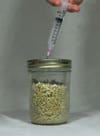
Some mushrooms — truffles, porcini — are almost impossible to cultivate at home, but others are easy and delicious. You can buy spores cheaply on the internet and grow them on a sterile medium in, yes, a Mason jar. The method I use was developed by druggy aficionados of psychoactive mushrooms, but it works very well for delicious home shiitakes and oyster mushrooms. You will need a syringe of mushroom spores (available pre-filled from numerous internet spore vendors), and you will make your own medium out of brown rice and vermiculite. Here is a thorough explanation, but the basic technique is as follows. 1. Prepare the lids of your jars by punching a 1-cm-diameter hole in each, completely filling the hole with a blob of silicone caulk, and letting it set. 2. Reduce dry uncooked brown rice to the consistency of flour in a blender, or buy brown rice flour. 3. In a bowl, add distilled water to vermiculite so the mixture is just saturated. Let any excess water drain off. 4. Mix one part brown rice flour into 3 parts soaked vermiculite, by volume. 5. Place the medium in your canning jars, filling each one nearly to the top. Half-pint jars are recommended but I’ve had success with full pints as well. 6. Close the jars with the modified lids. 7. In a pressure cooker, place a rack or steamer in an inch of water and bring to a boil. Place the jars on the rack, close the cooker, and let simmer at 250°F (121°C) for 45 minutes to completely sterilize the jars and their medium. 8. Turn off the cooker and let it cool to room temperature before opening. 9. Sterilize the needle of your spore syringe over a flame and let it cool. 10. Stick the needle through the silicone port in the lid of each jar, and distribute 1 cc of spore solution into each jar. When you withdraw the needle, the port should close up behind it seamlessly. 11. Keep your jars in a dark, room-temperature location until you start to see the brown pinheads of mushroom mycelium. If you see green or blue mold instead, throw out the medium, re-sterilize, and start again. 12. “Birth” the contents of each jar into a plastic pail with a bed of vermiculite, and cover the pail with plastic wrap. 13. Within a couple of weeks you should start to see healthy mushrooms. Don’t eat them unless they are precisely the kind of mushroom you’re expecting to grow!
Canning
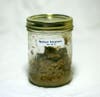
Just because canning is a classic doesn’t mean it can’t thrive in the modern kitchen. When I was researching the preservation of mashed potatoes, I did some experimentation in preserving my own as well. I like vacuum-sealing the jar first, but that’s not crucial. What is crucial is completely sterilizing the jars and their contents in a pressure cooker or pressure canner for an adequate time at a sufficient temperature. The USDA, which has an interest in not letting US citizens all die of botulism, publishes a very reliable guide to home canning.