A recent post over at MAKE set forth the call to companies: If you’re going to kill a product or product line, make it open source! That way the ever-resourceful hacker and modder communities can really sink their teeth into a product that wouldn’t be generating any profit for the company anyway. We’ve got a list of six ahead-of-their-time, awesome gadgets that were killed too soon–gadgets that could be capable of some amazing stuff if opened to the right people.
When a product is made open source, the entire documentation, the source code, and schematics are made available to the public for use and modification. Essentially, anyone who wants to will not only have the legal right, but all the tools necessary to change their gadget in any way they want. Lots of software is already open source, and some hardware as well, like the Arduino microprocessor, 3-D printers like the Maker Bot and RepRap, and a few consumer gadgets like the Chumby. Making a product open source allows enthusiasts to really get their hands dirty, to use a product in ways its makers never intended, and to extend the life of the gadget beyond its untimely demise.
Of course, there are some legitimate reasons a company would be resistant to make a deceased product open source. Software and hardware doesn’t exist in a vacuum; even if a product line is cancelled, there may be intellectual property that the company wants to keep and re-use. It takes effort and money to scan through a product’s documentation to make sure there’s nothing in there that’d cause trouble down the road if made entirely available, and many companies just don’t want to bother. The Microsoft Zune, for example, might be essentially cancelled, but it inspired the very-much-alive Windows Phone 7 platform, and Microsoft would rightfully be hesitant to publish too much information about a current platform. Still, this is a wish list, so we might as well wish, right?
Anyway, we liked MAKE’s list so much that we decided to add our own nominations–gadgets old and new which were canned, but which had lots of potential and could have turned into really interesting hobbyist projects if given the open source treatment. We’d love to hear from you guys, too: Any suggestions? Which gadgets do you think could have been hacker favorites?
Click to launch the photo gallery.
Sega Dreamcast
The Sega Dreamcast marked the end of Sega’s storied hardware career, but it’s revered by hardcore and classic gamers despite its swift demise. The Dreamcast may have been underpowered compared to competitors like the Sony PlayStation 2, Microsoft Xbox, and Nintendo GameCube, but it was far ahead of its time. It was the first console to boast a built-in internet connection, something now considered standard, and it was also first to allow online multiplayer gameplay. Plus, it was just a weird little system in a lot of ways, especially in its curious memory card: The Visual Memory Unit, or VMU, was actually a self-contained portable system with its own screen, sort of like a beefed-up Tamagotchi. It fit into the controller and could actually be used as a second, private screen during regular gameplay. It was never really exploited that well (my only memory of it is displaying “Rad!” during games of Crazy Taxi), but had lots of potential–privately selecting plays in sports games, for example. The Dreamcast is pretty outdated now–it’s more than a decade old, after all–but if it was made open source shortly after it was cancelled, who knows what developers and hackers could have done with it. We could have seen VoIP internet calling, chat, or media purchasing. We could have seen real games for the weird little memory card. Who knows?
Cybiko
The Cybiko was an utterly unique little gadget, released in 2000 and killed a few years later. It was a handheld communicator aimed at teens–I bet marketing execs pitched it as an Xtreme Palm Pilot–that allowed for chatting, email, games, and music playback. With a touchscreen, full QWERTY keyboard, and short-range RF transmitter, it was unlike anything else on the market, but was never really embraced. Like the Chumby, the Cybiko seemed perfect for the open-source tinkerer community. It had all these features–different input methods, a wireless radio–that were ahead of its time, and it was dirt cheap. If it had been made open source, we might have seen some really interesting stuff–improved RF signals, wireless communication with PCs, all kinds of new software–but it pretty much collapsed instead.
Microsoft Kin
Microsoft’s smartphone-lite Kin line, consisting of two Sidekick-like phones, was an embarrassment for the company. Reviews were generally middling to scathing, always noting that it was a total ripoff for a non-smartphone to require an expensive smartphone data plan. By some accounts Microsoft sold just a few hundred Kins. It was discontinued after only 48 days on the market, a move that reeked of sheer panic and no confidence at all in the product. But when a new product crashes that hard and that fast, it usually means at least it’s not a boring failure. For all of its problems, the Kin had a whole bunch of legitimately good ideas. It was designed to be a sort of modern Sidekick, focused not on texting (so ’90s!) but on social networking. Facebook, Twitter, and Myspace were actually more important to the Kin’s ethos than standards like a web browser. The interface was something totally new, asking users to drag contacts, browser links, messages, and photos to the “Spot,” a dot at the bottom of the screen that handled all sending functions. It boasted an unlimited subscription to the Zune streaming music market, something totally new to messaging phones. Best of all, it introduced a concept called the Studio. The Studio was a web app that mirrored all the activity on your phone, instantly: Take a photo with your phone, it’s in the Studio. Enter a new contact or bookmark a new website, and the Studio knows it. Start reading a news story on your phone, finish it in the Studio. Brilliant idea, one that’s never really been tried again. Microsoft can’t really make the Kin open source–there’s too much important intellectual property being used, just like the Zune. But man, what if they had? Lots of the Kin’s faults could have been fixed: Developers could have added a much-needed maps and calendar app, could have changed the way the phone dealt with certain commands, or could have altered the camera’s firmware so it took less lousy photos. The Kin had potential–it would have been great to see what an enthusiast committee could have done, had Microsoft let them.
Teddy Ruxpin
If you were born in the mid-’80s, you probably remember Teddy Ruxpin, the slightly animatronic teddy bear. Insert a cassette into his back (which is not an accurate representation of ursine anatomy), and he would begin telling a story by moving his beak-like plastic mouth and furtively glancing around with plastic eyes. For some reason, children did not find this horrifying, but instead were charmed by stories like “Teddy and the Mudblups: Is Being Neat Hard to Do?” and the surely creepy “Grubby’s Romance: Falling in Love is Something Special.” Teddy Ruxpin fell out of fashion within a few years, as children’s toys do, but was reincarnated several times by various companies seeking to recapture some of that old weird magic. In 2005, Backpack Toys brought out a 21st-century version that replaced the cassettes with digital cartridges. That gets us thinking: What other kinds of scary, funny, or bizarre uses could a determined hacker do with Teddy Ruxpin, had his innards been published on the internet as open-source code? Pranks? Spreading misinformation to young children? Could he be mounted on a car’s dashboard and plugged into a GPS unit, reading directions with his creepy little mouth? Could he read a Twitter feed? We may never know.
Microsoft Zune
So technically, Microsoft’s Zune hardware line hasn’t been cancelled. There are rumors to suggest that Microsoft is not likely to release another gadget with the Zune name, but the Zune line is still not entirely dead–the Zune HD, for example, is compatible with some of the same services as Windows Phone 7, which it inspired. That being said, Microsoft’s mobile efforts are focused on Windows Phone 7, and any benefit the rest of the Zune line sees is likely incidental. Though the Zunes were widely mocked, they’ve always been good-to-great media players: The interface was always efficient and interesting, they packed Wi-Fi connections way ahead of the iPod Touch, and sound quality was always stellar. The Zune HD has all of those attributes, but also a sleek and stylish design, a revolutionary interface that would later show up in Windows Phone 7, and great hardware, like a Tegra processor and OLED screen. Microsoft will probably never make the Zunes open source–there’s too much intellectual property embedded in them–but developers could definitely do some interesting things. How about expanding the Wi-Fi capabilities so you could legitimately share songs? Or adding new audio codecs, especially lossless codecs, to really get the most out of the Zune’s vaunted sound quality? Or how about, for god’s sake, support for Mac?
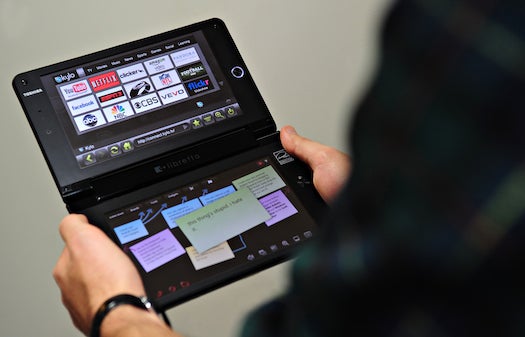
Toshiba Libretto W105
In my original review, I called the Libretto a “napkin-sketched concept unexpectedly brought to life.” It was also pretty much unusable in any way other than as a curiosity. But the idea of a clamshell, dual-screen computer is endlessly tempting–it just sounds cool, and the fact that there has never been a decent one doesn’t deter us from wanting one. The Libretto tried valiantly, but its reliance on Windows and its small, chunky form factor doomed it. It’s not exactly “deceased,” as it was a limited-edition product, but we doubt Toshiba was particularly pleased with its reception, and it’s unlikely there’ll be a follow-up. But what if Toshiba had released all the needed drivers and other tools developers would need to develop for it? It’s unlikely that it would have received enough attention from the big-name developers to actually allow it any success in a world dominated by the iPad and, soon (probably) Android Honeycomb tablets, but we could have at least gotten a taste of what a dual-screen computer could be. Like, say, an e-reader app that actually uses both screens, so you can read it like a book? Or maybe a fancy stylus-driven note-taking app? We’d need to be convinced that a dual-screen laptop has any real benefit, but at least the Libretto could have been interesting.