Gray Matter
A wire screen is all it takes to prevent dangerous gases from exploding

Screen Test: A fine-mesh kitchen sieve with a candle inside simulates a Davy miner’s safety lamp. An explosive mixture of propane gas and air is blown in from the outside. If the mesh is fine enough, the fire will stop at the screen even as the explosive gas flows through it.  Mike Walker
If you were a coal miner in the early 1800s, the light you used was an open-flame oil lamp—even though mines were sometimes filled with “fire-damp,” a volatile mixture of air and methane gas. Explosions were inevitable, and at times threw bodies from mine shafts like grapeshot from a cannon. Humphry Davy became a national hero when, in 1815, he found a remedy: Surround the lamp flame with mosquito screen.


Davy, one of the world’s first professional scientists, solved the problem by systematically studying what happened when gases burned. He started with the observation that gas flames would not travel down long, thin metal tubes because the metal draws heat from the flame, lowering the temperature of the gas below the ignition point.

He tried making the tubes thinner and shorter, until he discovered that thin tubes needed to be only about as long as their diameter to prevent fire from traveling their length. The logical end point was fine metal mesh, which you could think of like thousands of very short tubes arranged in a grid.

As bizarre as it sounds (and I really didn’t believe it until I saw it with my own eyes), you can blow an explosive mixture of gases through a fine wire mesh toward a candle flame and, when the gas explodes, the fire stops dead at the mesh—this despite the fact that the gas came right through the holes in the mesh and is just as explosive on the outside as it is on the inside.

Davy refused to patent his invention, preferring to bask in the glory of his role as the miner’s savior. His lamp remained in use, and his name was a household word, right up until the invention of electric light. Today his lamp is all but forgotten, but his reputation as one of the first and greatest chemists lives on.
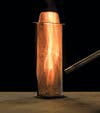
Re-Creating a Davy Lamp:  Mike Walker

Want to read more articles like this, plus tips and tricks, home hacks, DIY projects, and more? Subscribe to Popular Science today, for less than $1 per issue!

14 Comments

Very cool! I always wondered what made the lamp safe in an atmosphere of explosive gases.

This is illogical,

that's insanely creepy on so many levels. my grandpa was a fire chief, rip, he taught my dad everything there was to know about fires who then taught me a lot about them. one of the things he didn't need to teach me was to never put an unlit opened propane torch next to an "open" flame.

but it works! that's amazing. and i can see how it works. kudos mr. mad scientist

"Today his lamp is all but forgotten, but his reputation as one of the first and greatest chemists lives on."

False. Propane lanterns are still widely used today for camping. They are still based off of this principle using mesh mantles.

I wonder if that would be able to contain plasma...

Im definetly not a rocket scientist, but is coleman lanterns not also the same thing? with the little cloth bootie?

pv=nrt

volume varies directly with temperature

hotter air = bigger air = cant pass through mesh

Bigger air...yeah right... Sounds like you learned the formula and never understood the implications. This formula describes the properties of a given amount of gas. However, the individual air particles do not get measurably larger because it is heated up.

@V3rtigo
By plasma, I assume you are speaking about fusion reactors and some such. In short, no, this won't. The temperatures and pressures involved are too great to be contained by any material we know of and can make a mesh out of. After all, it isn't any fun for anybody if the P gets large enough to rupture the V. :P

Hey Freekin, I think you need to Wiki plasma. In fact a flame is plasma.

Mantles on lanterns are DO NOT prevent combustion of outside materials like a Davy lamp. They are there as the incandescence and candoluminescence of the various oxides they can contain create a much more intense light than simple combustion. The high temperature of the mantle itself is more than enough to ignite most materials.

I never said that the individual air particles gaining volume. I meant a given amount of gas.

assuming the rising volume of the air is limited by the mesh, then the pressure must be increased. If the gas expanded uniformly, then the flame might escape, because there is no air with smaller volume and pressure. However, since the expansion is not uniform (because of gravity and wind), the air furthest from the flame has the lowest pressure and volume meaning that that air is going to escape first.

This means that the lower pressure and density air that fuels the fire coming from the bottom, rises up around and with the fire because of the rising temperature and volume. However, because this air is not as hot and big as the air that is the fire, this air escapes the net more easily.

Actually, I don't see any reason why individual air particles would not get relatively larger depending on the heat, however, I also don't see any reason why they should. Perhaps you have facts to back up your statement

@V3rtigo
If my reasoning is correct, then, with increasing pressures and volumes of combustions, the net can have larger holes, and you can make the wires much thicker. However, if the expansion rate is faster than the speed of sound, then this definitely won't work, because this gas, or plasma, will not have the same volumes and pressures of air decreasing with distance from the expansion, it will be too abrupt.

@Freekin:
-"it isn't any fun for anybody if the P gets large enough to rupture the V. :P"

Me:
-what?

@Freekin:
-"it isn't any fun for anybody if the P gets large enough to rupture the V. :P"

Me:
oh

@jclevall

Yes, they serve both purposes.

Hm This does not appear very safe for general use. A candle is dangerous ,but this a trouble waiting to happen. It might be useful for outdoor lighting in a controlled environment. I would be interested to know how long the lamp can burn before shutting down or this too dependent on the candle and gas used?

www.amazingchandeliers.co.uk

Popular Tags

Regular Features


138 years of Popular Science at your fingertips.

Innovation Challenges


Popular Science+ For iPad

Each issue has been completely reimagined for your iPad. See our amazing new vision for magazines that goes far beyond the printed page


Download Our App

Stay up to date on the latest news of the future of science and technology from your iPhone or Android phone with full articles, images and offline viewing


Follow Us On Twitter

Featuring every article from the magazine and website, plus links from around the Web. Also see our PopSci DIY feed


February 2012: The Future of Fun

Science is reinventing play, from extreme sports to gamification to ridiculous roller coasters to the playgrounds of tomorrow, and this issue is chock full of fun. Also, on a less fun note: Did global warming destroy my hometown?


circ-top-header.gif
circ-cover.gif
bmxmag-ps