I had a VW 1600 engine that needed to be torn down. And I had a camera. Now, you have a photo gallery of the innards of that engine, which makes for an easy walk-through of the parts make your car go.
VW Engine
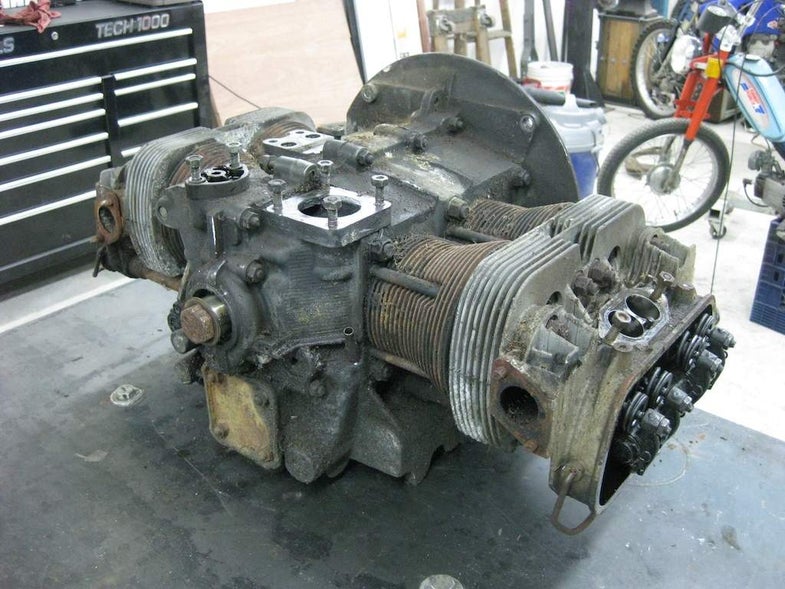
This dual port 1600 engine came from a 1970 Super Beetle. It sits here in my shop, awaiting a teardown.
VW Engine Intake Manifold
This is the intake manifold. A carburetor sits on the flange at the top and feeds a fuel-air mixture into the engine.
VW Engine Valves
After the fuel-air mixture travels down the intake manifold, it arrives at the cylinder head. It ultimately needs to end up inside the cylinder, but only at the right time. Shown here are the rockers and the valves. The rocker arms depress the spring-loaded valves, opening them to allow the intake charge to enter at precisely correct moment and, slightly later in the cycle, to allow the exhaust gases to leave.
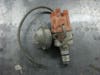
VW Engine Distributor
With the fuel-air mixture in the cylinder, something needs to ignite it. High-voltage sparks are triggered by the ignition points, which are inside this distributor. Then the rotor, also inside the distributor, routes the sparks to the spark plug in the appropriate cylinder.
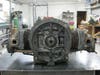
VW Engine Being Torn Down
With the intake and exhaust manifolds removed, the engine begins to look more manageable. The flywheel has also been removed in this picture.
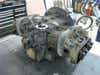
VW Engine Being Torn Down Front
This is another view of the engine with the accessories and manifolds removed. The heads (the things on the farthest right and farthest left of this picture) will be the next to go.
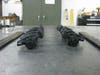
VW Engine Rocker Arms
In a previous picture, we saw the rocker arms in position on the engine. The rockers are in the center of the picture, and the long rods on the outside of this picture are called pushrods. In a pushrod type of engine such as this one, the pushrods push up on one end of the rocker. The other end then pushes down on a valve, causing it to open.
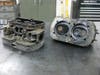
VW Engine Heads
The cylinder head contains the ports that allow fuel and air into the cylinder and exhaust gasses out of the cylinder. They also contain the valves that open the passage to those ports at only the right times in the engine’s combustion cycle. In the cylinder head on the left, we see the ports that connect to the intake and exhaust manifolds. In the cylinder head on the right, we see the valves, which are normally on the inside of the engine.
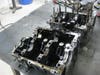
VW Engine Cases Split
Unlike most car engines, and more like a motorcycle engine, VW 1600 engine cases split into two parts. Car and truck engines more typically consist of one solid block into and onto which the engine is built.
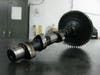
VW Engine Camshaft
A camshaft controls the timing of valve openings. The cam lobes (the oblong things) push on pushrods (or directly on the valves in an overhead cam engine) to cause the valves to open.
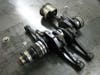
VW Engine Crankshaft
In an engine, reciprocal linear motion (pistons going up and down) is converted into rotary motion. The parts in this picture make that happen. The pistons move up and down in the cylinders as the explosions happen. Connecting those pistons to the crankshaft are the conrods (short for Connecting Rods). Because the point on the crankshaft to which the conrod connects is off of the center axis of the crankshaft, the reciprocating motion of the piston and conrod causes the crankshaft to rotate.