Obscure Gear: What the heck is a Variac?
And why do I own three?
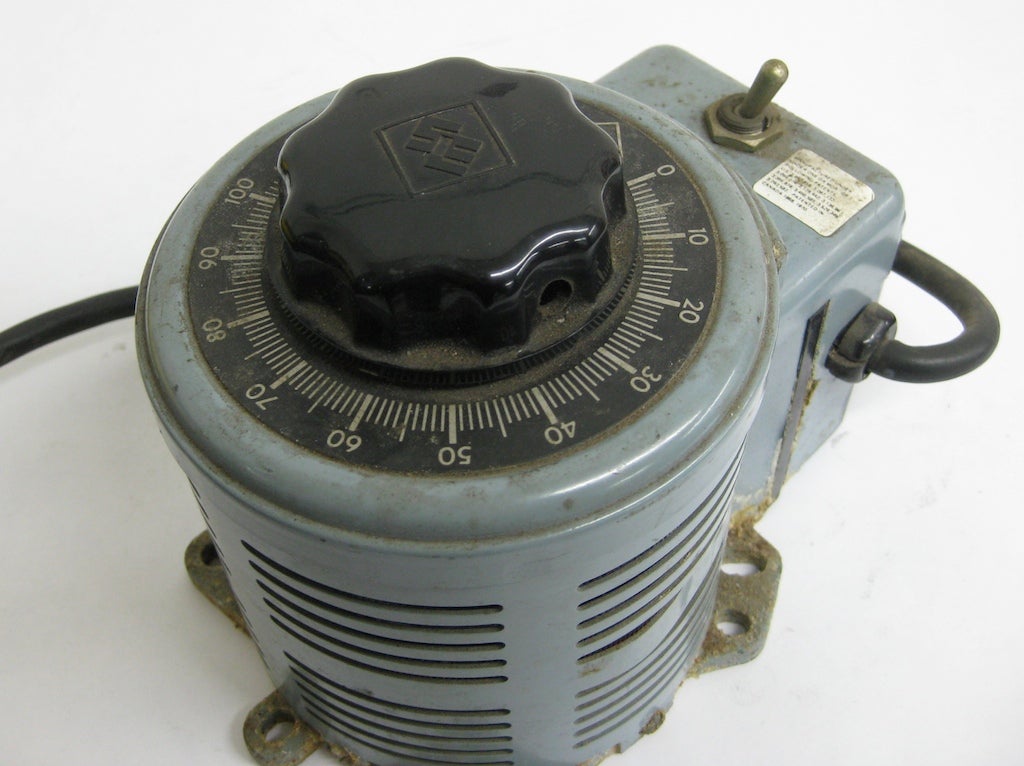
A Variac looks like a sci-fi laboratory prop. For some reason, I have three of them in my shop, and yes, one is just a book end. But they do have a useful purpose.
Variac is a generic trade name for a variable autotransformer. If that doesn’t help explain much, let’s look at what a regular transformer is, and how they relate to a collection of vintage arcade games.
The chances are good that you’ve seen a transformer and even better that there is one in the room with you right now. A transformer provides electrical isolation and impedance matching, and, in the application we’re considering here, translates voltages between primary and secondary circuits. In operation, alternating current at one voltage is applied to the primary side of the transformer yielding alternating current in the secondary side of the transformer at a different voltage.
Variable Autotransformer Windings
To understand how this magic happens, you need two basic concepts. First, a principle derived from the fundamental connection between electricity and magnetism: A current flowing through a wire will create a magnetic field in the area around the wire. It follows directly from this that a changing current will create a changing magnetic field. Second, a principle discovered by and named after Michael Faraday: A changing magnetic field in the presence of a circuit will induce an electric current in that circuit.
Using these two principles, we can see that using alternating current to create a changing magnetic field in the presence of another circuit will induce a current in that circuit. This is precisely what happens in a transformer. A typical transformer consists of coils of wire for the primary and secondary windings wrapped around a shared iron core, which maximizes the shared magnetic flux and, in so doing, the efficiency of the transformer. The ratio of the voltage induced in the secondary windings to that in the primary windings will be proportional to the ratio of the number of windings in those two coils.
So what is a Variac?
A transformer consisting of only one coil which is shared by the primary and the secondary side of the circuit is known as an autotransformer. A variable autotransformer is known generically as a Variac, which is what I’ve dissected here. The ratio of the primary to the secondary windings is variable, which means that the ratio of the secondary voltage to the primary voltage is variable.

Variable Autotransformer Wiper
The inside of a variac looks like a giant rheostat. There is a single winding which is partially exposed so that the movable wiper can make an electrical connection. The primary connection of the transformer is made to both ends of this winding. The secondary connection is made to one end of the winding, called the common connection, and to the movable wiper. As the wiper moves, and ratio of the transformer changes.
Some people use variacs to bring long dormant electronic equipment back to life gradually. Variacs are also used in experiments and testing to simulate various voltage and line conditions. Electrical equipment designed for a voltage other than the 120V or 240V supplied domestically can be powered at the intended voltage level with a variac. I personally happen to have three because I used to live directly next to a substation, in a warehouse that had unusually high mains voltage and a collection of vintage arcade games. I use one now as a piece of workbench test equipment, another as a bookend, and I’m saving the third to be a prop. In my sci-fi laboratory.