My welding hobby started shortly after I got a bid for a steel staircase. As with everything, the money always causes me to do the Carnett calculation:
Then I run off to buy the gear.
This of course leaves out the skill to do any of these things -- but the Carnett calculation includes the discovery phase, where I make all my mistakes, ask just about anyone for help, and somehow come out on the other side a more skilled operator. And 50 percent of the time, I really do save money.
My father-in-law purchased a 140-amp 110-volt Hobart MIG welder for me as a birthday gift. I had no mentor, no skills, just an urge to weld something. I started welding and never looked back. I now own my original Hobart MIG, a Miller 252a/220v that lets me weld half-inch steel, and a Miller Dynasty that is a combo stick and TIG unit.
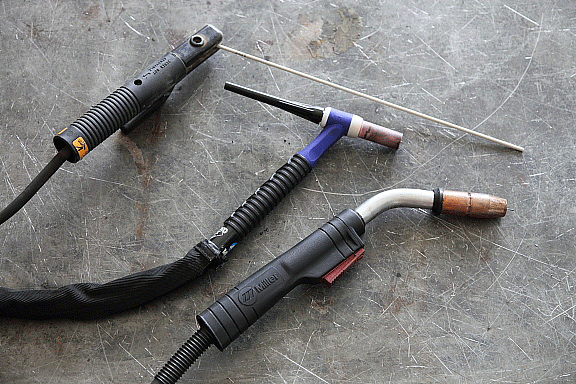
Here's a look at your basic types of welding. I'm going to keep this very simple, because you just want to get your feet wet and start playing.
This is the old-school technique. It allows for deep penetration using fairly cheap equipment. The guys that do it all day are true artists. You see this used a ton in the field of oil rigs, bridge building, boat building, and the like, but the smaller units can easily be used in your garage. Electric current arcs between the material that you want to join and the consumable electrode rod. The rod is coated with a flux that protects the weld area and eliminates the need for a cover gas. The thickness of material that you can weld is related to the power output of the machine and the thickness of the welding rod. Stick welding gear is available at the consumer big-box stores and is a very cheap way to get started in welding. The problem is that it takes more skill to get a good weld with stick than with MIG, so I can only imagine the number of units sold every year that get only 20 minutes' use. If you have a friend who is good at stick welding, it's a great place to start, but otherwise I'd recommend you begin with a MIG unit.
This is the welding process that looks like a gun that shoots metal. MIG is like stick, but instead of having to stop to change the used-up welding rods, the machine has a spool of wire that is auto-fed with the simple pull of a trigger. You can use wire coated with flux, or regular steel wire and a cover gas. The output power of the welder, the thickness of the wire on the spool, and the rate it's fed all contribute to how thick a metal you can weld with a MIG unit. The gear is more complex, so it costs more than stick to weld the same thickness of metals.
With practice and some care you can be making decent MIG welds inside an hour. Most consumer stores only sell MIG gear up to 140 amps / 110 volts, but this will allow the weekend welder to manage most projects. Over time your needs will expand, and you will want to weld thicker metals, or weld longer without stopping: that's when you will move onto the 220-volt higher-end units that are sold at the welding shops.

This is the most complex form of welding, and one that can consume you when you graduate to it. It is very quiet because the electrode is not being consumed. You manually hold the tungsten electrode over the weld area, which is shielded by an inert or semi-inert gas mixture to protect the area. As you heat the area up, you manually fill the joint with a hand-fed wire. You need to melt the material just enough, so that you can fill it just enough. Think of it as a micro-super-hot heat source that is melting the metal. This allows for welding very thin or thick material, great control, and an incredible looking weld, but it is very slow, and if you suck it looks horrible. The thickness of what you can weld is based on the output of the machine and the thickness of the filler metal. TIG units are not available at your big-box stores.
Coming soon: Part Two -- the gear that cuts!
John B. Carnett, PopSci's staff photographer, is using the latest green technology to build his dream home. Follow along as the project progresses on his Green Dream blog: popsci.com/green-dream
Stay up to date on the latest news of the future of science and technology from your iPhone with full articles, images and offline viewing
Featuring every article from the magazine and website, plus links from around the Web. Also see our PopSci DIY feed
Share links with friends, comment on stories and more
In our December issue, Popular Science names the 100 best innovations of the year: bombproof wallpaper, self-parking cars, the fastest helicopter, and 97 more. Plus inventor profiles and videos.
Check out the best of what's new here.


I've only tried welding twice in my life and it was with a TIG welder (Miller 225 and Lincoln 225). I have to say, after a 5 minute introduction I was on my way making what the instructor called very good welds.
I haven't tried Stick or MIG yet, but I think I'm gonna skip them alltogether and go the TIG route.
My only issue is that TIG welders are not cheap. A good, solid entry level one can run you up to $2000. There's no such thing as a cheap TIG welder (it just wont work or last).
So I'm trying to save up a little cash :-)
This was great breakdown of your welding process. It's also good to see how you've developed your welding skills and gear over time. It looks like you have a nice set up in your shop, so I was curious as to what sort of plan you used to organize your workspace to fit your welding projects?
Gladiatorgw.com
MIG is like a hot glue gun, but with metal. It's super easy.
I TIG'ed pressure vessels for years. A really good book is "How to Weld Damn Near Anything" by Jessie James. Read it before you buy a welder so you can understand what the different types of welding are for.
Cool article. Ive been welding for over 6 years now, with over 3 years TIG welding aluminum and stainless steel professionally. I find that while TIG is the most difficult to master, it is very satisfying when you lay down that perfect bead. Only thing I find dissatisfying is getting shocked when you accidentally feed the filler wire into the electrode!
blaxpear wrote: "There's no such thing as a cheap TIG welder (it just wont work or last)."
I have to disagree, at least from the DIY POV.
For professional daily use of course, you would want a Miller or Lincoln, and pay over $1000.
I've taught myself to TIG weld to fabricate go kart racing parts and to restore or modify frames, and have been doing it for about a year.
I bought a new 'Hutai' (cheap Chinese) 220v TIG machine on eBay, which is pretty basic. It's DC only, (ie can't weld Al,) and doesn't have provision for a foot pedal, but it was only $350, it does have pushbutton (HF) arc start, rudimentary pulse features, and a current/gas ramp up/down delay control, and I find it quite adequate. Knowing it's Chinese "junk," I baby it, and NEVER leave it outdoors or in the (unheated) garage overnight. You'd want to bring your consumables (filler, tungstens) indoors overnight anyway.
I do plan to get a better (smaller) swivel torch, but being retired I doubt I'll ever be able to afford a "good" welder.
Do I miss Al capacity and a foot pedal current control while welding? Sure. But it works quite well for steel, and IMO was a huge bargain. You just have to choose VERY carefully and educate yourself RIDICULOUSLY well before buying. Remember you will pay and pay for consumables (like gas, and tungstens, which you'll burn a lot when learning,) with TIG - but it's worth it as the process is incredibly versatile and controllable. You can make a neat weld on anything from the thinnest sheet (tin can) or tiny firearm parts, to 9/16" 4130 steel -as long as they're clean, and not contaminated (say, with bronze brazing,) or cast iron, which WILL NOT weld.
I got one of those chin strap-controlled hoods and (not ever having acquired the "neck nod" technique for flipping down a manual hood,) find that jaw control convenient. A weldor who has acquired other hood habits would find it difficult to adjust to, even annoying (as they also would hate the pushbutton type torch,) but having known only this, I like it.
Ony thing I would never try is buying a cheap MIG unit. Too mechanically delicate to do on the cheap. A MIG welder must have a well designed, very high quality, precise and durable wire feed mechanism, or it would be unusably annoying and waste lots of wire. It would tangle MOST of the time. And I would never do without the shielding gas function. There are many "flux wire only" MIG welders being sold out there for less. I'd steer far clear of those - even if they were "good" brands (like TS's Hobart.) Flux (gasless)welding is just too messy for me after seeing TIG, which is so clean and safe you can do it on the dining room table (as long as it's heat protected, LOL. Your 'work' will still get RED hot...just no sparks.)
As for interim price, "quasi-good" brands, check out HTP. Sometimes their sales produce decent intermediate pricing, and their support (something that's nonexistent with a Chinese welder) has a good rep.
A cheap TIG is actually a MUCH better choice an a fluuuux wire MIG, though you'll have to put in your time practicing to get good with TIG. Personal instruction would be great if you live where it's available.
Be VERY careful with eBay. Make absoilutely sure you tal to the supplier and establish a DOA return policy you (somehow....?) trust. I was lucky I guess. But MANY Chinese welders are either shoddily assembled, and/or almost all are mistreated in shipping (welders are HEAVY and can destroy themselves through their own weight in shipping. The Chinese do NOT pack well, and you can expect what you would, of cheap labor in assembly.)
Uh, oh....
The original post forgot a very important type of welding, the earliest, from which all else (including cutting) was developed -flammable Gas (as opposed to MIG/TIG's inert gas shielding,) or "oxy-acetylene" welding.
My mentor (who, being an experienced pro, has always been right except for his "cheap welder" prejudice) keeps telling me I WILL want a torch setup as well as the TIG I use.
He insists there are times you just need to heat metal (VERY hot, not just "propane hot,") to bend it, or to cut lots of it fast and rough. And yes, I have seen the wisdom of that statement recently. He also claims there's nothing like it for lighting BBQ charcoal ;)
Anyway, for oxy-acetylene welding, you need the two gas tanks, ling hoses, and a safe torch setup (with the proper flashback valves and different tips for heating, cutting and welding - which is somewhat like TIG, but not as clean.) I still avoid it, as keeping high pressure 02 around is IMO prohibitively dangerous for sporadic use (and TWO MORE gas tanks, with regulators, are expensive to buy and keep full.)
My mentor of course pooh-poohs that, but he uses it often, has a huge shop space, and has transported tanks to and from jobs all his life (and even witnessed and survived a number of fires.)