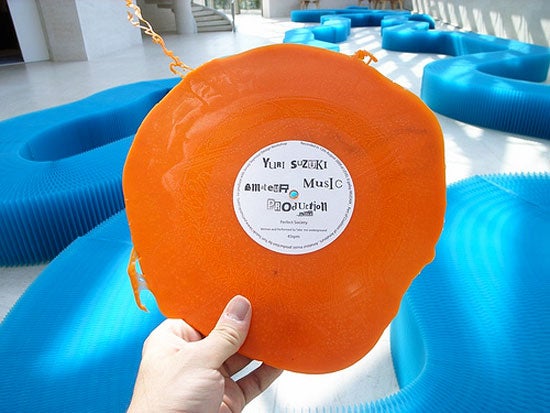
DIY Record Making courtesy yuri suzuki

ProTools? Bah! Let's make some vinyl! As part of Jerszy Seymoour's Coalition of Amateurs exhibition at Luxembourg's modern-art museum, Mudam, artist Yuri Suzuki created records from scratch in an afternoon.

First, he recorded three amateur punk bands and used a standard record cutter to make a master. Then they whipped up their own colored vinyl and used the master to hand-stamp out some copies. The technique is appealingly low-tech: just boxes of liquid vinyl with a dude standing on top.
Record pressing:  Yuri Suzuki
For that DIY aesthetic, they left the final products untrimmed. There's no audio of the results, but just looking at the photos, I'm tempted to heat up the stove at home tonight and see if I can't make a few back-up copies of Blonde on Blonde.

[Design Boom]

Want to read more articles like this, plus tips and tricks, home hacks, DIY projects, and more? Subscribe to Popular Science and enter to win $5,000!

3 Comments

..and how exactly does one go about getting a 'standard record cutter'? A preliminary google search brings up a lot of albums with the word cutter in it, but no tools for creating lps.

Here's some possible ways you could make your own LP's.

CUSTOM RECORDS VINYL MASTERING this place does one-off pressings.
www.customrecords.com/

VESTAX VRX 2000 Vinyl Recorder-This is basically an LP recording machine, makes single copies of your music on vinyl.
www.roadogz.com/stories/downunder/vrx.htm

Also try googling "How to pirate a vinyl record".

RTV silicone, the type you mix with a catalyst, not the hardware store type in a tube, can be used to make a mold from a record.

For best results on the mold, use the thinnest silicone you can get, then add a little silicone fluid - also known as fuser oil. That was used in some older photocopiers and laser printers. Silicone brake fluid will also work. It's just silicone fluid with a purple dye added.

To make copies, use a hard urethane resin like the ones sold by Smooth-On. They have one that's thin as water and cures in 90 seconds after you begin mixing. Takes a few minutes to cool down and become fully rigid.

I've seen a demo where a mold made from Dragon Skin (TM) silicone was used with that fast cure resin. The demonstrator said the mold had been used to make a couple hundred castings, never used any mold release.

Popular Tags

Regular Features


Download Our iPhone App

Stay up to date on the latest news of the future of science and technology from your iPhone with full articles, images and offline viewing


Follow Us On Twitter

Featuring every article from the magazine and website, plus links from around the Web. Also see our PopSci DIY feed


Become a Fan On Facebook

Share links with friends, comment on stories and more


December 2009: Best of What's New

In our December issue, Popular Science names the 100 best innovations of the year: bombproof wallpaper, self-parking cars, the fastest helicopter, and 97 more. Plus inventor profiles and videos.

Check out the best of what's new here.

Popular Science Photo Pool


Share your photos in the Pop Sci pool at www.flickr.com!
tags_sprite.png
POP_embeddedForm_cover_May09.jpg

Events and Promotions