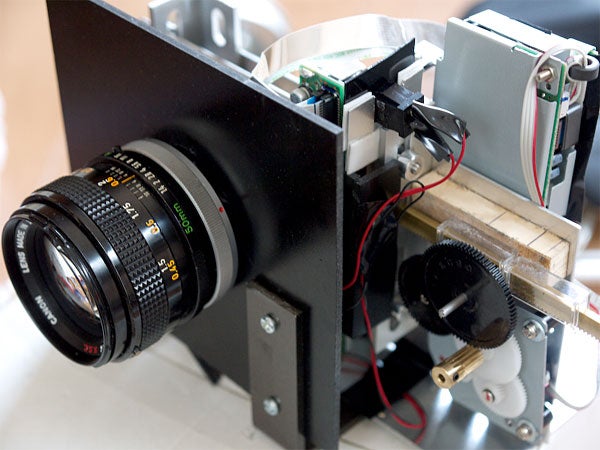
Tinkerers have been turning flatbed scanners into cameras for a while, but this version by a Japanese modder is one of the finest I've seen--both in technical execution and the incredible quality of the massive 130-megapixel images it creates.
Basically, this is the digital equivalent of a large-format view camera. Only even bigger. A mechanical implement moves the scanner's CCD sensor over the image projected by the old Canon FD lens (he has other lens mounts, too). And here's a still life, all 13,068 x 10,173 pixels of it:


Five amazing, clean technologies that will set us free, in this month's energy-focused issue. Also: how to build a better bomb detector, the robotic toys that are raising your children, a human catapult, the world's smallest arcade, and much more.


Online Content Director: Suzanne LaBarre | Email
Senior Editor: Paul Adams | Email
Associate Editor: Dan Nosowitz | Email
Assistant Editor: Colin Lecher | Email
Assistant Editor: Rose Pastore | Email
Contributing Writers:
Kelsey D. Atherton | Email
Francie Diep | Email
Shaunacy Ferro | Email
That's just plain awesome. Imagine having that as a security camera.
It wouldn't make for a very effective security camera; the time it takes to record an image at that high of a resolution to permanent media would kill the recordable frame rate, and you'd run out of space to store footage very, very quickly.
Hmmm. I didn't think about that. I'm not quite camera savvy. Or tech savvy for that matter.
Note that the scanner does not achieve this resolution optically, it is actually interpolated up. It is not much different then interpolating a 6 megapixel image up to 130 megapixel, and that is why the full resolution clip looks blurry.
You would honestly be much better off with Cannon's 15 megapixel $500 camera than this hack. Not only is it infinitely more dependable and portable, it also can take an exposure in 1/4000 of a second, compared to about 30 seconds for this hack (in other words this thing couldn't get a good picture of something even slightly moving to save its life).
Don't be fooled by the large megapixels. You could buy an expensive film scanner that achieves 7,200 optical pixels per inch, but it is much more expensive, and I don't think that it would be superior to cannon's 15 MB sensor - even for stills. Sensor quality and megapixels are NOT the same thing.
So it's a hack, at least he has the brains to whip up something like this from junk...
You simply put a lens in front of a scanner - but it is still junk. He hardly came up with an original idea either. People have been doing this for over a decade! Not so much brains as monkey see monkey do. If he had "brains" he would have known that it was a waste of time and moved on.
3DTOPO
The point is, he did not spent lots of money on expensive film scanners or cameras.
And using his device, he has done a lot of fine work, did you visit the link to see examples of his work?
I wonder if its a matter of sour grapes, on your part, true lots of people have build such a device in the past, but have you?
As for the examples of his work, can you match the quality of his work?
My point is you can achieve the same resolution with a cheap ($59) digital camera and just enlarge the images up using software interpolation. If time is money (it is to me), then it would be far more effective to just buy a cheap digital camera (or salvage one) compared to all of the salvaging, experimenting, tinkering, just to achieve low quality images.
The resolution he is achieving is NOT optical. If it were, I would consider building one myself.
As for his work, it doesn't really do anything for me - I personally much prefer my own work. Not to mention the resolution of his work is unacceptable to me (blurry), the chromatic aberration visible in the images is horrible, and there is severe noise visible.
I would much rather have less pixels at the expense of them being sharp, clear and clean - and as a bonus - you can fit it in your hand, and take pictures of scenes that are not perfectly still.
3DTOPO
you said "Note that the scanner does not achieve this resolution optically, it is actually interpolated up"
Interpolation upwards is not as good, because software has to guess the in between pixels, you and me both agree on that, and that's how cheap $50 cameras and scanners seemingly get higher resolutions
3DTOPO, did you by any chance notice that most of the pictures posted are thumbnails, and you click on them to get a higher resolution download? I downloaded the one of the wrist watch, original scan at full resolution. I copied and pasted the options for you, the small sizes were interpolated DOWNWARDS from the original, but they don't look good at 919 by 1024, because there is just not enough resolution to show detail. But on a 96 ppi computer screen, lower resolution is made up for, by the screens ability to show millions of colours and NOT fine detail. The pictures being taken with this scanning camera, are meant for PRINT and are wasted on a PC screen. And you should look at the old cameras meant for making printing plates from paste up magazine pages after the editing team finishes its lay-out , those cameras are always extremely big in order to get depth of field, and capture detail.
The download options for the wristwatch photo;
Square (75 x 75)
Thumbnail (90 x 100)
Small (215 x 240)
Medium (449 x 500)
Large (919 x 1024)
Original(6281 x 7000) at 10.73 Mb.
In my my Windows Picture and Fax Viewer, it opened so I could see the whole picture at 1200 dpi.
In affect, its a extreme close up of a small item, yes, a $50 2 mp camera would take the same shot on a 1600 x 1200 image sensor chip maybe 10-mm square, and the lenses has to reduce the image to fit the 10-mm sensor. And most cameras are not designed for such close ups, of small objects so lack depth of field, they are more intended to photograph people and large objects, including landscapes.
You state that "The resolution he is achieving is NOT optical"
BUT IT IS becucase this scanning camera, its lens puts the image onto what is in affect a estimated 200-mm by 300-mm sensor, or 7.5 inches by 12-inches in affect a large size 1500 by 2400 resolution sensor WITHOUT needing the image lens to reduce the image to 10-mm by 10-mm, MEANING the lenses can concentrate on a extreme close up,I suggest you try doing the same with a $50 digital camera, if you could even get it to focus, then using Photoshop to interpolation upwards. You would get NOWHERE fast.
If anything, the originals are getting interpolated DOWNWARDS, in order to reduce file size, and downwards is not a dirty word in digital imaging, because the software is not creating new pixels by what I term guess work.
Yes the scanning camera, has to scan the image line by line, the same as a scanner scanning a document or photo AND that does take time BUT a digital camera also has to scan its 10-mm square sensor chip, bit by bit, that explains why you can not take hi resolution movies with a video capable camera, it would not be able to scan its sensor chip at full resolution, at 30 frames per second. that's why such a video is limited to 640 by 400 maximum, more often its 320 by 200.
I forgot
"In my Windows Picture and Fax Viewer, it opened so I could see the whole picture at 1200 dpi,"
[please add]
BUT the image was software interpolated downwards to display the full picture on my (and your) screen at 96 dpi.
But print the original as intended, THEN you get to see the detail.
And that's the point of making these cameras, because buying one that has such depth of field enabling focusing on small things, costs mega bucks.
Some of us are not rich, so we prefer using our time, to build something that obviously you yourself can just go out and buy.
And you stated "You could buy an expensive film scanner that achieves 7,200 optical pixels per inch" but it is NOT going to take a photograph of a wristwatch, it just SCANS film you already have, and say you use a 6 x 4 photograph, or 35-mm negative, it is going to be hard to scan detail, unless the photograph is extremely sharply detailed BUT that depends on the quality of the film you use in your old fashioned obsolete camera that soon will be a museum piece because film is going off the market due to the high cost of silver.
I wondered if by any chance you were a sales rep for Cannon and have been getting some advertising in?
Yeah old.timer u tell em. Some times taking pictures is about art, not just buying a camera and snapping. The process sounds really interesting and makes some amazing images.
Could this be hooked up to a telescope?
They take exposures that last for hours.
The CIA spy sat, I think uses multiple imaging chips, so does something that NASA is putting up soon. They can not use scanner cameras like the device discussed here. I believe some digital cameras are coming out with multiple image sensor chips, (at a price) the failings of existing cameras, are the small size of the image sensing chip, larger imaging sensors, means the lens can devote itself more to focus, and extreme close ups. (making a hi res 20 by 20-mm chip costs more than you would expect, the price of any microchip is based on the number of rejects, and there are ALWAYS rejects, chip making is never 100% perfect nor close, and the price you pay for a good imaging sensor chip, also pays for making the rejects that don't get sold.i.e, every chip is tested only at the end, its not possible to test during the making.)
And that is what this scanning camera does, it gets around the limitations of 10-mm image chips, albeit at a cost, ONLY still life.
A telescope with a camera, taking hours for a exposure, I suspect it MUST be chemical film, the long exposure because stars are very faint, I don't think a digital imaging sensor can pick up more light with a long exposure, but due to the digital nature, you could computer enhancement to make up for absence of long exposure. Computer enhancement in this case, means computer amplification of light on each pixel on the image sensor, and is nothing like interpolation to increase resolution of a image.
So for a telescope digital photo, in a computer, your software looks at each pixel, but DOES NOT add pixels by looking at surrounding pixels, because what ever image you do that to, you destroy sharpness, and add blurriness. And faint stars, become bigger and misty, rather than brighter pin like
The scanner camera can not be used for long exposure, because by nature, its only reading the image line by line, so think this, 99% of any long exposure time, the software is reading other lines.
A digital camera, with a 10-mm image chip, can read the image thrown onto the sensor chip, line by line, in a fraction of a second so can be used for moving objects, all $50 cameras are great at that, but useless with fine detail, and interpolation upwards, wont work, unless you have detail to begin with, forget $50 point and shot digital cameras.
There is a vast difference therefore, the scanner camera is tool of choice, for finely detailed, close up, still life.
Nobody should believe that a cheap camera, with computer interpolation to increase the resolution, can take such pictures, which when printed out, can become posters covering bill boards, a metre by a metre, and larger. Years ago, Kodak used enormous film cameras, to create their still life photos, which they pasted up as murals inside buildings
Anyway, I never built a scanning camera, but am fully aware of its uses, and the work you can do with one, I am more into photo editing, but it pays to keep clued up about other forms of digital imaging, you never know what you learn, that you use with your own interests.
I forgot, Kodak's photo printer, was a drum metres long, over a metre in diameter, the paper was rolled around the drum, and the image was printed out over a number of hours, the image being scanned from a large format hi res photo, taken in their enormous camera.
Check out on Google Books, either Popular Mechanics, or Popular Science magazine roundabout the mid '60s.
Old.Timer: you are clearly clueless. His lens is only using 35mm of the scanner bed! Which means if the scanner is achieving 300DPI, without software interpolation, his image would be about 900 pixels wide. If his Scanner is running at interpolated resolution of 9600 DPI, then he could achieve an image 14,000 pixels wide INTERPOLATED, and that is around the size of his images.
I was talking about using a film scanner to build a similar camera, that actually achieves 7200 DPI OPTICAL resolution. A film scanner would be far more ideal, because the scan area is roughly the same area as the usable area of the lens (35mm), and because it achieves high resolution WITHOUT interpolation.
The rest of you rants do not even deserve a response - you are way off base.
Conrad: no, you would not want to hook this up to a telescope. You can not achieve time exposure with this (or even control the duration of an exposure for that matter), the scan beam passes the over an area of the lens for a very brief time, it would be impossible to take deep exposures. You basically have minimal control with this sort of camera.
p.s. Old timer is wrong again: digital cameras on the other hand CAN take long exposures (in fact open any astronomy magazine, and pretty much all you will see these days are digital sensors). My Cannon has a "bulb" mode, which means you can open the shutter as long as you want, bathing its' CCD in photons....
Conrad, you raised a interesting question, I got your answer.
As the spy sats are moving, they need instant shots, and NASA can not use time exposure, with digital imaging but must be using multiple exposure (read/scans of the image sensors)and both agencies use Super Computers to process their images.
So, if you have a telescope, and wanted to experiment, use a decent digital camera and take multiple exposures.
Then in Photoshop, each exposure becomes a layer, (they must be perfectly aligned) then you increase whiteness (for example, as I am keeping it simple)while cutting back on black, than flatten down all the layers and there's your star picture.
I admit I have not tried it, I just thought of it,I certainly am going to experiment.
BUT, what if you use the same exposure, in multiple layers, and process as above?
That is your low cost enhancement.
Old.Timer: the method you are advising would never reach as good results as a good deep long exposure that any decent digital camera is capable of. Not to mention it is a lot of unnecessary work.
If you use one exposure, you will not get anymore information than what it is in the single exposure. What you are proposing is called "magic". Good luck.
3DTOPO
Wake up, it is not using 35-mm of the scanning bed, its throwing the image over the whole scanning bed, from which he is scanning point by point, the whole scanning bed.
And while the scanner might have a pixel sensor twice the size of a pixel in a camera sensor, but if the image he scans is 10 times bigger than the surface of a 10-mm image sensor, he is already immensely better off.
the following is something you said at the beginning, I suggest you PROVE it, or back down.
"My point is you can achieve the same resolution with a cheap ($59) digital camera and just enlarge the images up using software interpolation. If time is money (it is to me), then it would be far more effective to just buy a cheap digital camera (or salvage one) compared to all of the salvaging, experimenting, tinkering, just to achieve low quality images."
I suggest a time frame of 24-hours to PROVE your point.
And you said the following "Not so much brains as monkey see monkey do. If he had "brains" he would have known that it was a waste of time and moved on."
As I said, I suspect its sour grapes on your part, because he built something that you could never do, and had it published by PS where you know that you yourself would not be able to duplicate it.
So, seeing time is money to you, please get your cheap camera, and software, and post something, just as good, if not better.
Maybe there is also the fun of building such a thing too, so in regard to your monkey see monkey do, why don't you give us examples of any ORIGINAL work or project you have ever done, anything at all that does not duplicate somebody else's work.
Or failing that, post some of your OWN creative work, as in similar quality photos taken any way you like, including if you now go and build you own scanner camera.
Old.Timmer: you have the ramblings of a senile man.
Please explain how is it possible to use the whole scanning area for a lens that has a focused area of only about 35mm? The scanner moves behind the lens, which means it is only useful for the area of the lens. The lens is from a 35mm camera, therefore that is the area that is usable. How on earth would you get a larger area than the lens into the lens? That is just crazy.
The only way would be possible is with additional optics, which are clearly not being used.
You prove it! Or is this more of your suggested magic? Absolutely nuts.
Old.Timer, it doesn't look like you're having any luck talking sense into 3DTOPO so I'll give it a try. . .
3DTOPO, look up a "camera obscura" on google and glance at some of the drawings/pictures, specifically of the primitive "pinhole" versions. These were used by some artists (way before the time of film) to project an image that could be traced, essentially.
Now, stick with me here. . .let's imagine sticking a 50mm (or any focal length lens, for that matter) on a light-tight box, what do you think would happen when light passes through that lens?
A projected image, perhaps?!
Any lens with high optical quality (like the 50mm, which is well known as the "thrifty fifty" because of its high quality optics and low cost) could be used to produce an image like those in this article. A "50mm" lens is only a 50mm lens when the center optical element is 50mm from the plane upon which the image is projected, so the "50mm" lens used in this experiment is no longer technically a 50mm lens like it was when used on a 35mm film camera.
In this case, the lens simply allows the image to be projected onto that particular size of surface and for that projected image to be focused as desired. I also imagine that this photographer used the low aperture of the 50mm lens to intentionally limit depth of field, but that's a whole different discussion.
Anyhow, this is not an optical interpolation. It's a digital interpolation (because the scanner doesn't have a single large sensor like that in a digital camera) of a single image.
Look into optics a bit, hopefully you'll understand eventually.
And by the way, taking a cheapy digital camera and stitching together tons of photos won't give you these kinds of results. The single lens/single image allow for continuity of photographic elements such as depth of field, exposure, white balance, etc, which would be nearly impossible to duplicate with a smaller camera. Even with my 12.3 megapixel D90 I wouldn't be able to combine multiple images seamlessly to achieve a 130 megapixel image. Give this guy (and all others who have done similar projects) some credit, it's well deserved.
3DTOPO: Why do you feel the need to be such a prick? You should know that you are so wrong on so many levels. I really don't want to waste much more of my time explaining to you how dumb you are, and I'm sure you are already aware of that... so, two things...
1st- It is spelled "Canon".
2nd- If you own a "Canon" camera that has a "Bulb" option for a shutter speed; it must be a DSLR. All of Canon's digital single lens reflex cameras use a CMOS sensor not a CCD.
Have a wonderful day and remember... your family & friends think you are a horrible excuse for a human.
I think what is confusing to most here is that the scanner (or most scanners) use a linear ccd not an array. Some are a large pixels in width say up to 6000 such as (http://www.fairchildimaging.com/products/fpa/ccd/linear/ccd_191.htm). It like taking the array say 1600x1200 and instead reducing it to just a strip. They then "scan" this across the subject. When your subject is not moving and only the scan head, then you can get a very good image. And yes it can be interpolated like any other image. The clarity issue in these photos is not due to the resolution which is quite good, but to the limited field of view that such a camera/scanner has. The lens on a scanner is typically in a very narrow range and setup to reduce reflects and keep color tone correct. Also it is setup to maximize the light returning from the light source in the scanner. This give you the 48bit color resolution and high dynamic range in a scanned image.
This changes when you scan without a controlled light source such as in an open environment. The lens here effectively allows you to focus on a target much father away and still effectively "scan" it.
So the poster who recommend the film scanner (7200dpi) is correct that it might make a better version than this one. I would however say the design could be improved to give you a better field of depth making the photo even clearer.
Actually it seems to me that not all the information is included in the story here. The scanner used isn't just a normal flatbed scanner. John Mahoney seems to have left this detail out of his story. It's a higher quality Epson 4.5x6cm scanner of very high quality rather then a typical scanner used for documents. It's an old Epson gt-s620, I actually can't find anywhere to buy this. I wonder if it was only ever sold in Japan or it's just too old. This together with a 50mm lens should be able to produce an image, but not likely filling the entire area that the scanner can scan.
3DTOPO is correct when he says that a standard 50mm lens could not resolve an image once the distance between the lens and the sensor is increased. But 3DTOPO also has no right to be a jerk about it. I can prove this point by using a D700 with a 50mm lens and a set of Nikon bellows. (I realize that this is a Canon lens, but both companies Canon and Nikon work under the same laws of physics) Once you start moving the lens away from the sensor, the image becomes blurry and the lens can no longer be focused, it will only focus on subjects within 1" or so of the lens. If you like I can post a sample image somewhere. You can tell by the images from the scanner camera that he seems to be using the lens in it's standard configuration. The subjects are not that close to the lens. Some samples from the builder's flickr account show the lens focused to infinity, this wouldn't be possible if the lens had too much space between it and the sensor. The images you see here are only possible if the lens is the standard distance from the sensor. The lens would work if it was closer to the sensor however, but you would have to crop the image even smaller an loose resolution. This happens when you use a standard lens on a DX camera. With this high quality scanner and lens combo you should be able to produce sharp images at a high resolution, but it's possible there is some software interpolation going on here to up scale the image, but this is a really high quality scanner so it could be 1:1.
3DTOPO said: "He hardly came up with an original idea either."
Please read the article:
"Tinkerers have been turning flatbed scanners into cameras for a while, but this version by a Japanese modder is one of the finest I've seen"
We all know this isn't a new idea. It's just a good example and execution of an interesting idea. Yes I would rather shoot on a D700 most of the time, but the tinkerer in me has always wanted to build my own camera and wooden tripod. Not because it is easy, but because it is hard.
Greetings,
I do not understand how this works. The article gives very little information, and the comments are confusing.
How many pixels does the CCD have, and how are they arranged? Is it a single pixel, in which case it would have to scan across thousands of times? Is it a line of pixels? Is is a square of pixels like in a digital camera?
And is the the CCD moving directly behind the lens scanning the light coming through, or is it scanning a surface that the light is projected onto?
Thanks
Well! It is a nice blend of two technologies. The Scamcam with images as clear as 130 mega pixel is an advent to new series of cameras. The Japanese have always been known for their avant-garde technology.
http://arindamchakraborty.com/
This is pretty cool stuff but the same result CAN be made with a regular digital camera, a tripod & some photo stitching software.
Put the camera in manual mode so that all the exposures are the same (all DSLRs & many Point n Shoots will have this mode). Mount the camera on a tripod. Zoom in some (don't use digital zoom), take a picture then rotate the camera on the tripod slightly & take another shot. Repeat until you've covered the entire scene. Next stitch the photos together digitally (I use Photoshop's awesome stitching software). I made a really nice panorama of Mount St Helens using this technique. Stitching 10 or so images together resulted in a seamless image that was 12828 x 3574 pixels. Made a beautiful high resolution poster sized print.
I'm not knocking scancams, just pointing out they're not the only way to make super high resolution images on a budget.
It follows out of the picture is indeed very clear, I would like to have such a camera, a good camera, its configuration is very important, especially the camera lens,it is like a glasses lens
www.firmoo.com
It's amazing how many people there are like 3DTOPO who are completely clueless, yet feel they must bash everything they read online, thus proving their cluelessness beyond a doubt, while also elucidating their seriously flawed social skills.
The rest of you guys did a really good job of trying to bring light to the darkness...so much so, that even a dumb truck driver can understand you.
This "camera" is interesting. Interesting is good. Interesting is why I read articles online.
Everyone one is completely off base on this. I'll tell you all what really happens. First the photographer points the 50mm lens at his target. Then, he doesn't interpolate anything. Instead he calls interpol, who inturn notifies aliens that recieve the image via the image transmitter, which we call a "scanner". The aliens then take the picture and enhanse it so they can see the very clear messages hidden within them. After that they send the finished image back to it's creator. How do I know this you ask? well take a look at the picture of the watch. What's with the 10 in between the 2 and the 4. All even numbers. And the minute hand in between the five and the 4. 2x5=10. The message is clear, february 4, 2010 the fifth out of the seven signs (which the seconds hand clearly points to 7)of the apocolypes will begin. And it will begin by the person named IWC. I bet if you look at the other pictures you would see this too. ( by the way if your buying any of this comment than I should let you know that I am having an air sale this weekend. 5 bucks a a litre.
Please e-mail me at zorgarath@gmail.com if you can come up with any computer hacks, and I'll look into them and post my findings.
3DTOPO -
I wonder if that's how it is in China. Someone shows an interest in hacking or technology, comes up with a project and presents it. I wonder if there's someone hovering by a keyboard, ready to shoot it down. I wonder if there's someone trying to prove, to people he will never meet, how smart he is and how stupid everybody else is.
www.medyumburak.com
I like it just for it's own sake, it's more art than any sort of functional use, but nevertheless a clever innovation. I disagree with a previous comment about 'monkey see, monkey do' it's still innovation and interesting photography.
www.nice-site.org
instructions i want them!