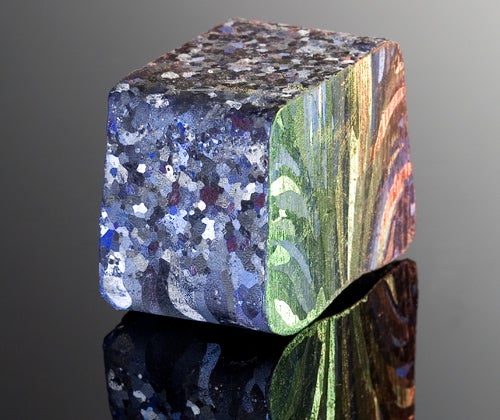
The phrase “passing the acid test” gained popularity in the gold-rush years of the 1850s when miners used strong acids to determine whether the metal they had found was real gold or not. If it bubbled and frothed on contact with acid, it wasn’t gold. But even these failures produced something interesting and beautiful.
When pure metals cool, they solidify into intricately interlocked crystals. You can’t see the crystals because they fit together perfectly to form what appears to be a uniform mass with a smooth, solid surface. But acid can reveal the structure inside.
I use samples of pure zinc and aluminum to demonstrate this, since metals that have been cast and then allowed to cool slowly produce larger internal crystals. Although I haven’t found one yet, I’m sure that somewhere out there is a common household object—candlestick, metal bowl—that would reveal a pretty crystal structure under the acid test. For my wife’s sake, I hope I find one soon, so I don’t have to keep trying to dissolve every new kitchen gadget I get.
Achtung! Concentrated muriatic acid is available in most hardware stores, but that doesn’t mean it’s harmless. It should never be handled by children, even under adult supervision. Work in a well-ventilated area, wear gloves and ANSI-approved splash-proof safety goggles at all times, and read and follow all other safety instructions on the bottle.
Like what you see? For more Gray Matter, head to popsci.com/graymatter. And for Theodore Gray's one-of-a-kind periodic table poster, check out periodictable.com/posters
Apologies In the midst of a move, Theodore Gray's etching video was lost. We do not have a footage of the experiment in action. If you do the experiment and make a video, however, send it our way; we'd love to see it and may run it.
Stay up to date on the latest news of the future of science and technology from your iPhone with full articles, images and offline viewing
Carry everything you need to make a smart buy on HDTVs, cameras and 14 other product categories right in your pocket
Featuring every article from the magazine and website, plus links from around the Web. Also see our PopSci DIY feed
Share links with friends, comment on stories and more
Innovative fixes for five of the country's biggest infrastructure messes, plus a look the quest to read the human mind, the LCD screen that might finally kill paper dead, and the world's scariest science.
Read the issue here.
from hamilton, on
I think this is a beautiful way to experiment with art at the molecular level!!!Unfortunately, we are just starting to be able to access the quantum level at an exponential rate, only in the last decade or two!This is an extremely simple experiment that hasn't been properly explored in all it's regions, so it should be shared with people that can appreciate simply beauty(like kids)!
My kids and I have tried this with aluminum and iron, with no results. We've tried dipping the metals in the acid for a second, and we've tried immersing them for 2 hours and more (checking every 1/2 hour or so). How long does this process take? Thanks.
Swilver... great outlook on this idea. I can very much appreciate it as such.
Question is, where do you get a piece of pure aluminum from and is it expensive?
Will any pure metal turn crystal colored like this?
Can you use other chemicals, or just specifically muratic acid for an effect like this?
My daughter is an avid reader of you magazine. She wanted to try this for an 8th grade science project.
We started gathering materials. Muriatic acid from a swimming pool supply store 31% acid - not bad.
I got some metals in various forms, alumimum, copper, tin, steel, stainless steel and interestingly magnesium.
All the metals fizzed to some extent, however even after a few hours all just came out looking bright and clean. No effect like shown in you picture. After removing the metal items they either rusted or tarnished very quickly. My daughter was quite disappointed.
The magnesium was altogether different. It reacted very violently giving off clouds of gas. Within seconds it completely dissolved - nothing was left!
This experiment should be done outside and with care! Also muriatic acid is a rust agent - other metal items near to the experiment quite quickly showed signs of rust.
Does anyone know of a source of pure metal samples? There are some on the web but they are expensive for a school science project.
Interestingly the acid turned from a pale yellow to a dark green depending on the metal. Can anyone explain this?
I think our science project is going to be reduced to the effect of muriatic acid on different metals.
Thanks.
from columbia, missouri
Ok, to answer a lot of peoples questions, the melting and slow cooling of these metals is a critical step, as many commercial metal samples are rolled and such and this destroys the crystal structure, so first try just that with your metal samples. Also make sure they're pure. Just because something is "aluminum" doesnt make it pure aluminum, in fact it can have some other metal in it that will prevent it from crystallizing properly, but sometimes this isn't the case. The easiest way I've personally found to do this is by melting a few post 1982 pennies as the newer ones are zinc on the inside (Illegal schmleegal,Its my money and I'll do what I please with it). They can be melted over just about any kind of heat source (wood fire, bbq briquettes, etc). Once you do that, skim off the oxides and copper from the top with a steel spoon and pour it in a small heat-resistant container. You can actually see the crystals on the surface without any hydrochloric (muriatic) acid when it cools, but you can do that too, just dilute it a bit. You can probably do this with lead sinkers or tungsten/bismuth ones (pour off the bismuth), but I haven't personally tried it, and I'm not sure if bismuth is oxidized by HCl
Thanks for the comment Masamune. You are correct that certain materials do make the crystals appear much more easily, and that cooling slower will allow bigger crystal grains to form.
I work for a materials analysis company (x-ray diffraction). Practically all metals when cooled will naturally form crystals, and these crystal grains are in various sizes, orientations, and shapes in the metal. Steels typically produce very small crystal grains when cooled, where as aluminum and lighter metals produce bigger grains. The trick to making the grains stick out when etching these materials with acids is to find the correct acid and strength, and immediately clean and oil the etched location immeadiately.
if you want to do this, however you require acids and safe working practices. be careful!
here is a website that has lists of metolographic etchants you can try. (aluminum is shown.)
http://www.metallographic.com/Etchants/Aluminum%20etchants.htm
Amendment...
The etchants sometimes contain deadly acids (hydroflouric acid) which can kill rapidly.
id suggest using etchants that avoid the use of hydroflouric acid.
What kind of gold is this?
Maxson
-----------
www.emailextractor14.com/
www.emailextractor14.com/?page_id=121