A home-built amphibian that can cruise at 30 mph on the ground or over water

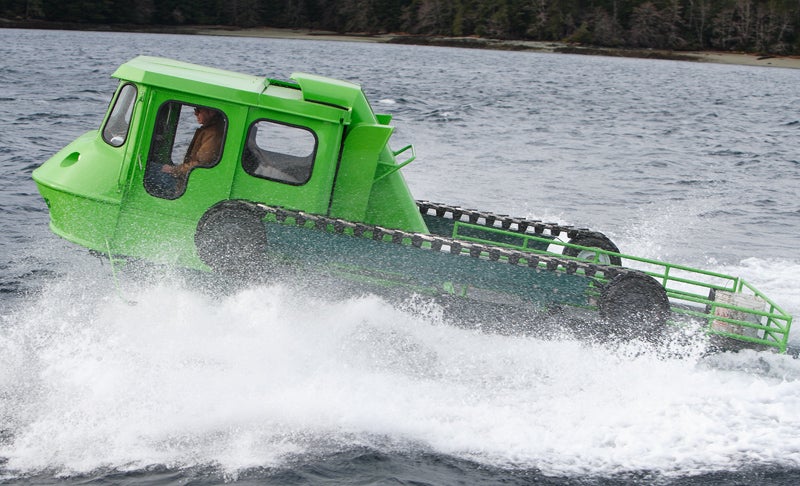
Sea Monster Painstakingly designed by 77-year-old Stan Hewitt, the 260-horsepower craft weighs more than 5,000 pounds. John B. Carnett

Twenty years ago, duck hunter Stan Hewitt built his first amphibious vehicle, a clunky 10-wheeled truck-boat hybrid that topped out at 10 mph on land and just 7 mph on water. Hewitt wanted to tackle the prime duck habitat of the Alaskan tundra, an area hard to access using regular vehicles, and needed to improve the craft’s speed and maneuverability to handle the currents there.

Hewitt knew he’d have to overcome a major obstacle: finding a way to keep the vehicle’s drag-inducing wheels out of the water. So when he finally had time to return to the project in 2004, he spent a year redesigning the 21-foot craft with tank-like rubber treads that could pivot 180 degrees when afloat. But its system of pumps and motors was prone to breakdown, so he was forced to start over. The next time, he used a simple hydraulic pump to vertically lift and lower the treads in and out of the water. When he finished, he had the first-ever amphibious vehicle with a fully retractable drive assembly.

Now the craft can reach speeds of up to 30 mph and effortlessly trek through mud flats, bogs, rivers, ice, snow and lakes—and do it with a 1,500-pound load. There’s room for a crew of five and all the gear they need for search and rescue, patrol, geological surveying or other fieldwork. Ironically though, Hewitt hasn’t gotten around to taking it duck hunting yet.

Getting on Track: It takes just 18 seconds for the vehicle to reposition its rubber treads so that it can run on land.  John B. Carnett

How it Works

Time: 2 Years
Cost: $130,000

Tracks: Two one-foot-wide rubber treads spread the vehicle’s weight over a large surface area, improving traction and exerting minimal pressure on the ground.

Propulsion: In sea mode, the Chevy Trailblazer engine drives an outboard propeller. In land mode, the treads drop so the engine can muscle the craft up onto shore.

Hull: Hewitt sandwiched foam between two layers of 3/16-inch-thick aluminum to make the cab more water-resistant.

Learn more about it at amphib-alaska.com

Want to read more articles like this, plus tips and tricks, home hacks, DIY projects, and more? Subscribe to Popular Science and enter to win $5,000!

5 Comments

What a masterpiece! With all the billions of dollars the government spends on research and development, this guy from Alaska develops a hydro vehicle far better than any thing the military has ever made. Wow.
Seeing modern inventors tackle problems like this, and come up with something so awesome just gives me chills.

arulventhan

from Singapore, sINGAPORE

Is there any government funding for this extrodinary attempt? I beleieve the government has to provide funds and other supports to bring this to a greater extent.

I agree. The modern invertors are cooking up far more nifty ideas than the other government boneheads. The idea should be funded and put in the military.

We have a great talent pool in these United States. Unfortunately for us tax payers, it doesn't reside in the Federal Government.Private inventors, such as this man, will always beat out GS-whatever level government engineers or scientists simply because the private man or woman does it for the love of doing it with little or no thought to compensation. And my hat is off to these backyard inventors and amateur scientists. May they build and invent forever.

interestingly enough, the first amphibious vehiles were designed by a guy in.... I think... Alabama? To use for getting around the marsh, where its water/mud/water/land all the time. no regular vehicle could do it. The government caught wind of it and manufactured them for the war.

Popular Tags

Regular Features


Download Our iPhone App

Stay up to date on the latest news of the future of science and technology from your iPhone with full articles, images and offline viewing


Follow Us On Twitter

Featuring every article from the magazine and website, plus links from around the Web. Also see our PopSci DIY feed


Become a Fan On Facebook

Share links with friends, comment on stories and more


November 2009: Astronaut 3.0

Inside NASA's astronaut bootcamp and the grueling new training regimen for deep space. Plus, ten young geniuses shaking up science today, one writer's quest to analyze every man-made chemical in her body and more.

Check out the issue's full contents online here

Popular Science Photo Pool


Share your photos in the Pop Sci pool at www.flickr.com!
tags_sprite.png
POP_embeddedForm_cover_May09.jpg

Events and Promotions