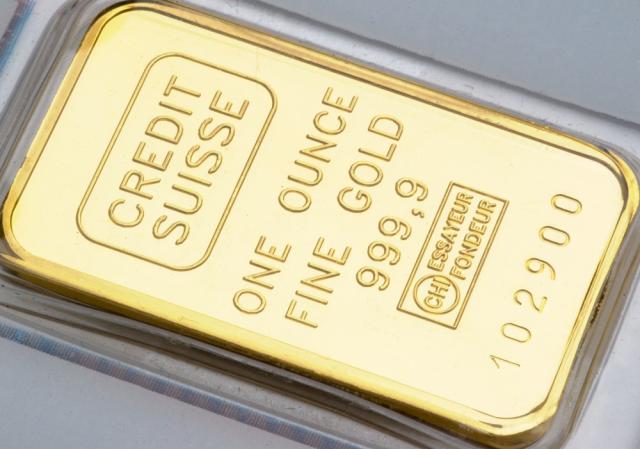
On Wednesday, the BBC reported that millions of dollars in gold at the central bank of Ethiopia has turned out to be fake: What were supposed to be bars of solid gold turned out to be nothing more than gold-plated steel. They tried to sell the stuff to South Africa and it was sent back when the South Africans noticed this little problem.
This is an amazing story for two reasons. First, that an institution like a central bank could get ripped off this way, and second that the people responsible used such a lousy excuse for fake gold.
I consider myself something of an expert on fake gold (I'm not really, I just think I am) ever since I was asked to give advice on the subject to the author Damien Lewis for his recent thriller, Cobra Gold. I worked out in detail for him how you could make really convincing fake gold, and ended up as a minor character in the novel, where I am known as "Goldfinger Gus".
The problem with making good-quality fake gold is that gold is remarkably dense. It's almost twice the density of lead, and two-and-a-half times more dense than steel. You don't usually notice this because small gold rings and the like don't weigh enough to make it obvious, but if you've ever held a larger bar of gold, it's absolutely unmistakable: The stuff is very, very heavy.
The standard gold bar for bank-to-bank trade, known as a "London good delivery bar" weighs 400 troy ounces (over thirty-three pounds), yet is no bigger than a paperback novel. A bar of steel the same size would weigh only thirteen and a half pounds.
According to the news, the authorities have arrested pretty much everyone involved, from the people who sold the bank the gold, to bank officials, to the chemists responsible for testing and approving it on receipt.
The problem is, anyone who so much as picked up one of these bars should have known immediately that they were fake, no fancy test required. The weight alone is an instant dead giveaway. Even a forklift operator lifting a palette full of them should have noticed that his machine wasn't working hard enough. I think they must have been swapped out while in storage: Someone walked in each day with a new fake gold bar and walked out with a real one. If they were fake on arrival then everyone who handled them in any way must have either had no experience with gold or been in on the scam.
Now, for me the more interesting question is, how do you make a fake gold bar that at least passes the pick-it-up test? The problem is that there are very few metals that are as dense as gold, and with only two exceptions they all cost as much or more than gold.
The first exception is depleted uranium, which is cheap if you're a government, but hard for individuals to get. It's also radioactive, which could be a bit of an issue.
The second exception is a real winner: tungsten. Tungsten is vastly cheaper than gold (maybe $30 dollars a pound compared to $12,000 a pound for gold right now). And remarkably, it has exactly the same density as gold, to three decimal places. The main differences are that it's the wrong color, and that it's much, much harder than gold. (Very pure gold is quite soft, you can dent it with a fingernail.)
A top-of-the-line fake gold bar should match the color, surface hardness, density, chemical, and nuclear properties of gold perfectly. To do this, you could could start with a tungsten slug about 1/8-inch smaller in each dimension than the gold bar you want, then cast a 1/16-inch layer of real pure gold all around it. This bar would feel right in the hand, it would have a dead ring when knocked as gold should, it would test right chemically, it would weigh *exactly* the right amount, and though I don't know this for sure, I think it would also pass an x-ray fluorescence scan, the 1/16" layer of pure gold being enough to stop the x-rays from reaching any tungsten. You'd pretty much have to drill it to find out it's fake. (Unless, of course, central bank gold inspectors are wise to this trick and have developed a test for it: Something involving speed of sound say, or more powerful x-rays, or perhaps neutron activation analysis. If bars like this are actually a common problem, you certainly could devise a quick, non-destructive test for them, and for all I know, they have. Except, apparently, in Ethiopia.)
Such a top-quality fake London good delivery bar would cost about $50,000 to produce because it's got a lot of real gold in it, but you'd still make a nice profit considering that a real one is worth closer to $400,000. A lower budget version could be made by using the same under-sized tungsten slug but casting lead-antimony alloy around it (to match the hardness, sound, and feel of gold), then electroplating on a heavy coating of gold. Such a bar would still feel and sound right and be only very slightly underweight, while costing less than $500 to produce in quantity. It would not pass x-ray fluorescence, and whether it passes a chemical test would depend on how thick the electroplating is.
This is the solution I recommended for Cobra Gold, because they only needed their fake gold to pass a field inspection, which is to say, someone picking it up and knowing what gold should feel like when you lift it. You may quibble for other aspects of the plot if you like, but I think the fake gold would have worked.
And let me tell you, it's a sad day for criminal masterminds when my fictional fake gold, designed only to trick a terrorist cell, is so much better than the real fake gold used to rip off a real government bank for millions of real dollars.
Stay up to date on the latest news of the future of science and technology from your iPhone with full articles, images and offline viewing
Featuring every article from the magazine and website, plus links from around the Web. Also see our PopSci DIY feed
Share links with friends, comment on stories and more
In our December issue, Popular Science names the 100 best innovations of the year: bombproof wallpaper, self-parking cars, the fastest helicopter, and 97 more. Plus inventor profiles and videos.
Check out the best of what's new here.


Well, It may be a surprise for those who don't understand the true nature of the so called Ethiopian government. For Zenawi and his government, this is a regular job. If there is something new, that is only one thing: the broad light domestic robbery is now transferred to broad light Exotic one. Period! When Zenawi and his groups were guerilla fighters 17 years ago, they had only penny in the packet of higher officials. The regular fighters didn't have a penny at all, even many of them didn't know what penny is. Thanks to Zenawi government, now day, every member of Zenawi becomes millionor, if not billionor. Where does that much money come from? This question is for you. Don't worry! We Ethiopians know the answer with no doubt. Any way, I thank you at least for sharing the micro out of our pile of problems.
thats completely awesome u could do the same thing with any thing u want to look like gold
Looks like a premise for another Ocean's + a dog movie.
Is there a fake gold "home kit" out yet?
Correct in that tungsten and gold are almost the same density (tungsten: 19250 kg per cubic meter vs gold: 19300 kg per cubic meter). The manufacturing of bars of tungsten just slightly smaller than the standard gold bars mentioned may be a bit of a problem; pure tungsten -- although not very expensive -- is usually available as a powder, and has the highest melting point all all metals, some 3,422 deg. Celsius.
Good luck finding any easily available furnaces to even melt this, let alone cast it into custom-made bars. And while the pure metal can be cut with a hacksaw, extruded and otherwise worked, any alloys or impurities make it extremely brittle and difficult.
It'd be quite hard to make an appropriate tungsten slug yourself, but handily lots of companies will do it for you. tungsten.com, for example.
Presumably they'd be a bit suspicious if the CAD files you gave them were blatantly supposed to look like a gold bar, but there should be ways around that. Then you're just working with gold which, relatively, is a doddle
Just a few days ago i was pondering making a fake gold bar, just so that I can trick all of my friends into thinking I was something I'm not! haha No, but really I was curious.
But what I was really thinking would be more plausible would be not bars, but the little 1 troy ounce or 10gm gold bars. Those are what I really want. just maybe 10 or 20 of those.
I wish there was a company who would make them. Such as a movie prop company.
Nice article!
There's no special or expensive test equipment needed to determine if a gold bar has tungsten in it. Just hold a magnet to the bar of gold. If it sticks; then there's tungsten in it. If if does not stick; then its all gold.
from Raynham Center, MA
there's a compound one can put in the tungsten to make it non magnetic so the magnet test may not be the best way to test for tunsten replacement with gold bars, gold jewelry, gold in general.
Joshua Freeman
www.life-union.com
Tungsten metal won't stick to a magnet, at least not strongly enough that you'd notice; it's paramagnetic. You could measure the amount of paramagnetism with some specialized gear, but not by feeling a magnet stick to your fake gold bar.
Some tungsten alloys are ferromagnetic, but you wouldn't want to use them for making your fake gold bars, they wouldn't be dense enough.
Also wouldn't the gold shield the tungsten from the field? I know in hard drives if you take out the magnets they are extremely powerful but they are shielded on the other side and won't even hold a paper clip.
Lol probably won't fool a professional but won't stop ya from getting us in trouble :)
Moshable Music
Lol probably won't fool a professional but won't stop ya from getting us in trouble :)
Moshable Music
"The first exception is depleted uranium, which is cheap if you're a government, but hard for individuals to get. It's also radioactive, which could be a bit of an issue."
Actually, the radioactivity may not much of an issue, DU is only weakly radioactive, perhaps detectable with instruments if one is checking for fraud, but not really a biohazard. Source, http://www.who.int/mediacentre/factsheets/fs257/en/
I don't doubt that it's kind of hard to find at the local Home Depot, but because it is used in such things as counterweights in aircraft (same source), it might not be as difficult to get as, say, unobtainium.
I recently handled a 100g Pamp Suisse gold bar and when I flipped it in the air by hitting it with my thumb nail, it had a distinctive ring while spinning in the air. I was a little surprised since gold is so soft. The author mentioned a lead-antimony coating could give a gold plated tungsten bar the same feel and sound as gold, but I would think that this would be tricky. I do not have another of the same type of gold bar to compare the sound to, but I hope to find one soon. For a relative common, small, 999.9 pure gold bar such as the Pamp Suisse 100g cast bar, I think the sound of its ring would be a relatively simple simple test to distinguish a fake from a genuine one as long as you had a bar of known authenticity to compare it to.
I found this comment helpful. They could fool someone from afar but people should be oriented that a true gold bar weighs heavier than that made of steel. The author can be an expert on fake gold and its amazing that he knows how to make a fake gold very convincing. http://goldstashforcash.com/events.php
In the area of buying gold, there are many interesting offers.
All-American Gold Buyers.
http://allamericangoldbuyers.com
SORRY to say that although it's an interesting idea, it's just NOT possible:
- Tungsten has NOT the "same" density as gold, there is a 50kg per cubic meter difference approximately, which is quickly noticed in a density test performed by a metal testing laboratory (The old Archimedes test: plunging the fake bar in a reference liquid, we can accurately measure minute differences nowadays).
"Quite the same density" 50years ago means nothing TODAY.
ALSO, the tungsten wouldn't be "100 %" pure, homogenous tungsten: it would be, if one would want to fake gold at an affordable price, a SINTERED powder product, which would alter it's density (amongst other properties): less density and some porosity in the finished product (only a few % but noticeable in a test).
-Another SIMPLE test to prove the scam would be a PLAIN electrical conductivity test : Gold and Tungsten have VERY different resistivity (and conductivity)values.
Driving a calibrated high frequency AC current then lowering the frequency progressively while monitoring the results, to determine the SKIN DEPTH of the gold layer wouldn't be hard.
-The magnetic test proposed by forum members here is a good test also: gold is diamagnetic and a good conductor, it will behave quite differently than a coated tungsten bar, since tungsten is paramagnetic (and NO, forum members, tungsten is NOT attracted to magnets, at least unnoticeably, it's not ferromagnetic, just paramgnetic!! reality is more complicated than that but this explanation will suffice).
-ISOTOPES: tungsten and gold possess minute amounts of impurities , amongst which different isotopes. Especially in tungsten!! These isotopes remain even if the ingots are repeatedly remelted, and would be easily detected.
-SOUND: yes, "speed of sound", but not with a complicated apparatus : comparing two small gold bars, a fake and a real one, they would'nt give the same "note" if tapped with a little metallic hammer: although having relatively similar densities, tungsten and gold have very different mechanical properties, amongst which surface hardness , tensile strength etc, thus it wouldn't give the same audible frequency if struck.
This kind of test was used to detect false EURO and french FRANCS some time ago (they gave a different "ting" when dropped), if not enough, false euros were rubbed on paper, but here this is not applicable since the tungsten would be heavily plated.
Everyone makes mistakes, and I do too of course,thus there may be many other more practical solutions for this.