A tiny helicopter
A Norwegian engineer reinvented the way helicopters keep themselves stable. The result: create a radio-controlled craft that can take off from the palm of your hand.
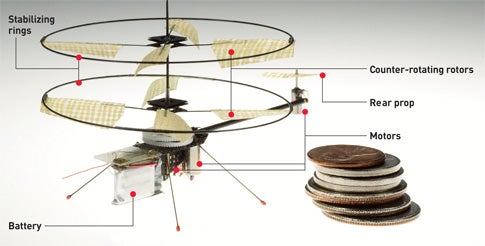
Helicopters are tricky beasts to keep aloft and stable. Full-size birds do it with skilled pilots, while most unmanned craft rely on gyroscopes and autopilot. But the 3.3-gram Picoflyer is too small for any such luxuries. Instead, Petter Muren, a Norwegian engineer who builds mini copters to fly indoors during long Scandinavian winters, reinvented the stability system.
- Dept: You Built What?!
- Time: 600 hours
- Cost: $2,500
- Difficulty: easy | | | | | hard (Editor’s note: 5/5)
To stay pointed in one direction, the Picoflyer, like many real whirlybirds, uses two sets of counter-rotating rotors, which offset the opposing forces that occur when an engine drives a propeller in flight. (If the rotors are driven one way, the engine and fuselage spin in the opposite direction.) But to keep from pitching or rolling out of control, the Picoflyer relies on a passive-stability system that adds no extra parts or weight. If the helo starts to tilt or lean one way, the ringed rotors naturally tilt equally in the other direction, bringing the bird back to level. Continuous little adjustments help it maintain a stable hover.
The US military has expressed interest in Muren’s micro-copter as a surveillance drone, and universities are keen on them for “flying swarm” studies. But most interested are toy and hobby manufacturers—Muren’s passive-stability system has already inspired a larger radio-controlled hobby chopper called Bladerunner.
- Power: The Picoflyer is powered by three electric motors and a magnetically attached battery, commanded by a handheld dual-joystick transmitter.
- Control: Spinning both rotors faster causes the helo to lift upward; adjusting the speed of only one makes it rotate left or right. Engaging the rear prop drives it forward or backward.
- Stability: The rings surrounding the blades aid stability by keeping the rotors spinning in a fixed plane.
This story has been updated. It was originally featured in the April 2006 issue of Popular Science magazine.