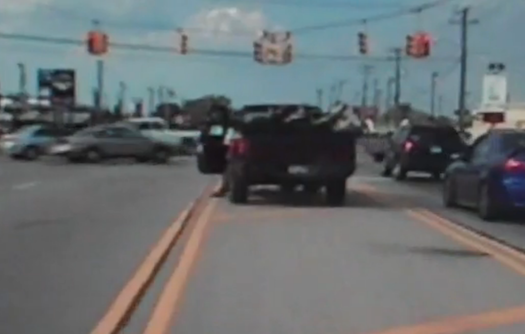
Anyone who has ever seen The Flintstones is probably aware of the unique braking mechanism on Fred’s stone age car. I always considered the technique of dragging your feet on the ground to bring your vehicle to a stop a matter of artistic license. Until last week, when this video appeared. It provides us with an excellent real-world example where knowing a little physics might have prevented this Michigan driver with failed brakes from attempting a cross-town drive using “The Flintstone Technique”, and possibly putting himself in the running for this year's Darwin Awards.
If it isn’t already obvious that this is not a good idea, let’s apply some simple physics to illustrate exactly why. There are a couple of ways to analyze this, but we will use the concepts of Energy and Work. Basically, the kinetic energy (KE = 1/2mv2) that the car possesses before the brakes are applied must be dissipated by the work (W = Fd) done by friction on the car. To come to a stop:
1/2mv2 – Fd = 0
According to the local newspaper, the driver of the defective truck was travelling at speeds up to 40 miles per hour (or about 18 m/s). Under normal circumstances, the braking distance for a vehicle travelling at this speed is about 80 feet (24 meters). We can solve for the braking force required from the equation above assuming a typical mass of about 2100 kilograms for this kind of truck:
F = 1/2(2100 kg)(18m/s)2/24m = 14,200 N or 3200 pounds.
A driver who is not Superman won't be able to exert 3200 pounds of force on the ground. So, assuming normal human strength, let’s calculate how much distance it should take for his truck to slow to a halt. Resting on the ground, an object will exert a force on the ground equal to the weight of the object (W = mg). However, this guy is hanging his feet out the side of the truck, which is going to make it much more difficult to push into the asphalt. Let’s estimate he can push down with a force about a quarter of his weight. If he weighs 200 pounds, this would result in a force of 50 pounds, or 225 N. We also know that the force of friction (F) between his feet and the asphalt depends on the force with which he pushes down (N) and the “coefficient of kinetic friction”(μ) between the soles of his shoes, which we will assume are made of rubber, and the pavement.
F = μN
The μ between rubber and asphalt varies between 0.5 and 0.8. Let's assume a value of 0.7. Therefore, solving for stopping distance, we get:
D = ½(2100kg)(18m/s)2/(0.7)(225N) = 2160 meters, or over 1.3 miles!
The situation might be improved if he exerted his full 200 pounds, or 900 Newtons, of force against the ground. In that case:
D = 1/2(2100kg)(18m/s)2/(0.7)(900N) = 540 meters (about a third of a mile)
However, the amount of torque exerted on his ankles and knees might make that a problematic proposition.
Clearly this driver (and everyone within his radius of influence) got lucky as he rolled through red lights, stop signs and other traffic obstructions in heavy cross traffic. With a little knowledge of basic physics, though, he could have avoided an appointment with the Michigan court system, possible jail time, and public ridicule. Remember, friends don’t let friends drive without brakes.
Finally, in case you’re interested, automobile brakes work so well due to the wondrous principles of hydraulics. Because the pressure is the same everywhere within a confined fluid (that's Pascal’s principle), applying a small force (F = PA) to a small area at one end of the system (the brake lines behind the brake pedal) results in a much larger force being applied at the other end, where the fluid expands to a significantly greater area against the brake pads.
Five amazing, clean technologies that will set us free, in this month's energy-focused issue. Also: how to build a better bomb detector, the robotic toys that are raising your children, a human catapult, the world's smallest arcade, and much more.


Online Content Director: Suzanne LaBarre | Email
Senior Editor: Paul Adams | Email
Associate Editor: Dan Nosowitz | Email
Assistant Editor: Colin Lecher | Email
Assistant Editor: Rose Pastore | Email
Contributing Writers:
Kelsey D. Atherton | Email
Francie Diep | Email
Shaunacy Ferro | Email
Just throw in moment of inertia and a couple of strings on an inclined plane, and you'll have covered most of Physics 101.
this man is an idiot. no question about it.
If humans actual did rely on their own feet to stop a car; I would think this would be an incentive to not drive so fast; knowing “HEY I GOTTA STOP THIS THING WITH MY OWN BURNING FEET!”. Perhaps it would cause people would just be safer drivers.
If you could PUSH the car with one foot, by all means brake it with one.
He couldn't accomplish either.
"A driver who is not Superman won't be able to exert 3200 pounds of force on the ground."
He-man could probably do it.
I am so glad none of the people he hit, did not get hurt. This guy really made an achievement of stupidity. Amazing! I am sure to his friends and family, he will be remembered forever! lol
HEY its not this guys fault his brakes died on him!
and you have to admit it took a lot of heart to attempt to stop his giant truck with his irreplaceable feet
good old footwork always beats downshifting
@bjorn, My car has a emergency brake. All, cars do have an emergency brake. I wonder why this guy decided not to use it?
@bjorn, I listen to the video of this artical a second time. This individual knew in advance he had no brakes in his car. He just assume he could drive and get home using his own feet as brake bads. His brakes did not suddenly go out, no. He made a choice to use his own feet as brake pads.
So everything about this situation is this guys fault.
And this is why America is falling behind. It takes a physicist to explain to a person why they shouldn't try to stop a 2 metric ton vehicle with their feet!
COME ON!!
LOL!
@Adam Weiner, I LOVED this article!
This is when it's OK for the cops to beat someone senseless.
This is why I only push my skateboard. I'm usually too stoned to drive anyway. Cars are too big of an expense.
I'm shocked that "The Flintstones" deviated from total realism in this one minor detail.
Driver sues Hanna-Barbara in 3... 2... 1...
Bill Dale
Some years ago a guy settled a debt with me by giving me his BMW, which he acknowledged had inoperable brakes. I had no idea how inoperable they really were.
Once the brake pads wore out, he continued to drive it metal-to metal until the backing plates cut entirely through the front rotors... there were no rotors left. He then continued to drive using just the emergency brake, which consisted of a brake drum that was integral to the read brake disks. Once they wore out, he coasted into his mother's back yard, slightly mangling her house, and the front bumper. It cost me about $500. just in replacement parts to get the brakes working again.
Recently a truck driver was convicted for killing a man and his daughter he hit when his brakes went out. He had broken several laws, including driving on a highway with a long down-hill stretch that was posted as illegal for trucks for that very reason.
You cannot produce sound, heat or motion without expending energy. If you stand beside a car and try to rock it back and forth, you'll soon become exhausted. If your brakes go out and you need to stop, turn the wheel sharply from side to side, forcing the car to tip from side to side, scrubbing off rubber from the tires and scrubbing off road speed, too. Put your transmission in any position other than neutral, preferably first or reverse. Open any doors you can, which will increase wind resistance and get the attention of motorists ahead of you. Turn off your engine, but do not turn the key to the LOCK position, or you will not be able to steer. If there is a curb, cramp the wheel against it, rubbing the tires.
If caught on a downhill expanse, take any left-hand turns onto side streets possible, since you will then no longer be headed downhill, and you are less likely to lose control than if attempting a right-hand turn.
You may have to start the engine again briefly to operate the power steering, as well as the power brakes if there is any brake action left. Honk the horn as much as possible to warn others of your emergency. Veering back and forth has the secondary benefit of getting other motorists' attention... if you're lucky, you might get a selfless, alert trucker to drive in front of you to bring you to a gentle, safe stop.
The driver of this truck was aware of the problem of his own brakes and chooses to drive with the idea of a temporary band aid solution as using his own feet to get from point A to point B. His idea was absurd and wrong to attempt in the first place. Some things are best not even attempting. This article makes public what should be obvious to most people. They just make public this event, because it is so astounding to even attempting so stupid.